
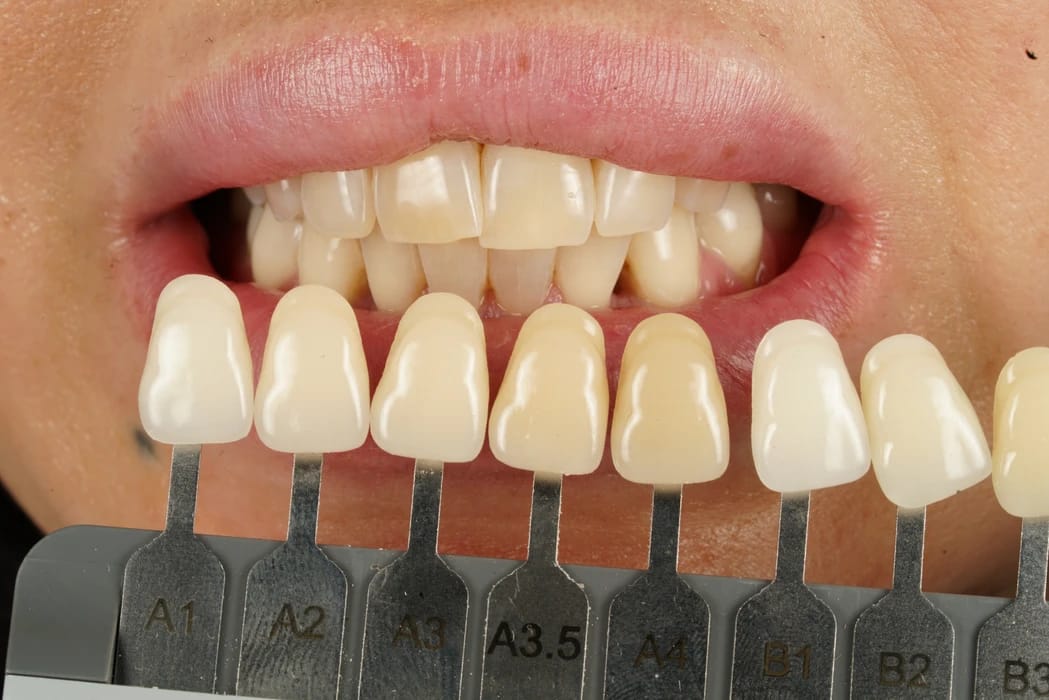
Tooth Shade Selection in Cosmetic Dentistry: The Clinical Science of VITA Classical, 3D-Master, Bleach Shades (BL1–BL4) & Digital Spectrophotometry
Quick answer: A tooth shade guide is the reference dentists use to choose or match the colour of crowns and veneers. The VITA Classical guide groups natural shades from A1 to D4, the VITA 3D-Master system arranges shades in evenly spaced steps, and bleach shades (BL1–BL4) cover the lightest end. Whitening lightens natural enamel only, so a very light shade such as BL1 usually needs veneers. At Ulubey Dental Clinic in Antalya, Dr. Surur Ulubey, whose clinical focus is aesthetic dentistry, and Dr. Ali Cem Ulubey choose the shade with you before treatment.
Tooth Shade Selection in Cosmetic Dentistry: The Clinical Science of VITA Classical, 3D-Master, Bleach Shades (BL1–BL4) & Digital Spectrophotometry
Selecting the appropriate tooth shade for porcelain veneers, crowns, or post-bleaching aesthetic protocols is an optical science governed by colorimetry, light transmission physics, and individual facial harmony.
Many patients seeking cosmetic dentistry in Antalya inquire about the “whitest possible shade,” yet single-tone, high-opacity restorations often yield an unnatural aesthetic. At Ulubey Dental Clinic, we employ digital spectrophotometry, cross-polarized macro photography, and biomimetic ceramic layering to calibrate value, chroma, and incisal translucency to biological facial landmarks.
Below is a clinical overview of dental shade systems, color dimensions, bleach scales (0M1–0M3 vs. BL1–BL4), and the optical principles that guide natural restorative outcomes in modern prosthodontics.
📋 Clinical Table of Contents & Scientific Navigation
- 1. Executive Summary: Core Principles of Aesthetic Shade Matching
- 2. Munsell Color Science in Dentistry: Hue, Value, and Chroma
- 3. The VITA Classical (A1–D4) System & Its Clinical Scope
- 4. The VITA 3D-Master® System: Equidistant Colorimetric Space
- 5. The Hollywood Bleach Spectrum: 0M1, 0M2, 0M3 vs. BL1, BL2, BL3, BL4
- 6. Optical Properties: Translucency, Opalescence & Fluorescence
- 7. Visual Limitations: Metamerism, Retinal Fatigue & Standardized Lighting
- 8. Digital Shade Matching: Spectrophotometry vs. Cross-Polarized Photography
- 9. Facial Harmony Parameters: Sclera Relationship & Complexion Calibration
- 10. The Veneer Core: Why “Stump Shade” (ND1–ND9) Dictates Final Color
- 11. Master Shade Guide Comparison Matrix
- 12. Frequently Asked Questions (FAQ)
Planning Veneers or a Smile Makeover in Antalya?
Calculate treatment estimates and evaluate ceramic materials with our clinical tools:
👉 Hollywood Smile & Veneers Cost Calculator |
👉 Antalya Dental Treatment Prices 2026 Directory
1. Executive Summary: Core Principles of Aesthetic Shade Matching
- Value as the Primary Determinant: In dental prosthodontics, Value (relative luminosity or lightness) is clinically recognized as the most noticeable dimension to the human observer. Minor mismatches in Hue or Chroma are often well-tolerated, whereas an incorrect Value immediately reveals artificial dental work.
- The Sclera Harmony Guideline: Aesthetic literature suggests that smile integration is optimal when the Value of the maxillary central incisors aligns closely with the luminosity of the patient’s eye sclera, preventing unnatural facial contrast.
- Polychromatic Tooth Architecture: Biological teeth exhibit natural color gradients: higher chroma at the cervical third, a representative body shade in the middle third, and opalescent, semi-translucent characteristics at the incisal edge.
2. Munsell Color Science in Dentistry: Hue, Value, and Chroma
Dental shade analysis is fundamentally based on Albert Munsell’s 3D color coordinate system, as discussed in prosthodontic literature (PubMed: PMC9015060):
Refers to the specific wavelength of reflected light. In natural teeth, Hue is predominantly confined to yellowish-red spectrums, classified classically as: A (Reddish-Brown), B (Reddish-Yellow), C (Greyish), and D (Reddish-Grey).
Measures lightness or darkness along an achromatic scale from black to white. In cosmetic smile design, establishing the appropriate Value is critical to ensuring vitality without artificial glare.
Represents the purity or concentration of the Hue. For example, shade A1 exhibits lower chroma (less yellow-brown saturation) than shade A4.
3. The VITA Classical (A1–D4) System & Its Clinical Scope
Developed in 1956 by VITA Zahnfabrik, the VITA Classical Shade Guide remains a standard reference in dental laboratories globally. It organizes 16 tabs across four Hue groups:
- Group A (Reddish-Brownish): A1, A2, A3, A3.5, A4 (Represents approximately 70–80% of natural adult teeth).
- Group B (Reddish-Yellowish): B1, B2, B3, B4 (Frequently present in younger, lighter smiles).
- Group C (Greyish): C1, C2, C3, C4.
- Group D (Reddish-Greyish): D2, D3, D4.
Spectrophotometric evaluations note that VITA Classical tabs are not distributed symmetrically across the CIELAB color space. Irregular gaps exist between certain tabs, and intervals are non-linear when tabs are arranged strictly by Value (e.g., B1, A1, B2, D2, A2…). For complex aesthetic cases, digital verification helps bridge these colorimetric gaps.
4. The VITA 3D-Master® System: Equidistant Colorimetric Space
To provide a mathematically uniform representation of natural tooth shades, VITA introduced the Toothguide 3D-Master®. This system structures shades across systematically spaced intervals based on CIELAB coordinates.
The standardized three-step selection procedure consists of:
- Step 1: Determine Value (Levels 1 to 5): The clinician identifies the lightness group (1 = Lightest, 5 = Darkest).
- Step 2: Determine Chroma (Levels 1 to 3): Within the selected value group, saturation is evaluated using the middle “M” tab.
- Step 3: Determine Hue (L, M, R): Identifies whether the tone tilts towards yellowish (L), neutral (M), or reddish (R).
Example: A designated shade of 2M2 indicates Value Group 2, Medium Hue, and Chroma Level 2, providing reproducible laboratory communication.
5. The Hollywood Bleach Spectrum: 0M1, 0M2, 0M3 vs. BL1, BL2, BL3, BL4
Historically, B1 was regarded as the highest value commonly observed in natural adult enamel. However, modern professional bleaching (Philips Zoom WhiteSpeed) and high-strength aesthetic ceramics (IPS e.max) introduced specialized Bleach Shades.
| Bleach Scale | Ultra-Bright Bleach | High Aesthetic Bleach | Soft Natural Bleach | Biological Boundary |
|---|---|---|---|---|
| Ivoclar Bleach BL Scale | BL1 | BL2 | BL3 | BL4 (Transitions to B1) |
| VITA 3D Bleach Scale | 0M1 | 0M2 | 0M3 | 1M1 |
Clinical Characteristics of Bleach Shades:
- BL1 / 0M1: High-value shade with minimal chroma. Creates a pronounced aesthetic transformation; requires careful stratification to preserve surface texture and avoid an overly opaque appearance.
- BL2 / 0M2: Provides substantial brightness while retaining a modest degree of optical depth, often selected for full-arch aesthetic restorations.
- BL3 / 0M3: Reflects the appearance of freshly bleached natural teeth, offering a balance between visible whitening and biological naturalness.
- BL4 / B1: Corresponds to the upper boundary of natural, unbleached tooth shades; commonly recommended when matching existing adjacent natural teeth.
6. Optical Properties: Translucency, Opalescence & Fluorescence
The fundamental optical difference between handcrafted biomimetic veneers and flat, monochromatic restorations lies in replicating three natural light phenomena:
A. Incisal Translucency & Internal Characterization
The incisal third of natural anterior teeth consists primarily of enamel without underlying dentin, allowing partial light transmission. Beneath the surface, vertical lobes known as mamelons create subtle optical variations, framed by a delicate incisal halo.
B. Opalescence
Due to Rayleigh light scattering within natural hydroxyapatite crystals, enamel reflects shorter bluish wavelengths under incident light while transmitting warmer amber wavelengths under oblique illumination. Biomimetic ceramic systems (e.g., IPS e.max Ceram Opal) are designed to reproduce this natural chromatic shift.
C. Fluorescence
Natural dentin absorbs ultraviolet light and re-emits it within the visible blue-white spectrum. Incorporating fluorescent components into dental ceramics ensures restorations maintain optical vitality under diverse light environments, such as daylight or ultraviolet lighting.
7. Visual Limitations: Metamerism, Retinal Fatigue & Standardized Lighting
Subjective shade matching by visual inspection can be subject to perceptual variables (PubMed: PMC11395361):
- Retinal Cone Adaptation: Staring at tooth surfaces for more than 5 to 7 seconds can cause sensory adaptation in retinal cone photoreceptors. Clinicians utilize neutral gray or light-blue background cards between assessments to neutralize visual perception.
- Metamerism: Different light sources (such as incandescent dental operatory units versus natural daylight) emit varying spectral outputs, causing shades to appear different across environments. Clinical shade assessment should be conducted under standardized, color-corrected daylight lamps (~5500K, CRI > 90).
- Surrounding Contrast: High-contrast cosmetics (e.g., intense lipsticks) can alter perception of chroma and value, and should be removed prior to final shade confirmation.
8. Digital Shade Matching: Spectrophotometry vs. Cross-Polarized Photography
Modern clinical protocols reduce subjective variance through digital verification methods:
A. Digital Spectrophotometry (VITA Easyshade® V)
Spectrophotometers are documented in dental research as reliable instruments for objective colorimetry (PubMed: PMC7595466). By emitting a controlled light burst and analyzing spectral reflectance across wavelengths, they provide numerical CIELAB coordinates (L*, a*, b*):
• ΔE < 1.0: Perceptually undetectable difference.
• ΔE 1.0–2.0: Perceptible primarily to trained clinicians under controlled lighting.
• ΔE > 3.7: Clinically noticeable shade variance.
B. Cross-Polarized Dental Photography
Surface reflections from wet enamel can obscure underlying dentin details. Utilizing polarizing filters on macro lenses eliminates specular glare, allowing clinicians and ceramists to visualize internal saturation, subtle hypocalcifications, and mamelon distribution (PubMed: PMC10670912).
9. Facial Harmony Parameters: Sclera Relationship & Complexion Calibration
Comprehensive aesthetic evaluations integrate biological reference points:
Comparing tooth brightness against the white of the eye provides a biological baseline. When restoration value exceeds the sclera, the dental arch can draw disproportionate visual attention, whereas aligning with scleral brightness fosters integrated harmony.
• Warm Undertones: Often complement shades in the A1, B1, or BL2 range, which present gentle warm micro-undertones.
• Cool Undertones: Readily complement neutral high-value shades such as BL1 or 0M1.
10. The Veneer Core: Why “Stump Shade” (ND1–ND9) Dictates Final Color
Ultra-thin ceramic laminate veneers (0.3 mm to 0.6 mm) are semi-translucent. Consequently, the optical appearance of the underlying prepared tooth substrate directly influences the final clinical shade.
When underlying tooth structure exhibits discoloration (e.g., post-endodontic darkening, evaluated via the IPS Natural Die Material guide ND1 to ND9), cementing high-translucency ceramic can lead to a compromised aesthetic outcome with dull greyish undertones.
At Ulubey Dental Clinic, we document the prepared tooth stump shade alongside the IPS Natural Die guide. In cases with darker underlying dentin, the laboratory utilizes medium-opacity (MO) ingots or specialized masking opaques before applying radiant, high-value facial porcelain.
11. Master Tooth Shade Guide Comparison Matrix
| Shade Category | VITA Classical | VITA 3D-Master Equiv. | Relative Value Rank | Clinical Characteristics & Application |
|---|---|---|---|---|
| High-Aesthetic Bleach | None (Off-scale) | 0M1 / BL1 | 1 (Highest) | Maximum brightness with minimal chroma. Preferred for high-contrast aesthetic designs. |
| Balanced Bleach | None (Off-scale) | 0M2 / BL2 | 2 | Substantial luminosity combined with natural optical depth; widely applied in aesthetic veneers. |
| Natural Bleached Limit | B1 | 1M1 / BL4 | 3 | Upper threshold of natural biological enamel; conservative aesthetic restorations. |
| Youthful Baseline | A1 / B2 | 2M1 / 2L1.5 | 4–5 | Characteristic baseline of healthy young adult enamel with subtle warmth. |
| Adult Average | A2 / A3 | 2M2 / 3M2 | 6–8 | Prevalent adult dental shade; common baseline prior to in-office bleaching treatments. |
| Higher Chroma / Sclerotic | A3.5 / A4 / C3 | 4M2 / 4M3 | 9–12 | Indicates thinned enamel with prominent secondary dentin; suitable candidate for smile redesign. |
Discuss Your Aesthetic Shade Options in Antalya
Evaluating whether BL1, BL2, or a biological B1 shade aligns with your smile goals? Connect with Dr. Ali Cem Ulubey directly on WhatsApp for a personalized digital smile consultation.
Request Digital Shade ConsultationClinical consultations available in English, Turkish, Persian/Farsi and Azerbaijani.
Frequently Asked Questions (FAQ)
What is considered the lightest natural tooth shade?
In the VITA Classical scale, B1 is traditionally considered the highest-value natural tooth shade. With the introduction of bleach guides (BL1–BL4 and 0M1–0M3), restorations can achieve luminosities above baseline biological limits.
What distinguishes BL1 from BL2 in porcelain veneers?
BL1 represents the highest-value bleach shade with minimal chroma, providing high visual prominence. BL2 retains a similar brightness level but exhibits slightly greater optical depth and subtle warmth, facilitating natural light integration under diverse conditions.
How is objective tooth shade determined clinically?
Accurate shade evaluation pairs digital spectrophotometry (e.g., VITA Easyshade), which calculates objective spectral reflectance data, with cross-polarized macro photography under standardized 5500K daylight lighting to evaluate internal dentin chroma free of surface reflections.
What is a “Stump Shade” and how does it affect veneer outcomes?
The “stump shade” corresponds to the natural color of the prepared tooth structure prior to veneer placement. Because thin ceramic veneers possess semi-translucency, the underlying substrate color influences the final shade. Clinicians record this using guides like the IPS Natural Die Material system (ND1–ND9) to determine necessary ceramic opacity.
Can in-office teeth whitening achieve shade BL1?
With Philips Zoom WhiteSpeed, lightening of up to 8 shades is possible when the in-clinic session and the 6-day home phase are combined; results vary from person to person, so the final shade (for example B1 or BL4) cannot be promised in advance. However, reaching an ultra-bleach shade such as BL1 typically requires porcelain veneers, as underlying biological dentin saturation establishes a natural limit.
Related Aesthetic & Travel Guides
Last updated: · Editor contact: [email protected] · ulubeydental.com/contact-us


