
Smile Design vs Veneers in Turkey
Quick answer: Smile design and veneers are not competing options: smile design is the digital plan for the shape, colour and symmetry of your smile, and veneers are one way to carry it out. At Ulubey Dental Clinic in Antalya, an e.max veneer costs €250 per tooth and a composite veneer €120; a 10-tooth e.max makeover starts from €2,500. Dr. Surur Ulubey and Dr. Ali Cem Ulubey plan the design with you before treatment. E.max veneers carry a 5-year clinic guarantee against fracture or debonding, conditional on attending the recommended check-ups.
In modern cosmetic dentistry, smile design vs veneers is frequently discussed as if they were competing alternatives. In reality, they represent two complementary halves of the same restorative discipline: smile design is the architectural 3D digital blueprint; veneers are the custom-milled biomimetic restorations used to realize it.
At Ulubey Dental Clinic in Antalya, we reject the industrial “assembly-line” veneer model. A long-lasting aesthetic restoration requires a harmonious synthesis of studio photography, high-intensity photopolymerization, adhesive optical physics, and material gradients.
Curious about your veneer or smile makeover budget?
Calculate your personalized 2026 cost in 60 seconds with our interactive tool:
👉 Hollywood Smile & Veneers Cost Calculator |
👉 Antalya Dental Treatment Prices 2026 Directory
1. The 100% Digital Workflow: Studio Photography & The Live Mock-Up
A predictable smile transformation does not begin with an invasive dental handpiece; it begins with photographic diagnostics and live functional simulation:
- Studio Facial & Intraoral Photography: Using a specialized Sony A7R2 camera paired with a 90mm Sony Macro lens and a Godox MF12 dual macro flash system, we capture extraoral portraiture, dynamic smile lines, and lateral aesthetic angles. We evaluate how the proposed smile arc complements your facial midline and interpupillary line.
- Optical 3D Scanning: We eliminate imprecise silicone impression trays using the Dentsply Sirona Primescan® Connect intraoral scanner, capturing millions of micron-accurate 3D data points in seconds.
- The Live Intraoral Mock-Up (Zero Tooth Reduction): In our fully digital CAD/CAM workflow, we design the proposed smile. Before touching or preparing your natural teeth by even 0.1 mm, we transfer this 3D blueprint directly over your teeth using medical-grade bis-acrylic resin.
The live mock-up allows you to see, touch, and test your new smile in real life. We evaluate lip support at rest and evaluate phonetic pronunciation—specifically verifying ‘F’, ‘S’, ‘D’, and ‘V’ sounds (ensuring incisal edges lightly touch the wet-dry border of the lower lip without speech impediment). Once approved, this mock-up acts as our strict surgical depth guide, so that only the minimum enamel needed for your case is prepared.
2. Material Science: Crystallized E.max vs. Multi-Layered 4Y-TZP Zirconia
Dental materials are evolving rapidly. Understanding the flexural strength (measured in MegaPascals / MPa) and crystal structure dictates whether a case calls for lithium disilicate or gradient zirconia:
Ivoclar IPS e.max® CAD / Press (lithium disilicate)
Ivoclar states a biaxial flexural strength of 530 MPa for IPS e.max CAD after crystallization (manufacturer data). Its optical advantage lies in its needle-like crystal matrix, which refracts and transmits ambient light identically to natural human enamel. It is the premier choice for cosmetic front teeth where natural opalescence and incisal halo effects are paramount.
Amann Girrbach Multi-Layered 4Y-TZP Gradient Zirconia (10-Year Fracture Guarantee)
Traditional zirconia (3Y-TZP) was very strong but excessively opaque. Modern restorative dentistry utilizes advanced modified 4Y-TZP / 5Y-TZP multi-layered gradient zirconia:
- Incisal / Enamel Layer (5Y-TZP): Features higher yttria content, giving high translucency that mirrors natural tooth enamel.
- Cervical / Dentin Core (4Y-TZP): As the material descends toward the gingival margin, yttria content decreases and flexural strength increases.
This gradient provides optical beauty in the smile line combined with fracture resistance against heavy chewing forces. Because Ulubey Dental works exclusively with an official Amann Girrbach Partner Laboratory utilizing dedicated Amann Girrbach CAD/CAM milling units and sintering furnaces, our Amann Girrbach zirconia restorations carry a 10-year fracture guarantee, conditional on attending your recommended check-ups.
3. Adhesive Physics: SmartLite Pro Photopolymerization & Cement Optical Matching
A ceramic veneer is only as durable as its adhesive interface. At our clinic, cementation is treated as a high-precision chemical process:
- Dentsply Sirona SmartLite Pro® LED Curing: Veneer bonding uses light-cure and dual-cure resin cements. Incomplete photopolymerization causes micro-leakage, margin discoloration, and adhesive failure. We utilize the state-of-the-art Dentsply Sirona SmartLite Pro modular LED system, delivering a uniform, high-intensity collimated light beam that ensures complete monomer-to-polymer conversion through translucent ceramic.
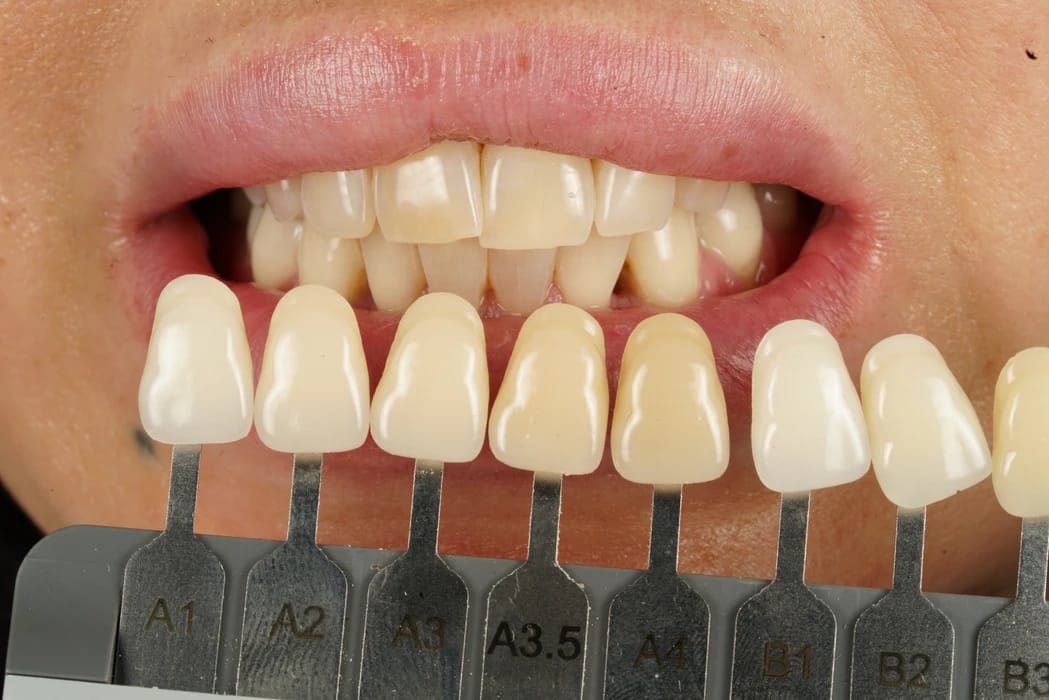
- Cement Optical Shade Calibration: Because ultra-thin E.max veneers are translucent, the underlying adhesive cement directly impacts the final tooth shade. We use dedicated water-soluble Try-in pastes to test Warm, Neutral, Light, and Bleach shades under natural light before final bonding, ensuring the cement enhances rather than distorts the planned tooth vitality.
- Enamel vs. Dentin Tubule Protection: Staying within enamel (0.3–0.5 mm micro-prep) gives the most reliable micromechanical bond. Cutting deep into dentin exposes microscopic dentinal tubules leading directly to the pulp nerve, risking chronic thermal sensitivity and reducing adhesive longevity.
4. Pink Aesthetics: Gingival Zenith Points & Biological Width
True smile harmony requires balancing white aesthetics (teeth) with pink aesthetics (the gumline). We assess the Gingival Zenith Points—the highest apical contour of the gum on each tooth.
When gingival asymmetries or uneven tooth margins are identified, we 3D-print a custom surgical stent derived from our Primescan scan. Using soft-tissue laser contouring, we reshape the gumline while strictly respecting the Biological Width (the vital 2 mm supra-crestal connective tissue attachment). Respecting this boundary prevents chronic post-operative gum inflammation and ensures healthy pink tissue framing your veneers.
5. Clinical Selection: Who Needs Veneers, Crowns, or TMJ Bite Balancing?
Many patients arrive asking exclusively for “Zirconium,” having heard the term on social media. Zirconia is an outstanding biomaterial, but when used for full crowns, it requires removing about 63–72% of the crown’s tooth structure (Edelhoff & Sorensen, 2002).
- TMJ Health & Severe Bruxism: Before any cosmetic preparation, we inspect joint health and bite forces. Patients with heavy nocturnal grinding require custom occlusal bite balancing, night guard therapy, or high-strength modified zirconia to prevent porcelain micro-fractures.
- Severe Crowding: When teeth are severely rotated, aggressive tooth reduction to “force” alignment with veneers is medically contraindicated. We recommend short-term clear aligners first, followed by conservative prepless veneers.
- Conservative Planning: Rather than prepping 20 teeth, digital smile design frequently shows that whitening the lower teeth and placing 6 upper E.max veneers creates a balanced, stunning transformation while preserving maximum natural enamel.
Digital Smile Design vs. Veneers vs. Zirconia Crowns: Master Comparison
| Treatment Modality | Primary Purpose | Enamel Reduction | Optical Translucency | Flexural Strength | Antalya Cost |
|---|---|---|---|---|---|
| Digital Smile Design (DSD) | 3D virtual planning, mock-up & phonetics | 0.0 mm (Non-invasive) | Digital Simulation | N/A | Included |
| Ivoclar IPS e.max® Veneers | Anterior smile aesthetics & tooth shape | 0.3 – 0.5 mm (Enamel only) | Highest (Natural enamel-like) | 530 MPa (IPS e.max CAD, manufacturer) | €250 |
| Amann Girrbach 4Y-TZP Zirconia | High-load teeth, bruxism, 10-yr fracture guarantee (conditional on check-ups) | 0.8 – 1.2 mm (Conservative) | High Gradient (Multi-layered) | Higher in the core than at the edge (gradient) | €185 |
| Composite Bonding Veneers | Minor edge chips, temporary reversible fixes | 0.0 – 0.2 mm (Ultra-prep) | Good (Prone to staining) | Lower than ceramics | €120 |
Cost in Antalya vs. UK & European Private Dentistry
Digital smile design and veneer treatment in Antalya usually costs less than private treatment in the UK or Germany, while using the same authentic Ivoclar Vivadent and Amann Girrbach systems. Our prices are fixed per tooth and itemised in your written quote:
| Aesthetic Package | Ulubey Dental (Antalya) | UK (published fees) | Germany (published reference) |
|---|---|---|---|
| Single E.max Veneer | €250 | from £1,400 (Harley Street, London) [1] | €700–1,500 [6] |
| Amann Girrbach Zirconia (10-yr fracture guarantee, with check-ups) | €185 | from £1,400 (all-ceramic crown, Harley Street, London) [1]; NHS Band 3: £332.10 [3] | — |
| 10 Teeth Upper Smile Makeover (E.max) | from €2,500 | — | — |
| 20 Teeth Full Hollywood Smile (E.max) | from €5,000 | — | — |
| Digital Smile Design (DSD) & Live Mock-Up | Included in Package | — | — |
Sources (accessed 3 October 2026): [1] Published fee guide of a private dental practice in Harley Street, London (source and URL available on request). [3] NHS England, How much NHS dental treatment costs (charges from April 2026, also reported by Which?, 26 May 2026). [6] Verbraucherzentrale, Veneers (as of 5 April 2024); Stiftung Warentest (24 January 2025). The 10- and 20-tooth rows have no published reference price, so none is shown.
Experience Your 3D Smile Preview Before Booking Flights
Send clear smile photos to our clinical WhatsApp line. Dr. Ali Cem Ulubey and Dr. Surur Ulubey personally evaluate your smile aesthetics and prepare an itemized, transparent preliminary treatment plan within 24 hours.
Message Us on WhatsAppSpeak directly with our dentists in English, Turkish, Persian/Farsi or Azerbaijani.
Frequently Asked Questions
What is the difference between smile design vs veneers?
Smile design is the digital planning blueprint—capturing facial proportions, lip dynamics, and tooth symmetry via 3D scanning before touching a tooth. Veneers are the physical, custom-milled ceramic shells (such as Ivoclar IPS e.max) bonded to execute that blueprint. Smile design is the architectural plan; veneers are the restoration.
What is a live dental mock-up and how does it work?
A live mock-up is a temporary 3D smile simulation placed directly over your natural teeth without any drilling or enamel shaving. Using bis-acrylic or 3D-printed resin, patients test their new smile in real-time, verifying facial aesthetics, lip support, and phonetic pronunciation (‘F’, ‘S’, ‘D’, ‘V’ sounds) before approving final tooth preparation.
Why is staying within enamel (minimal prep) vital for veneer longevity?
Ceramic veneers rely on chemical resin bonding, which bonds most strongly and predictably to tooth enamel. Cutting aggressively into dentin exposes microscopic dentin tubules leading to the pulp nerve, risking chronic tooth sensitivity, pulp devitalization, and increased bond failure over time.
What is pink aesthetics and why are gingival zenith points important?
Pink aesthetics refers to the health, contour, and symmetry of the gums framing the teeth. Gingival zenith points—the highest contour points of the gumline—must follow the curve of the upper lip. Using 3D surgical gingival guides, we sculpt asymmetrical gumlines while strictly respecting the biological width to prevent chronic gingival inflammation.
What is the difference between E.max and multi-layered gradient zirconia?
Ivoclar IPS e.max (lithium disilicate; 530 MPa biaxial flexural strength for IPS e.max CAD, per Ivoclar) combines strength with very natural translucency, making it the premier choice for cosmetic front teeth. Modified 4Y-TZP zirconia offers a strength gradient: a translucent incisal edge, increasing in strength toward the core, backed by a 10-year fracture guarantee (conditional on your recommended check-ups).
Why is photopolymerization with Dentsply Sirona SmartLite Pro so critical?
Veneer longevity depends on complete curing of the resin cement beneath the ceramic. Using the advanced Dentsply Sirona SmartLite Pro modular LED system ensures uniform, high-intensity collimated light transmission through the veneer, eliminating micro-leakage and post-operative sensitivity.
Do veneers ruin your natural teeth?
Properly planned conservative veneers do not ruin teeth. By utilizing prepless or ultra-thin 0.3-0.5 mm micro-preparation within enamel, most of the natural tooth structure is preserved: in a laboratory study, veneer preparations removed about 3–30% of the crown’s tooth structure and full-crown preparations about 63–72% (Edelhoff and Sorensen, J Prosthet Dent 2002). Aggressive ‘Turkey teeth’ crown shaving is avoided entirely.
How long does a digital smile design and veneer treatment take in Antalya?
The complete treatment takes 5 to 7 working days in a single visit. Day 1: Primescan 3D scan, studio facial photography, and live mock-up. Day 2: Micro-preparation and custom temporaries. Days 3-5: Precision CAD/CAM lab milling. Days 6-7: Aesthetic try-in, adhesive bonding, and bite balancing.
Related Aesthetic Dentistry Guides & Calculators
- Antalya Dental Treatment Prices 2026 Directory
- Hollywood Smile Cost Calculator (Instant 60-Sec Estimate)
- Zirconia Crown Cost Calculator
- Best Dental Implant Brands in Turkey (Doctor Guide)
- Turkey Teeth: The Honest Doctor’s Guide
- Meet Our Clinical Team: Dr. Ali Cem Ulubey & Dr. Surur Ulubey
External Partner Standards: Amann Girrbach CAD/CAM Systems (Certified Partner Laboratory Network) & Ivoclar IPS e.max Clinical Standards.
💡 Skip ahead — try our calculator
Answer 5 questions, get a personalized 2026 Hollywood smile and veneers price range in 60 seconds. No email required.
This article is for general patient education and does not replace clinical assessment. Suitability for veneers, crowns, or other smile design treatments depends on individual oral health, bite, gum tissue, and aesthetic goals — all of which require examination and digital scanning. References: Ivoclar IPS e.max clinical performance studies. Amann Girrbach zirconia documentation. Long-term ceramic veneer survival literature (Beier et al., Clinical Oral Investigations).
Editor contact: [email protected] · ulubeydental.com/contact-us