Wisdom Teeth: Pain, Impaction and When to Remove Them
This page is general information and does not replace an examination.
Wisdom teeth are the third molars at the very back of the mouth. They usually come through in the late teens or early 20s, but often lack space and become impacted or only partly erupt[1]. That can cause pain, gum infection (pericoronitis), decay, gum disease, a cyst or an abscess[1]. A wisdom tooth that causes problems is usually removed; one that causes no problems is usually left and monitored at check-ups[1][2]. X-rays help plan the decision[1]; when a lower root lies close to the nerve, a 3D CBCT scan shows the anatomy, although it does not by itself reduce the risk of nerve injury[4].
- 1. What are wisdom teeth?
- 2. Impacted and partly erupted wisdom teeth
- 3. Symptoms and when to see a dentist
- 4. Remove or keep? What the evidence says
- 5. X-rays, CBCT and the nerve
- 6. What happens during removal
- 7. Recovery and aftercare
- 8. Possible complications
- 9. How we handle wisdom teeth at our clinic
- 10. Frequently asked questions
- 11. Sources
What are wisdom teeth?
Wisdom teeth (third molars) are the last teeth to develop, one at the back of each side of the upper and lower jaw. They usually start coming through in the teens or early 20s, but they can cause problems at any age[1].
Impacted and partly erupted wisdom teeth
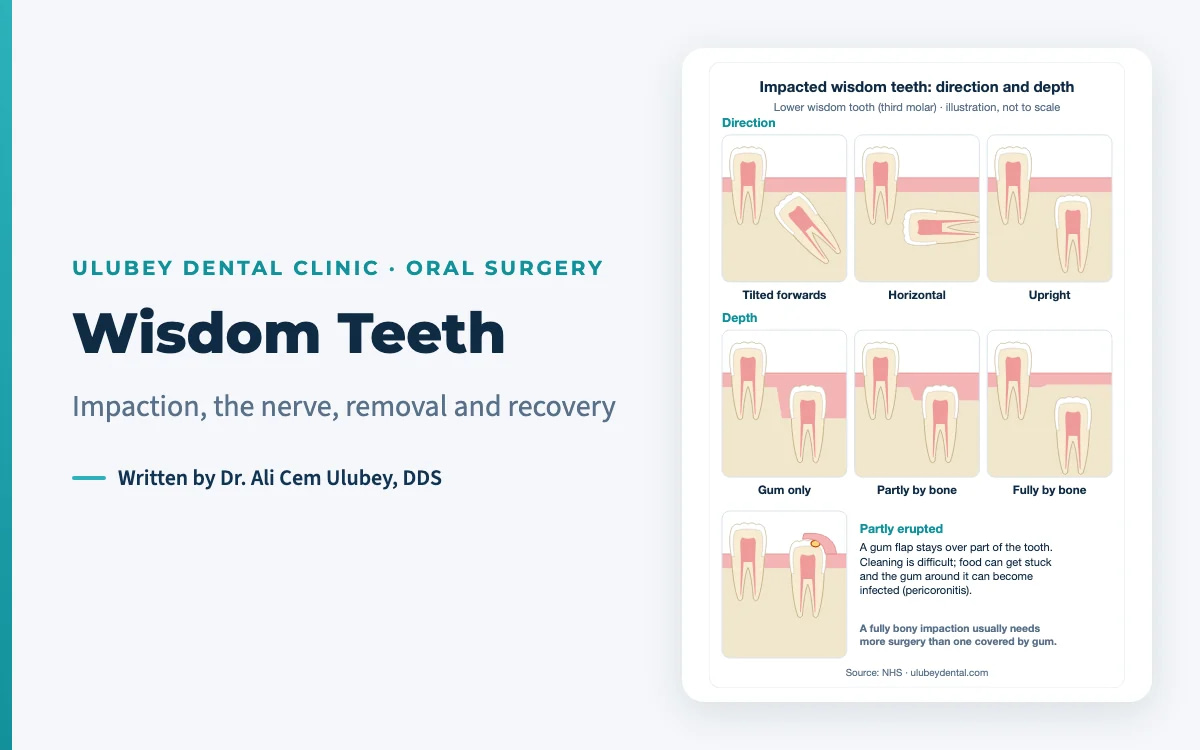
A wisdom tooth may not have enough space to come through fully. It can be blocked by another tooth (impacted) or stay partly covered by the gum[1]. Both situations make cleaning difficult and can lead to[1]:
- pain and swelling;
- infection of the gum around the tooth (pericoronitis);
- food getting stuck;
- tooth decay, in the wisdom tooth or the tooth in front of it;
- gum disease;
- a build-up of fluid around the tooth (a cyst);
- a dental abscess.
Impaction is described by direction and depth: a tooth can lie tilted forwards, horizontally or upright, and can be covered by gum only (soft-tissue impaction) or partly or fully by bone. A fully bony impaction usually needs more surgery than a tooth that is only covered by gum.

Symptoms and when to see a dentist
A wisdom tooth may cause no symptoms at all. When it does, people often notice a sore, swollen gum at the back of the mouth, pain when closing the teeth, a bad taste, food trapping, or difficulty opening the mouth. See a dentist if these signs appear; the dentist may take X-rays to check how the wisdom teeth are positioned[1].
Swelling that spreads into the cheek, under the jaw, towards the eye or neck, difficulty swallowing or breathing, or a high temperature needs urgent care. In Türkiye call 112; in the UK call 999; in Germany call 112.
Pericoronitis, the gum infection around a partly erupted wisdom tooth, often comes back. NICE notes that a first episode, unless particularly severe, should not be considered an indication for surgery, while second or subsequent episodes are an appropriate indication[2].
Remove or keep? What the evidence says
Wisdom teeth that cause problems are usually removed. Wisdom teeth that cause no problems are a different question:
- NHS: if a wisdom tooth is not causing problems, it will usually be left where it is and monitored at routine check-ups[1].
- NICE (UK): prophylactic removal of pathology-free impacted wisdom teeth should be discontinued; surgical removal should be limited to patients with evidence of pathology[2].
- Cochrane (2020): there is insufficient evidence to determine whether symptom-free, disease-free impacted wisdom teeth should be removed or kept. Keeping them may be associated with a higher long-term risk of gum disease at the neighbouring second molar, but that evidence is very low certainty. The authors advise shared decision-making based on patient values and clinical expertise, with regular clinical checks if the teeth are kept[3].
| Situation | Examples from the NICE list |
|---|---|
| Decay or nerve problems in the tooth | Unrestorable caries; non-treatable pulpal or periapical pathology[2] |
| Infection | Cellulitis, abscess, osteomyelitis; recurrent pericoronitis[2] |
| Damage to the tooth or its neighbour | Internal or external resorption; fracture of the tooth[2] |
| Cysts and tumours | Disease of the follicle including cyst or tumour[2] |
| Other treatment | A tooth impeding surgery or reconstructive jaw surgery, or within the field of tumour resection[2] |
Source: NICE TA1 [2]. Plaque formation is a risk factor but is not in itself an indication for surgery[2].
X-rays, CBCT and the nerve
A panoramic X-ray shows all four wisdom teeth, their angle and the roots. In the lower jaw, the roots can lie close to the inferior alveolar nerve, which gives feeling to the lower lip, chin and teeth. When the X-ray suggests a close relationship, a cone-beam CT (CBCT) scan shows it in three dimensions.
CBCT is a planning tool, not a guarantee. A 2022 systematic review of seven randomised trials found moderate-quality evidence that adding CBCT does not routinely reduce nerve injury after high-risk lower wisdom tooth surgery[4]. Its value lies in showing the anatomy before surgery, so that the risk can be explained, the approach planned and, in high-risk cases, the right setting chosen.

What happens during removal
A dentist may be able to remove a wisdom tooth, or may refer you to a specialist at a hospital, clinic or another dental practice[1]. You usually have a local anaesthetic injection to numb the area[1]. The main steps are[1]:
- The gum is opened if it covers the tooth.
- The socket is widened.
- The tooth is removed in one piece, or cut into 2 or 3 pieces.
- The gum is stitched if needed, with dissolvable stitches.
It often takes just a few minutes and should take no more than 40 minutes; you usually go home the same day[1].
Recovery and aftercare
Most people can return to normal activities the day after wisdom tooth removal; a more difficult removal may need 1 to 3 days off work[1]. For up to 2 weeks you may have[1]:
- some pain and swelling, which should start to improve after 1 or 2 days;
- bruising on the cheek;
- a sore, stiff jaw;
- discomfort when chewing and swallowing.
The NHS’s aftercare advice[1]:
- eat soft or liquid food until you can chew comfortably;
- keep the wound clean with gentle rinsing, and clean your other teeth carefully, avoiding the wound;
- if it bleeds, press on the area for at least 10 minutes with a clean cloth or cotton wool;
- do not eat hard or crunchy food, or food that can get stuck in the wound such as nuts or seeds;
- do not smoke, and avoid alcohol and very hot drinks.
For pain after extractions, an American Dental Association guideline names non-opioid medicines, mainly anti-inflammatory painkillers (NSAIDs) alone or with paracetamol, as first-line[7]. Take only what your dentist prescribed or what the package directs.
Possible complications
Wisdom tooth removal is usually a simple procedure, but complications can happen, and your dentist should explain them beforehand[1]:
- Dry socket, where the blood clot does not form properly or is dislodged[1]. It is reported in 1–5% of routine extractions but upwards of 30% of surgically removed wisdom teeth[5], and smokers have more than three times the odds[6]. See our dry socket guide.
- Infection, which may need antibiotics[1].
- Nerve damage, causing numbness or tingling in the tongue, lip or chin; it usually gets better but can last weeks or months[1].
Ask for an urgent dental appointment if bleeding does not stop, if pain and swelling are severe or getting worse and painkillers do not help, or if pain comes with a bad taste, a high temperature or feeling unwell[1].
How we handle wisdom teeth at our clinic
Both of our dentists, Dr. Ali Cem Ulubey and Dr. Surur Ulubey, examine and treat their own patients; there are no rotating dentists. Wisdom tooth removal, including impacted teeth, is done in the clinic.
- Assessment: examination and a panoramic X-ray for every patient. When a lower wisdom tooth lies close to the nerve, its relationship to the nerve is checked with a CBCT scan, which our dentists evaluate.
- High-risk cases: impacted wisdom teeth with a high risk to the nerve are preferably referred to a university faculty of dentistry. We tell you this before anything is planned.
- Simple and surgical removal: partly erupted and impacted wisdom teeth are removed under local anaesthetic. Where stitches are needed, we use fine 4-0 resorbable sutures and, where possible, remove them on day 7–8.
- Medicines: a simple extraction does not need antibiotics; after a surgical extraction we prescribe them. Pain relief is usually an anti-inflammatory (NSAID) such as diclofenac, naproxen or dexketoprofen, chosen for the individual patient; follow the prescription and package leaflet.
- Smoking: stop as early as possible, ideally at least 4 weeks before; if you cannot, we ask you to cut down to at most 6–8 cigarettes a day. No smoking for at least 1 week afterwards, until the wound has closed.
- Visiting patients: a single extraction is done in one appointment. After a complex surgical extraction, we advise waiting 48 hours before flying.
Extraction prices, including impacted wisdom teeth, are on our dental treatment prices page; you receive a written quote after the examination and X-rays. Aftercare for every extraction is covered in our extraction aftercare guide.
Frequently asked questions
Do wisdom teeth always need to be removed?
No. If a wisdom tooth is not causing problems, the NHS says it will usually be left and monitored at routine check-ups, and NICE limits surgical removal of impacted wisdom teeth to cases with evidence of disease. A 2020 Cochrane review found insufficient evidence either way for symptom-free teeth and advises shared decision-making with regular checks.
How long does wisdom tooth removal take?
According to the NHS, removal often takes just a few minutes and should take no more than 40 minutes. You usually go home the same day. A tooth that is fully covered by bone or lies close to the nerve takes more planning, which is why X-rays, and a CBCT scan when needed, come first.
How long does recovery take after wisdom tooth removal?
Most people return to normal activities the next day; a more difficult removal may need 1 to 3 days off work. Pain and swelling can last up to 2 weeks but should start to improve after 1 or 2 days. Pain that gets worse after day 2 or 3 should be checked for dry socket.
Can wisdom tooth removal damage the nerve?
It can. The NHS lists nerve damage, with numbness or tingling in the tongue, lip or chin, as a possible complication; it usually gets better but can last weeks or months. When a lower wisdom tooth lies close to the nerve, we check it with a CBCT scan, and high-risk cases are preferably referred to a university faculty of dentistry.
Can I fly after wisdom tooth removal?
A single extraction is done in one appointment. After a complex surgical extraction, we advise waiting 48 hours before flying. Plan the removal early in your stay rather than the day before you leave, so that the first check and any questions about bleeding, swelling or dry socket can be handled before you travel.
What is pericoronitis?
Pericoronitis is an infection of the gum around a wisdom tooth that has only partly come through. It causes a sore, swollen gum at the back of the mouth, a bad taste and pain on closing. NICE notes that a first episode, unless severe, is not on its own a reason for surgery, but repeated episodes are.
Sources
- NHS. Wisdom tooth removal (page last reviewed 12 June 2024; accessed 25 October 2026). www.nhs.uk/tests-and-treatments/wisdom-tooth-removal
- National Institute for Health and Care Excellence (NICE). Guidance on the extraction of wisdom teeth. Technology appraisal guidance TA1. Published 27 March 2000 (accessed 25 October 2026). www.nice.org.uk/guidance/ta1/chapter/1-Recommendations
- Ghaeminia H, Nienhuijs ME, Toedtling V, et al. Surgical removal versus retention for the management of asymptomatic disease-free impacted wisdom teeth. Cochrane Database Syst Rev. 2020;5:CD003879. PMID 32368796. pubmed.ncbi.nlm.nih.gov/32368796
- Robbins J, Smalley KR, Ray P, Ali K. Does the addition of cone-beam CT to panoral imaging reduce inferior dental nerve injuries resulting from third molar surgery? A systematic review. BMC Oral Health. 2022;22(1):466. PMID 36329417. pubmed.ncbi.nlm.nih.gov/36329417
- Daly BJ, Sharif MO, Jones K, Worthington HV, Beattie A. Local interventions for the management of alveolar osteitis (dry socket). Cochrane Database Syst Rev. 2022;9:CD006968. PMID 36156769. pubmed.ncbi.nlm.nih.gov/36156769
- Kuśnierek W, Brzezińska K, Nijakowski K, Surdacka A. Smoking as a risk factor for dry socket: a systematic review. Dent J (Basel). 2022;10(7):121. PMID 35877395. pubmed.ncbi.nlm.nih.gov/35877395
- Carrasco-Labra A, Polk DE, Urquhart O, et al. Evidence-based clinical practice guideline for the pharmacologic management of acute dental pain in adolescents, adults, and older adults. J Am Dent Assoc. 2024;155(2):102-117.e9. PMID 38325969. pubmed.ncbi.nlm.nih.gov/38325969
This article is general patient information and does not replace a clinical examination or X-rays.
Editor contact: [email protected] · ulubeydental.com/contact-us