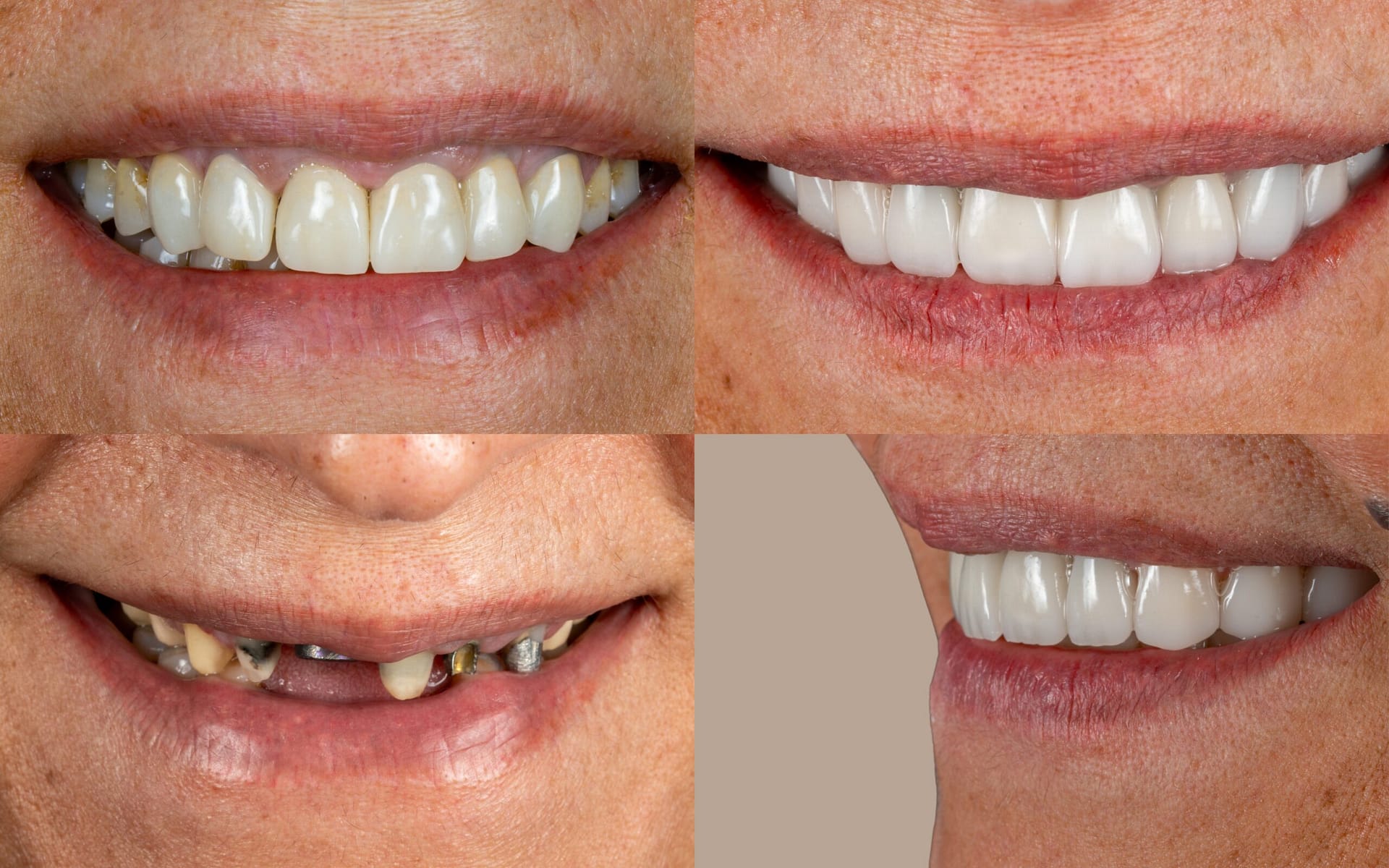

Dental Bridges: Types, Lifespan and Cost per Unit
A dental bridge replaces one or more missing teeth with false teeth (pontics) fixed to the teeth or implants beside the gap[4][5]. Pooled studies report about 89% of conventional tooth-supported bridges still in place after 10 years[1]. At Ulubey Dental Clinic in Antalya each bridge unit costs the same as a crown: €185 in Amann Girrbach zirconia or €250 in E.max, so a 3-unit zirconia bridge is 3 × €185 = €555. Only an examination with X-rays shows whether a bridge suits your gap.
- 1. What is a dental bridge?
- 2. The four types of bridge
- 3. How long do bridges last?
- 4. Zirconia or E.max for a bridge?
- 5. Maryland bridge: when it makes sense
- 6. The bridge procedure step by step
- 7. Dental bridge cost in Antalya
- 8. Guarantee and what it covers
- 9. Caring for a bridge
- 10. How we plan bridges at our clinic
- 11. Frequently asked questions
- 12. Sources
What is a dental bridge?
A dental bridge is a fixed replacement for one or more missing teeth[5]. The false tooth in the middle is called a pontic; it is joined to crowns or wings on the teeth beside the gap, or to dental implants. The supporting teeth or implants are called abutments[4]. Unlike a denture, a bridge is cemented or screwed in place and you cannot take it out[5].
A bridge restores chewing and the look of your smile, and it stops the teeth next to the gap from drifting into it. The trade-off of a conventional bridge is that the supporting teeth must be shaped for crowns. That is the main reason we compare it with a single implant before recommending it; see dental implant vs bridge for that decision in detail.
The four types of dental bridge
Cleveland Clinic lists four main types: traditional, cantilever, Maryland (resin-bonded) and implant-supported bridges[4]. Each suits a different situation, and the evidence on how long they last differs.

| Type | How it is held | Typical use | Survival in studies |
|---|---|---|---|
| Traditional (conventional) | Crowns on the teeth on both sides of the gap | Healthy teeth on both sides of the gap[4] | 93.8% at 5 years, 89.2% at 10 years[1] |
| Cantilever | Crown(s) on one side only | Natural teeth on one side of the gap only; not as strong as a traditional bridge[4] | 91.4% at 5 years, 80.3% at 10 years[1] |
| Maryland (resin-bonded) | Thin wings bonded to the back of the neighbouring teeth | Typically front teeth[4] | 91.4% at 5 years, 82.9% at 10 years[2] |
| Implant-supported | Dental implants instead of natural teeth | Usually three or more missing teeth in a row[4] | 95.2% at 5 years, 86.7% at 10 years[1] |
Pooled data from different study populations; not head-to-head trials and not our clinic’s own data. You may cite this table with a link to this page.
How long do dental bridges last?
Cleveland Clinic gives an average lifespan of five to 15 years, with some bridges lasting longer with good care[4]. A key pooled analysis of conventional bridges, a systematic review in Clinical Oral Implants Research, estimated 93.8% survival after 5 years and 89.2% after 10 years[1].
The same review found that the most frequent problems with tooth-supported bridges were biological: decay of the supporting teeth and loss of pulp vitality[1]. In practice, this means a bridge most often fails because a supporting tooth develops a problem, not because the ceramic breaks. Cleaning under the pontic and regular check-ups therefore matter as much as the material.
Long bridges carry more risk. A traditional planning rule called Ante’s law says the supporting teeth should be strong enough for the teeth they replace; its evidence base has been questioned[6], so we judge each case from the X-rays, the bite and the condition of the supporting teeth rather than a single rule.
Zirconia or E.max for a bridge?
Both are ceramics with no metal, but they behave differently in a bridge, where the connectors between the units carry the chewing load. A systematic review of multiple-unit bridges found 5-year survival of 90.4% for zirconia bridges and 89.1% for reinforced glass-ceramic bridges (the material group that includes lithium disilicate, sold as E.max). Framework fractures were reported in 8.0% of reinforced glass-ceramic bridges against 1.9% of zirconia bridges, while zirconia bridges had more ceramic fractures and loss of retention[3].

| Zirconia (Amann Girrbach) | E.max (lithium disilicate) | |
|---|---|---|
| 5-year survival (bridges) | 90.4%[3] | 89.1% (reinforced glass ceramic)[3] |
| Framework fracture in 5 years | 1.9%[3] | 8.0%[3] |
| How we use it | Our standard material for bridges, including back teeth | Avoided for bridges; only a 3-unit bridge with one pontic in a low-load area |
| Price per unit | €185 | €250 |
| Guarantee | 10-year fracture guarantee (made at our Amann Girrbach partner lab) | 5-year clinic guarantee |
Survival and fracture figures: Pjetursson 2015 [3], studies published up to 2013. Prices and guarantee: Ulubey Dental Clinic, October 2026.
E.max gives excellent single crowns and veneers, but in a bridge the thin connectors are its weak point. We avoid E.max bridges and consider one only for a 3-unit bridge with a single pontic, in an area with low biting forces, when the supporting teeth are strong enough. For most bridges we recommend zirconia.
Maryland bridge: when it makes sense
A Maryland or resin-bonded bridge holds the false tooth with thin wings bonded to the back of the neighbouring teeth, so those teeth need little preparation[4]. It sounds ideal, but the main weakness is de-bonding: the wings come loose. A systematic review of 2,300 resin-bonded bridges found de-bonding in 15% over 5 years; bridges with a zirconia framework, bridges held by one tooth, and bridges in the front of the mouth had the highest survival[2].
Because a Maryland bridge can come loose and may need re-bonding, we use it only when it is really necessary, not as a routine option, and only for patients who live near enough to come back to us quickly if it de-bonds. For visitors from abroad, a conventional bridge or an implant is usually the safer plan.
The bridge procedure step by step
Examination and X-rays
We examine the gap and the supporting teeth and take a panoramic X-ray; periapical X-rays in the clinic when a tooth needs a closer look. Supporting teeth sometimes need a root canal treatment or a post first.Preparation under local anaesthetic
The supporting teeth are shaped for crowns. Cleveland Clinic notes that local anaesthesia is used for this step[4].Digital scan and temporary bridge
We scan with a Dentsply Sirona Primescan intraoral scanner instead of impression trays. You leave with a temporary bridge, usually within 2–3 hours.Try-in
The bridge, made at our partner laboratory, is tried in so we can check fit, bite and shade before it is finished.Fitting and bite check
The final bridge is cemented and the bite is checked. We show you how to clean under the pontic before you leave.
For crowns, our digital workflow takes 4–5 treatment days and a stay of about 5–7 days in Antalya. A tooth-supported bridge is usually made in the same workflow, so plan for a similar stay; your written plan confirms the exact days, especially if a supporting tooth needs root canal treatment first. Use the dental treatment stay planner to plan your trip.
Dental bridge cost in Antalya
We price a bridge per unit, and each unit costs the same as a single crown. A unit is every tooth in the bridge: the crowns on the supporting teeth and the pontic.
| Bridge | Calculation | Price |
|---|---|---|
| 3-unit zirconia bridge (one missing tooth) | 3 × €185 | €555 |
| 4-unit zirconia bridge (two missing teeth) | 4 × €185 | €740 |
| 3-unit E.max bridge (one pontic, low-load area only) | 3 × €250 | €750 |
| Root canal treatment on a supporting tooth, if needed | 1 root / 2 roots / 3 roots (+€30 per additional canal) | €120 / €150 / €180 |
| Post, if needed | Core build-up charged separately (€60) | €60 |
Implant-supported bridges are priced from the implants plus the bridge units; see our dental treatment prices page.
- Included in the per-unit price: the bridge itself and the temporaries and try-ins during your treatment visit.
- No fee: the consultation and the panoramic X-ray; follow-up messages at 30, 90 and 365 days after treatment.
- Charged separately only if needed: root canal treatment, posts, core build-ups and extractions, as itemised in your quote.
- Airport transfer and hotel: included in larger treatment plans, confirmed in your written quote.
Prices are indicative; your final written quote follows the examination and X-rays and is valid for 30 days. Unless the treatment plan changes, the written price does not change.
See all fees on our dental treatment prices page, or estimate crowns and bridge units with the zirconia crown cost calculator.
Guarantee and what it covers
10-year fracture guarantee on Amann Girrbach zirconia crowns and bridges made at our partner lab; 5-year clinic guarantee on crowns and bridges in other materials; crown and bridge guarantees exclude fracture due to bruxism (teeth grinding), and patients who grind their teeth must wear the night guard we provide. All guarantees are conditional on attending recommended check-ups and cover the prosthesis, not the root canal or filling beneath it. Check-ups can be done at our clinic in Antalya or by any licensed dentist where you live; read the full terms in our written dental guarantee.
Caring for a bridge
Food and plaque collect under the pontic, where a toothbrush does not reach, and decay of the supporting teeth is the most frequent biological problem with bridges[1]. The NHS advises brushing twice a day with fluoride toothpaste and using interdental brushes or floss to clean between the teeth[7].
- Water flosser: we recommend one for every bridge patient, to rinse under the pontic.
- Interdental brushes where they fit, floss where they do not.
- Toothbrush with fluoride toothpaste, twice a day[7].
We show you each tool in the clinic, hands-on, on your own bridge. If you grind your teeth, you will need to wear the night guard we provide to protect the bridge.
How we plan bridges at our clinic
Both of our dentists, Dr. Ali Cem Ulubey and Dr. Surur Ulubey, plan and fit bridges themselves; there are no rotating dentists. What that means in practice:
- Implant or bridge first: if the teeth beside the gap are healthy, we discuss a single implant before cutting them down for a bridge; see dental implants in Antalya.
- Materials: Amann Girrbach zirconia as standard, milled at our partner laboratory; Ivoclar IPS e.max only within the limits above.
- Digital workflow: Dentsply Sirona Primescan scanning; shade taken with a VITA Easyshade spectrophotometer and cross-polarised photography (see our tooth shade guide).
- Supporting teeth: we check every supporting tooth on X-rays and treat decay or root canal problems before the bridge is made.
Frequently asked questions
How long does a dental bridge last?
Cleveland Clinic gives an average of five to 15 years, and some bridges last longer. A pooled analysis of conventional bridges found 89.2% still in place after 10 years. Most failures come from decay or nerve problems in the supporting teeth rather than broken ceramic, so cleaning under the bridge and yearly check-ups have a large effect on how long yours lasts.
How much does a 3-unit bridge cost in Antalya?
At Ulubey Dental Clinic each bridge unit costs the same as a crown. A 3-unit zirconia bridge is 3 × €185 = €555; a 3-unit E.max bridge is 3 × €250 = €750. Root canal treatment, posts or extractions are added only if a supporting tooth needs them. Your written quote follows the examination and X-rays and is valid for 30 days.
Is a bridge or an implant better for one missing tooth?
Neither is better for everyone. If the teeth beside the gap are healthy, an implant spares them from being shaped for crowns. If those teeth already need crowns, or implant surgery is not advisable, a bridge is a sound choice. Pooled studies show similar 10-year survival for conventional bridges and implant-supported single crowns, about 89%.
Can I get a Maryland bridge?
Sometimes, but we use Maryland bridges only when really necessary. Their main problem is de-bonding: a systematic review found the wings came loose in 15% of resin-bonded bridges over 5 years. Because a loose bridge needs prompt re-bonding, we offer it only to patients who live near enough to return quickly. Visitors from abroad usually do better with a conventional bridge or an implant.
Why do you avoid E.max bridges?
In a review of multiple-unit bridges, framework fractures occurred in 8.0% of reinforced glass-ceramic bridges, the group that includes E.max, compared with 1.9% of zirconia bridges over 5 years. E.max remains an excellent material for single crowns and veneers. For bridges we use zirconia as standard and consider E.max only for a 3-unit bridge with one pontic in a low-load area.
How many days do I need in Antalya for a bridge?
A tooth-supported bridge is usually made in the same digital workflow as our crowns: typically 4–5 treatment days and a stay of about 5–7 days. You receive a temporary bridge, usually within 2–3 hours of preparation. If a supporting tooth needs root canal treatment first, or the bridge rests on implants, the plan takes longer; your written plan states the days.
Sources
- Pjetursson BE, Brägger U, Lang NP, Zwahlen M. Comparison of survival and complication rates of tooth-supported fixed dental prostheses (FDPs) and implant-supported FDPs and single crowns (SCs). Clin Oral Implants Res. 2007;18 Suppl 3:97-113. pubmed.ncbi.nlm.nih.gov/17594374
- Thoma DS, Sailer I, Ioannidis A, Zwahlen M, Makarov N, Pjetursson BE. A systematic review of the survival and complication rates of resin-bonded fixed dental prostheses after a mean observation period of at least 5 years. Clin Oral Implants Res. 2017;28(11):1421-1432. pubmed.ncbi.nlm.nih.gov/28191679
- Pjetursson BE, Sailer I, Makarov NA, Zwahlen M, Thoma DS. All-ceramic or metal-ceramic tooth-supported fixed dental prostheses (FDPs)? A systematic review of the survival and complication rates. Part II: Multiple-unit FDPs. Dent Mater. 2015;31(6):624-639. pubmed.ncbi.nlm.nih.gov/25935732
- Cleveland Clinic. Dental bridges (last updated 24 May 2023; accessed 25 October 2026). my.clevelandclinic.org/health/treatments/10921-dental-bridges
- NHS. Dental treatments (page last reviewed 8 July 2026; accessed 25 October 2026). www.nhs.uk/live-well/healthy-teeth-and-gums/dental-treatments
- Balevi B. Ante’s law is not evidence based. J Am Dent Assoc. 2012;143(9):1011-1012. pubmed.ncbi.nlm.nih.gov/22942148
- NHS. How to keep your teeth clean (page last reviewed 30 June 2025; accessed 25 October 2026). www.nhs.uk/live-well/healthy-teeth-and-gums/how-to-keep-your-teeth-clean
This article is general patient information and does not replace a clinical examination or X-rays.
Editor contact: [email protected] · ulubeydental.com/contact-us