Oral Health and Medical Conditions: Diabetes, Heart, Medicines
This page is general information and does not replace an examination.
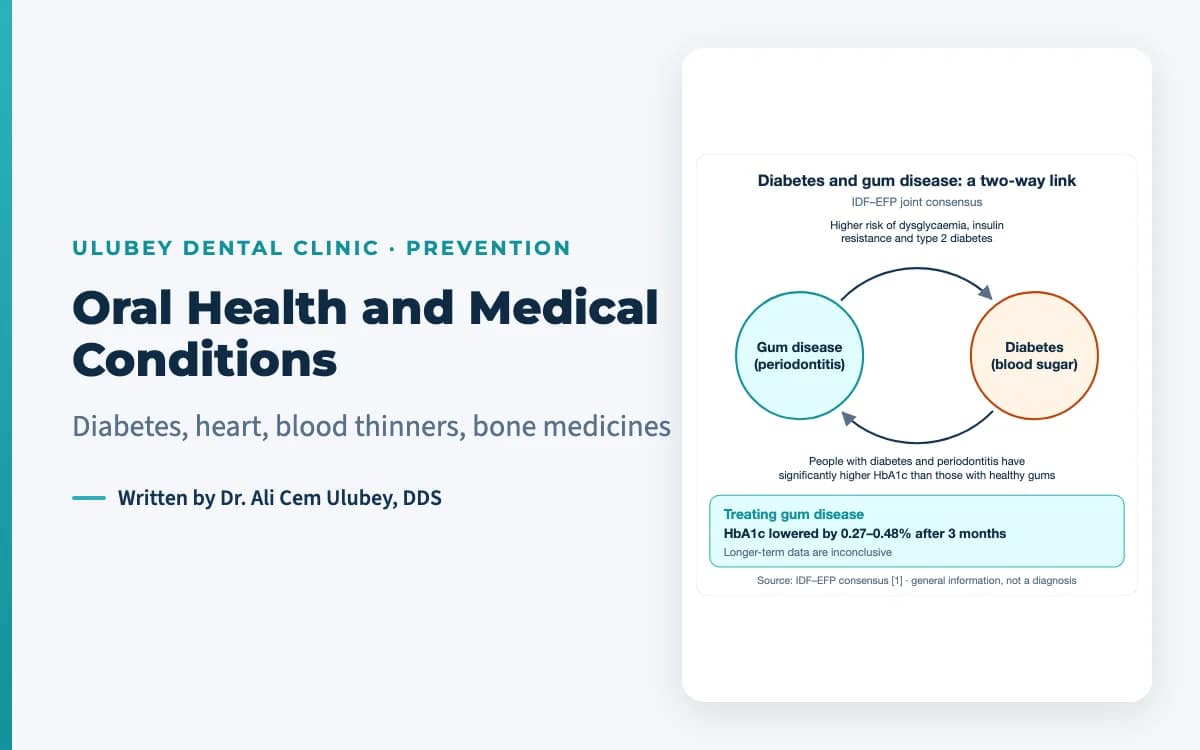
Your general health and your mouth affect each other. Diabetes and gum disease have a two-way relationship: people with diabetes and periodontitis have higher HbA1c than those with healthy gums, and treating gum disease lowered HbA1c by 0.27–0.48% after 3 months[1]. Blood thinners make dental bleeding more likely[3], bone-strengthening medicines carry a rare risk of jaw osteonecrosis[5], and many medicines dry the mouth, which raises the risk of tooth decay[7]. Tell your dentist about every condition and medicine. At Ulubey Dental Clinic we consult your physician before surgery when these apply.
- 1. Why your medical conditions matter to your dentist
- 2. Diabetes and gum disease: a two-way link
- 3. Heart disease and dental treatment
- 4. Blood thinners and dental treatment
- 5. Osteoporosis and cancer medicines: bisphosphonates and denosumab
- 6. Medicines that dry the mouth
- 7. Pregnancy
- 8. What we treat and what we refer
- 9. When to see a dentist promptly
- 10. Frequently asked questions
- 11. Sources
Why your medical conditions matter to your dentist
Many conditions and medicines change how the mouth heals, bleeds or fights infection, and some dental problems feed back into general health. That is why a dentist asks for your full medical history before planning treatment. Tell us about every condition and medicine, including non-prescribed and herbal products[3], even if they seem unrelated to your teeth.

| Condition or medicine | Effect on the mouth | What to tell your dentist |
|---|---|---|
| Diabetes | Two-way link with periodontitis[1]; persistent dry mouth[7] | Type, medicines, latest HbA1c |
| Heart disease | A few high-risk conditions need antibiotic cover before some procedures[2] | Diagnosis, valve or other heart surgery, medicines |
| Blood thinners | Bleeding more easily and for longer[3] | Which medicine; INR record if on warfarin[3] |
| Bisphosphonates, denosumab | Rare medication-related osteonecrosis of the jaw (MRONJ)[5][6] | Name, tablet or injection, since when, and why |
| Medicines that dry the mouth; cancer treatment | Dry mouth and more tooth decay[7] | Full medicine list; any radiotherapy or chemotherapy |
Sources as cited per cell. You may cite this table with a link to this page.
Diabetes and gum disease: a two-way link
Diabetes and periodontitis (advanced gum disease) are linked in both directions. A joint consensus of the International Diabetes Federation and the European Federation of Periodontology found strong evidence that people with periodontitis have an elevated risk of dysglycaemia and insulin resistance, that people with diabetes and periodontitis have significantly higher HbA1c than those with healthy gums, and that periodontitis is associated with an increased risk of developing type 2 diabetes[1].

The good news runs the same way: periodontal treatment is safe and effective in people with diabetes and was associated with HbA1c reductions of 0.27–0.48% after 3 months, although longer-term data are inconclusive[1]. Persistent dry mouth can also be linked to diabetes[7].
- If you have diabetes: have your gums checked regularly and tell your dentist your latest HbA1c.
- If you have gum disease: treatment helps your mouth and may help blood-sugar control; tell your physician too.
At our clinic: before every implant patient we test HbA1c along with other routine blood tests, even when no disease is known, and these tests have often revealed a high HbA1c the patient did not know about. Whether you can have implants with diabetes, and our HbA1c limits, are explained in our guide to who can get dental implants.
Heart disease and dental treatment
For most heart patients, routine dental care is safe and good oral health matters. The American Heart Association reviewed the evidence in 2021 and continues to recommend antibiotic prophylaxis before dental procedures only for the categories of patients at highest risk of an adverse outcome from infective endocarditis, while emphasising the critical role of good oral health and regular access to dental care for all[2]. Your cardiologist knows whether you are in one of those categories.
A review of implants in older patients found that implant survival in people with cardiovascular disease may be similar to or higher than in healthy patients[8]. Many heart patients also take blood thinners, covered in the next section.
At our clinic: patients who need prophylaxis receive a preventive antibiotic before the procedure. Tell us about valve replacements, previous endocarditis or heart surgery.
Blood thinners and dental treatment
Anticoagulant and antiplatelet medicines help prevent harmful blood clots, but they also make you bleed more easily and for longer, for example after an extraction[3]. The Scottish Dental Clinical Effectiveness Programme (SDCEP) advises patients to:
- tell the dentist which anticoagulant or antiplatelet medicine they take, and show the INR record if they take warfarin[3];
- tell the dentist about all other medicines, because aspirin and other anti-inflammatory painkillers such as ibuprofen and diclofenac can cause more bleeding[3];
- keep cleaning their teeth as usual, because healthy gums bleed less[3];
- not alter the medicine for dental treatment unless told to by their doctor, specialist or dentist[3].
For pain relief after treatment, SDCEP advises patients on anticoagulant or antiplatelet medicines to use paracetamol as directed on the pack if they can take it, to avoid NSAIDs such as aspirin, ibuprofen or diclofenac or medicines containing them, and to ask the dentist for advice if paracetamol is not possible or not enough[4]. Our usual painkillers are anti-inflammatories, so tell us about your blood thinner before surgery; the dentist chooses your pain relief with this in mind.
If bleeding starts again after treatment, press or bite on a folded, clean, damp handkerchief or gauze for 30 minutes; if that does not stop it, contact your dentist[4].
At our clinic: what the medicine is for matters. Before surgery we consult the physician who prescribed it and act after their approval; the physician permits the procedure or adjusts the medication if needed.
Osteoporosis and cancer medicines: bisphosphonates and denosumab
Bisphosphonates and denosumab are used for osteoporosis and in some cancers. They are linked to a rare side effect, medication-related osteonecrosis of the jaw (MRONJ), in which some jawbone becomes exposed[5].
- Osteoporosis: SDCEP puts the risk between 1 in 1,000 and 1 in 10,000. The risk is very low to non-existent for most ordinary treatments and higher, but still considered low, for treatment that affects bone, such as an extraction or implants[5].
- Cancer: for anti-resorptive drugs taken for cancer, the risk is typically less than 1 in 20[6].
- Do not stop the medicine yourself: the medical benefits are likely to far outweigh the risks[5].
- Contact a dentist promptly if you notice tingling, numbness or heaviness in the jaw, jaw pain or a bad taste, swelling, pus, loose teeth or exposed bone[5].
At our clinic: patients taking bisphosphonates are referred to their own physician first. If a bisphosphonate was given by injection (intravenously), we do no oral surgery for up to 5 years. Regular check-ups and good cleaning reduce the chance that surgery is ever needed[5].
Medicines that dry the mouth
Medicines are one of the main causes of a dry mouth; the NHS advises checking the leaflet that comes with your medicine to see if dry mouth is a side effect[7]. Other causes include dehydration, breathing through the mouth at night, anxiety, cancer treatment (radiotherapy or chemotherapy) and oral thrush; a dry mouth that does not go away may be caused by a condition like diabetes or Sjögren’s syndrome[7].
Saliva protects the teeth, so you are more likely to get tooth decay if you have a dry mouth[7]. NHS self-help advice[7]:
- take regular sips of cold water during the day and keep water by your bed;
- chew sugar-free gum or suck sugar-free sweets;
- brush twice a day and use an alcohol-free mouthwash;
- cut down on alcohol, caffeine, fizzy drinks and sugary or acidic food, and do not smoke;
- do not stop a prescribed medicine without medical advice, even if you think it is the cause.
The NHS advises seeing a GP if a dry mouth makes talking or eating difficult, does not improve after a few weeks of home or pharmacy treatment, or you think a prescribed medicine is causing it[7]. Tell your dentist too, so prevention can be stepped up.
Pregnancy
During pregnancy we only do urgent work, in the second trimester, approved by your physician. For example, a tooth that needs root canal treatment is opened, dressed and sealed with a temporary filling, and the definitive treatment is postponed until after the birth.
What we treat and what we refer
A good dentist knows the limits of the practice. This is how we handle the conditions on this page and related problems:
| Situation | What we do |
|---|---|
| Gum disease, including in diabetic patients | We treat it in the clinic |
| Patient on a blood thinner who needs surgery | We consult the prescribing physician and act after their approval |
| Bisphosphonate treatment | Referral to your own physician; no oral surgery for up to 5 years after intravenous bisphosphonates |
| Heart condition needing prophylaxis | Preventive antibiotic before the procedure |
| White or red patches in the mouth | Referral to a university faculty of dentistry; we do not take biopsies in the clinic |
| Impacted wisdom tooth close to the nerve | CBCT scan; high-risk cases preferably referred to a university faculty of dentistry |
| Jaw joint pain (TMD) | Night guard or occlusal splint made in the clinic and jaw exercises explained; advanced cases referred to physiotherapy |
| Pregnancy | Only urgent work in the second trimester with your physician’s approval |
Ulubey Dental Clinic protocol.
When to see a dentist promptly
- a mouth ulcer that lasts longer than 3 weeks, is different from ulcers you have had before, or bleeds[9], or a white or red patch that does not go away;
- exposed bone in the jaw, or tingling, numbness or heaviness in the jaw while on a bone-strengthening medicine[5];
- bleeding after dental treatment that does not stop after 30 minutes of pressure[4];
- gums that bleed, swell or recede, especially if you have diabetes.
Swelling that spreads towards the eye or neck, difficulty breathing or swallowing, high fever or uncontrolled bleeding is a medical emergency: call 112 in Türkiye, 999 or NHS 111 in the UK, 112 in Germany. A routine question about how a condition or medicine affects planned dental treatment can wait for your appointment; bring your medicine list.
Frequently asked questions
Does diabetes affect your teeth and gums?
Yes. Diabetes and periodontitis have a two-way relationship: people with diabetes and gum disease tend to have higher HbA1c, and periodontitis is linked to a higher risk of type 2 diabetes. Treating gum disease is safe in people with diabetes and lowered HbA1c by 0.27–0.48% after 3 months. Persistent dry mouth can also be linked to diabetes.
Do heart patients need antibiotics before dental treatment?
Most do not. The American Heart Association recommends antibiotic cover before dental procedures only for patients at the highest risk from infective endocarditis, and stresses good oral health for everyone. Your cardiologist can tell you whether you are in that group. At our clinic, patients who need prophylaxis receive a preventive antibiotic before the procedure.
Should I stop my blood thinner before seeing the dentist?
No, not on your own. SDCEP advises not to alter anticoagulant or antiplatelet medicine for dental treatment unless your doctor, specialist or dentist tells you to. Tell your dentist which medicine you take. Before surgery we consult the physician who prescribed it and act after their approval.
Is dental treatment safe if I take bisphosphonates for osteoporosis?
Most ordinary dental treatment carries very low risk. The rare jaw side effect, MRONJ, has a risk of 1 in 1,000 to 1 in 10,000 for osteoporosis treatment and is higher, but still low, after extractions or implants. Keep taking the medicine. We refer bisphosphonate patients to their physician first, and do no oral surgery for up to 5 years after intravenous bisphosphonates.
Which medicines cause a dry mouth?
Many medicines list dry mouth as a side effect, so check the leaflet that comes with yours. Cancer treatment, dehydration, mouth breathing, anxiety, diabetes and Sjögren’s syndrome can also cause it. A dry mouth makes tooth decay more likely. Do not stop a prescribed medicine without medical advice; sip water, use sugar-free gum and tell your dentist.
Does the clinic treat oral lesions such as white or red patches?
We examine the mouth at every visit, but we do not take biopsies in the clinic. White or red patches that need investigation are referred to a university faculty of dentistry. The NHS advises seeing a dentist or GP for a mouth ulcer that lasts longer than 3 weeks.
Sources
- Sanz M, Ceriello A, Buysschaert M, et al. Scientific evidence on the links between periodontal diseases and diabetes: consensus report and guidelines of the joint workshop on periodontal diseases and diabetes by the International Diabetes Federation and the European Federation of Periodontology. J Clin Periodontol. 2018;45(2):138-149. pubmed.ncbi.nlm.nih.gov/29280174
- Wilson WR, Gewitz M, Lockhart PB, et al. Prevention of viridans group streptococcal infective endocarditis: a scientific statement from the American Heart Association. Circulation. 2021;143(20):e963-e978. pubmed.ncbi.nlm.nih.gov/33853363
- SDCEP. Anticoagulant or antiplatelet medication and your dental treatment: information for patients (2022; accessed 25 October 2026). www.sdcep.org.uk/media/r3cjkyl5/sdcep-anticoagulant-or-antiplatelet-medication-and-your-dental-treatment.pdf
- SDCEP. Post-treatment advice for dental patients taking anticoagulant or antiplatelet medication (March 2022; accessed 25 October 2026). www.sdcep.org.uk/media/bocnpjel/sdcep-post-treatment-advice-for-dental-patients.pdf
- SDCEP. Dental advice for patients prescribed anti-resorptive drugs for the treatment of osteoporosis or other non-malignant diseases of bone (patient leaflet; accessed 25 October 2026). www.sdcep.org.uk/media/0fldawef/sdcep-mronj-information-for-osteoporosis-patients.pdf
- SDCEP. MRONJ information for patients prescribed anti-resorptive or anti-angiogenic drugs for cancer (patient leaflet; accessed 25 October 2026). www.sdcep.org.uk/media/bdwo1l44/sdcep-mronj-information-for-cancer-patients.pdf
- NHS. Dry mouth (page last reviewed 29 November 2023; accessed 25 October 2026). www.nhs.uk/conditions/dry-mouth
- Schimmel M, Srinivasan M, McKenna G, Müller F. Effect of advanced age and/or systemic medical conditions on dental implant survival: a systematic review and meta-analysis. Clin Oral Implants Res. 2018;29 Suppl 16:311-330. pubmed.ncbi.nlm.nih.gov/30328186
- NHS. Mouth ulcers (page last reviewed 11 March 2024; accessed 25 October 2026). www.nhs.uk/conditions/mouth-ulcers
This article is general patient information and does not replace a clinical examination.
Editor contact: [email protected] · ulubeydental.com/contact-us