Sensitive Teeth: Causes, Relief and Treatment
This page is general information and does not replace an examination.
Sensitive teeth (dentin hypersensitivity) hurt with a short, sharp twinge when something hot, cold, sweet or sour touches them. It happens when the inner layer of the tooth, the dentin, is exposed by worn enamel or receding gums[1][2]. Sensitivity can also be a sign of decay, a cracked tooth, a worn filling or gum disease, so a dentist should find the cause[1][2]. Desensitising toothpaste helps many people[3]; in the clinic, fluoride varnish, bonding or other treatments can follow[1][2].
What are sensitive teeth?
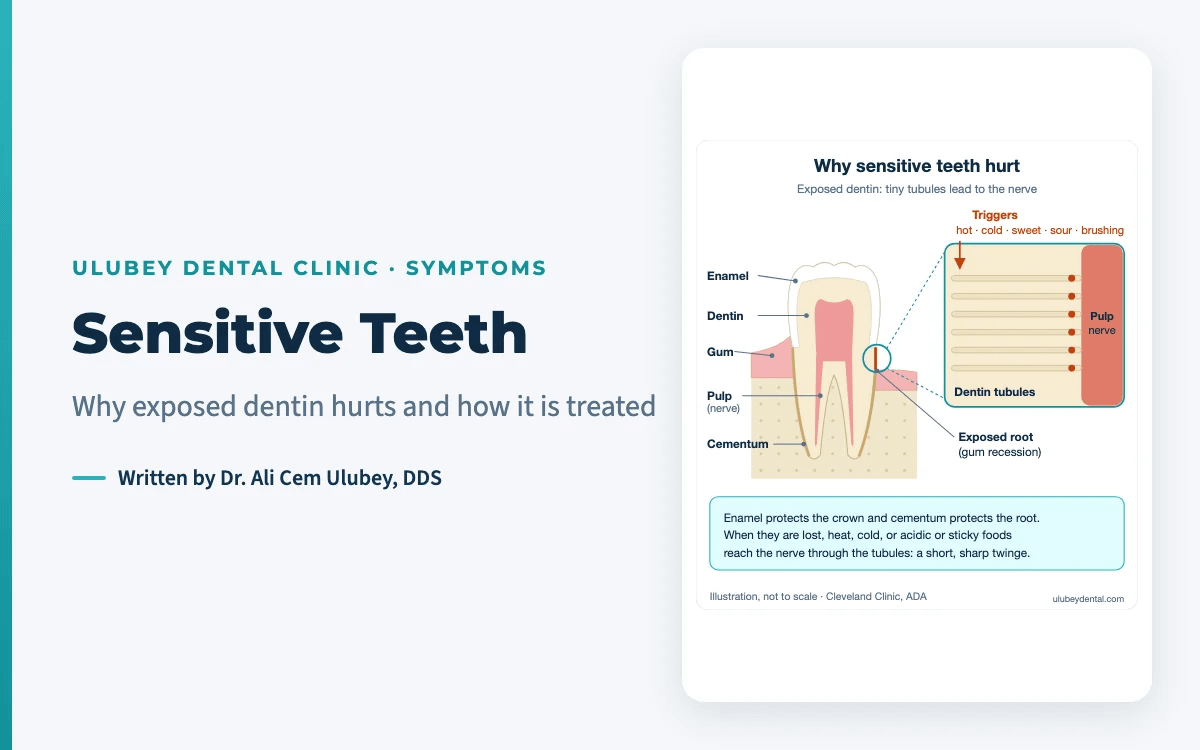
In a healthy tooth, enamel protects the crown above the gum line and a layer called cementum protects the root below it. Underneath both lies dentin. Dentin is less dense and contains microscopic tubules, small hollow canals. When dentin loses its covering of enamel or cementum, these tubules allow heat, cold, or acidic or sticky foods to reach the nerves and cells inside the tooth. Dentin can also be exposed when the gums recede. The result can be hypersensitivity[2].

The typical pattern is a quick, sharp pain with a trigger: an ice-cold drink, hot coffee, something sweet or sour, cold air, or touching the tooth with a toothbrush. Brushing or flossing can make people wince[2]. Exposed dentin can make it painful to eat or drink something hot, cold, sweet or sour[1].
Causes of sensitive teeth
Cleveland Clinic and the American Dental Association list these possible causes[1][2]:
- Worn enamel from acidic foods and drinks such as citrus fruits, tomatoes, pickles and tea[1].
- Brushing too hard or with a hard toothbrush, which can wear enamel and make gums pull back[1].
- Gum recession and gum disease, which expose the root surface[1][2].
- Tooth decay and worn fillings[2].
- Cracked or fractured teeth, which let bacteria in and irritate the tooth[1][2].
- Teeth grinding or clenching, which wears enamel and can expose dentin[1].
- Plaque build-up near the roots[1].
- Some mouthwashes that contain acids[1].
- Recent dental treatment such as fillings or cleanings, which can cause short-term sensitivity[1].
- Whitening products, which can increase sensitivity[1].
Enamel wear from acid, grinding or brushing has its own guide. Teeth grinding and night guards are covered in our bruxism guide.
Sensitivity or something else?
A short twinge that fades quickly once the cold or sweet is gone is the classic pattern of exposed dentin. Other patterns should be checked by a dentist, because sensitivity can be a sign of a bigger problem such as a cavity, gum disease or a cracked tooth[1]. The table is a guide for talking to your dentist, not a way to diagnose yourself.
| What you notice | What a dentist will check for | How soon |
|---|---|---|
| Short, sharp twinge with cold, sweet or brushing, gone within seconds | Exposed dentin from worn enamel or receding gums[1][2] | At your next check-up, or sooner if it gets worse |
| Sensitivity in one tooth only | Decay, a worn or broken filling, or a crack[1][2] | Book an appointment |
| Sharp pain when biting or releasing | A cracked tooth[1] | Book an appointment |
| Pain that lingers, throbs or wakes you at night | Whether the nerve inside the tooth is affected | See a dentist soon; toothache lasting more than 2 days should be seen[4] |
| Pain with swelling, a bad taste or fever | A possible dental abscess[5] | Urgent dental appointment; spreading swelling is an emergency[5] |
Sources: Cleveland Clinic [1], ADA MouthHealthy [2], NHS [4][5]. You may cite this table with a link to this page.
Cleveland Clinic warns that untreated sensitive teeth can lead to an infected tooth, cavities, gum disease, or long-term or worsening pain, and advises not to ignore the pain[1].
What you can do at home
- Use a desensitising toothpaste every day. These contain compounds that help block the transmission of sensation from the tooth surface to the nerve, and usually need several applications before sensitivity is reduced[2]. Cleveland Clinic also suggests dabbing a little on the sore spot before bed[1].
- Brush gently with a soft-bristled toothbrush, and floss gently every day[1].
- Limit acidic foods and drinks such as citrus and pickles[1].
- Use fluoride products to strengthen the teeth[1].
- Wear a mouth guard if you grind your teeth[1].
Which toothpaste? A 2020 network meta-analysis in the Journal of Dental Research compared toothpaste formulations in 125 randomised trials with 12,541 patients[3]. Most formulations performed better than placebo or regular fluoride toothpaste. Calcium sodium phosphosilicate was the most beneficial across tactile, cold and air tests, with high to moderate certainty; stannous fluoride alone, and potassium combined with stannous fluoride or hydroxyapatite, helped with tactile and air stimuli; arginine helped with air stimuli; and strontium and potassium helped with tactile stimuli[3]. Look for these active ingredients on the label rather than a brand name, and give a product a few weeks of daily use.
If sensitivity does not improve, or gets worse, see a dentist. Toothpaste treats the symptom; a dentist looks for the cause.
Treatment in the clinic
The right treatment depends on what is causing the sensitivity[2]. Sometimes tooth sensitivity goes away on its own, especially after a dental visit[1].

| Treatment | What it does | When it is used |
|---|---|---|
| Fluoride gel or varnish | Strengthens enamel and reduces the transmission of sensations[1][2] | Generalised sensitivity from exposed dentin |
| Dentin sealant / desensitising agent | Blocks pain signals[1] | Exposed areas that keep reacting |
| Bonding | Covers exposed roots[1] | A notch or exposed root surface at the gum line |
| Crown, inlay or filling | Corrects a flaw or decay that causes sensitivity[2] | Decay, a worn filling or a cracked tooth |
| Surgical gum graft | Protects the root where gum tissue has been lost[2] | Gum recession with an exposed root |
| Root canal treatment | Removes the source of the pain[2] | Severe, persistent sensitivity that cannot be treated by other means[2] |
Sources: Cleveland Clinic [1], ADA MouthHealthy [2].
Sensitivity after dental treatment or whitening
Fillings, cleanings and other treatments can cause short-term sensitivity[1]. If it does not settle, or if a newly filled tooth hurts when you bite, tell your dentist: the bite or the filling may need a check.
Whitening products can increase sensitivity[1]. How we manage sensitivity during and after whitening is explained on our teeth whitening page.
Prevention
Proper oral hygiene is the key to preventing sensitive-tooth pain[2]. In practice[1]:
- brush and floss gently every day with a soft-bristled toothbrush;
- limit acidic foods and drinks;
- see your dentist regularly for cleanings and check-ups;
- use fluoride products;
- wear a mouth guard if you grind your teeth.
Gentle, regular professional cleaning helps keep plaque away from the roots; see professional teeth cleaning.
How we treat sensitive teeth at our clinic
Both of our dentists, Dr. Ali Cem Ulubey and Dr. Surur Ulubey, examine and treat patients themselves; there are no rotating dentists.
- Find the cause first: examination of the teeth and gums, a panoramic X-ray for every patient and periapical X-rays in the clinic when a single tooth needs a closer look.
- In-clinic desensitising: we apply fluoride and a desensitising varnish. This is a paid treatment; the fee is confirmed in your written quote.
- Treating the cause: fillings for decay or worn fillings, bonding over exposed areas, crowns or onlays for cracked teeth, and root canal treatment when the nerve is affected.
- Gum recession: where it is appropriate, we perform a gum graft (the free gingival graft technique, named for the donor tissue, not the fee); it is quoted individually in writing.
- Grinding: a hard night guard made in the clinic, which can be ready within 2–3 hours when it is urgent.
Prices for fillings, crowns and root canal treatment are on our dental treatment prices page.
Frequently asked questions
Why are my teeth suddenly sensitive?
Sudden sensitivity often follows something that exposed dentin or irritated a tooth: recent dental treatment, whitening, a cracked tooth, a worn or broken filling, new decay, gum recession, or a change to acidic food and drinks or harder brushing. If it is limited to one tooth, lingers, or comes with swelling, see a dentist rather than waiting for it to pass.
Does desensitising toothpaste really work?
For many people, yes. A 2020 network meta-analysis of 125 randomised trials with 12,541 patients found that most desensitising toothpaste formulations worked better than placebo or regular fluoride toothpaste. They usually need several applications before sensitivity is reduced, so use one daily for a few weeks. If it does not help, a dentist should look for the cause.
Can sensitive teeth be a sign of a cavity?
Yes. Sensitivity can be a sign of tooth decay, a fractured tooth, a worn filling or gum disease, as well as of worn enamel or an exposed root. Sensitivity limited to one tooth, or pain that lingers after the trigger, is a reason to have the tooth checked with an examination and X-rays.
How long does sensitivity last after a filling or cleaning?
Short-term sensitivity after fillings, cleanings or other treatment is common and often settles on its own. If it does not improve, gets worse, or the tooth hurts when you bite, tell your dentist. A high filling or a deep cavity close to the nerve may need to be checked.
Can sensitive teeth be fixed permanently?
It depends on the cause. Decay, a crack or a worn filling can be repaired, and an exposed root can be covered with bonding or a gum graft. Sensitivity from worn enamel is usually controlled rather than cured, with desensitising toothpaste, fluoride products, gentle brushing, fewer acidic drinks and a night guard if you grind.
Is it safe to whiten sensitive teeth?
Whitening products can increase sensitivity, so a dentist should check the cause of existing sensitivity first. Decay, gum recession or a cracked tooth should be treated before whitening. How we plan whitening for patients with sensitive teeth is explained on our teeth whitening page.
Sources
- Cleveland Clinic. Sensitive teeth: causes, treatment and prevention (last updated 3 July 2025; accessed 25 October 2026). my.clevelandclinic.org/health/symptoms/10954-teeth-sensitivity
- American Dental Association, MouthHealthy. Sensitive teeth (accessed 25 October 2026). www.mouthhealthy.org/all-topics-a-z/sensitive-teeth
- Martins CC, Firmino RT, Riva JJ, et al. Desensitizing toothpastes for dentin hypersensitivity: a network meta-analysis. J Dent Res. 2020;99(5):514-522. PMID 32037944. pubmed.ncbi.nlm.nih.gov/32037944
- NHS. Toothache (page last reviewed 1 July 2024; accessed 25 October 2026). www.nhs.uk/symptoms/toothache
- NHS. Dental abscess (page last reviewed 18 March 2026; accessed 25 October 2026). www.nhs.uk/conditions/dental-abscess
This article is general patient information and does not replace a clinical examination or X-rays.
Editor contact: [email protected] · ulubeydental.com/contact-us