Dental Fillings: Composite vs Amalgam, Lifespan and Prices
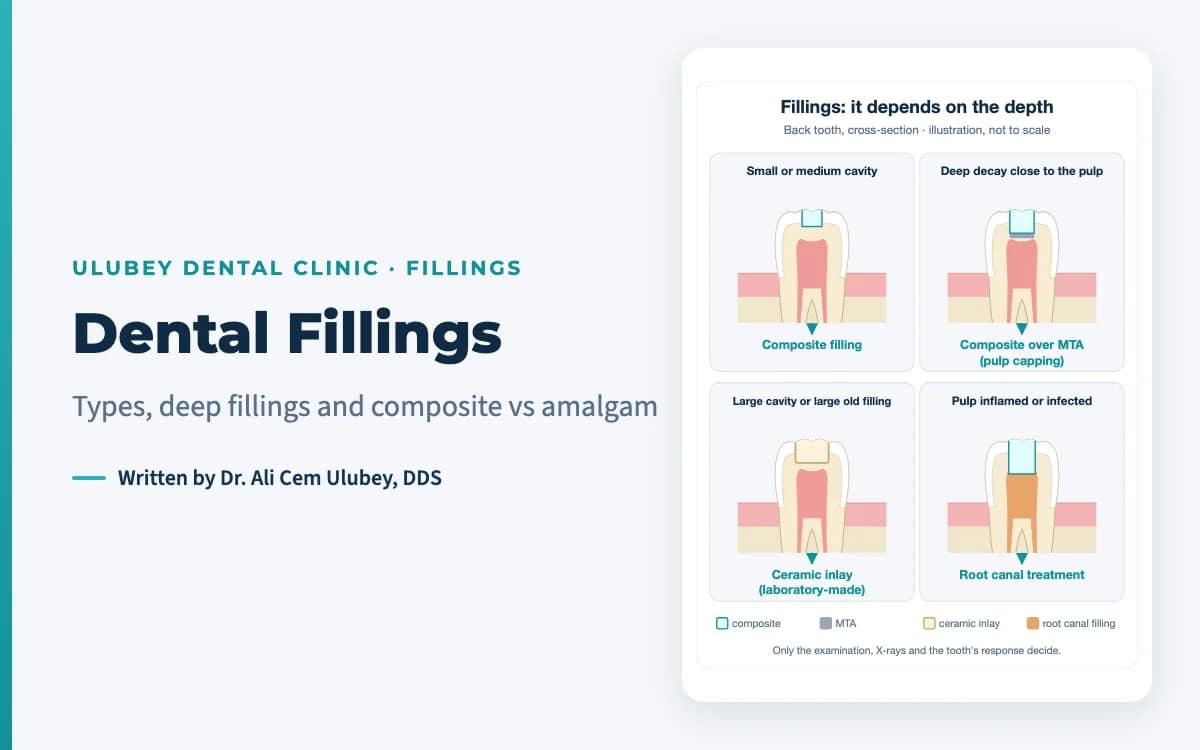
A filling repairs a hole in a tooth caused by decay[4]. The main types are tooth-coloured composite and amalgam (a mixture of mercury, silver, tin and copper)[4]; large cavities can also be restored with laboratory-made ceramic inlays[5]. Trials show composite fillings fail more often than amalgam, mostly through new decay at the edges[1], but at Ulubey Dental Clinic in Antalya we never place amalgam: we use composite (€60 standard, €90 with MTA pulp protection, €120 for a front-tooth aesthetic filling) and E.max inlays (€250) for larger cavities.
- 1. What is a dental filling?
- 2. Types of fillings compared
- 3. Composite vs amalgam: what the evidence says
- 4. How long do fillings last?
- 5. Deep fillings and pulp capping
- 6. A filling fell out or broke: what to do
- 7. What happens during a filling
- 8. Filling prices in Antalya
- 9. How we place fillings at our clinic
- 10. Frequently asked questions
- 11. Sources
What is a dental filling?
A filling replaces tooth structure lost to decay or damage. The dentist removes the decayed part, shapes the cavity and fills it so the tooth can chew normally again and the decay cannot progress[4]. Once decay has broken through the surface and formed a cavity, it usually needs a filling; very early decay without a hole can sometimes be stopped with fluoride[6].
Fillings can be direct, built up in the tooth at one appointment (composite, amalgam), or indirect, made at a laboratory and bonded later (ceramic inlays and onlays). Your dentist recommends the type according to your clinical needs[4].
Types of fillings compared
| Type | Material | Typical use | At our clinic |
|---|---|---|---|
| Composite (white) filling | Tooth-coloured resin bonded to the tooth and hardened with a curing light | Most small and medium cavities, front and back teeth | Yes: €60 standard · €120 front-tooth aesthetic |
| Composite with pulp protection | Composite over a protective layer of MTA | Deep decay close to the nerve | Yes: €90 |
| Amalgam (silver) filling | A mixture of mercury, silver, tin and copper[4] | Back teeth; still common in some countries | Never placed. Old amalgam is replaced on request or indication |
| Ceramic inlay or onlay | E.max ceramic made at a laboratory and bonded | Large cavities or large old fillings in back teeth | Yes: €250, usually ready in 2–3 days |
Composite vs amalgam: what the evidence says
The 2021 Cochrane review compared composite and amalgam fillings in back teeth. In the two parallel-group trials (1,645 composite and 1,365 amalgam fillings in 921 children), composite fillings had almost double the risk of failure (risk ratio 1.89) and a much higher risk of new decay at the edges (risk ratio 2.14), while the risk of the filling fracturing was not higher. The authors rated this evidence as low certainty[1].

On safety, the review found very low-certainty evidence of no clinically important difference between the two materials; children with amalgam had higher urinary mercury levels, but below known toxic levels[1]. The review also notes the Minamata Convention on Mercury, an international treaty in force since August 2017 that commits countries to phase down mercury use, including dental amalgam[1].
We do not place amalgam at our clinic. A composite filling bonds to the tooth and matches its colour; to give it a good chance of lasting, we place it with the tooth isolated under rubber dam and recommend a larger cavity be restored with an inlay rather than a very large filling. We do not replace intact amalgam fillings routinely; we replace them on request or when there is a clinical reason, such as decay or a crack around the filling.
How long do fillings last?
There is no fixed lifespan. A meta-analysis of 2,816 back-tooth composite fillings followed for at least 5 years found that the main reasons for failure were new decay and fracture. The risk of failure was significantly higher in people with a high risk of decay and in fillings covering more tooth surfaces[2]. In practice, small fillings in a mouth with little new decay last longest.
When a cavity is very large, a laboratory-made ceramic inlay or onlay is often the more durable option: a meta-analysis estimated 91% survival of ceramic inlays, onlays and overlays after 10 years[5]. Our guide to inlays, onlays and crowns explains when each makes sense.
Deep fillings and pulp capping
When decay reaches deep into the tooth, the dentist tries to keep the pulp (the nerve and blood vessels) alive. The European Society of Endodontology names preserving the pulp in a healthy, vital state and minimally invasive, biologically based treatment as key aims in managing deep caries[3].
At our clinic, when the decay comes close to the pulp, we place a protective layer of MTA (mineral trioxide aggregate) under the composite. This is called pulp capping and costs €90 including the filling. If the pulp is already inflamed beyond recovery or infected, the tooth needs root canal treatment instead. Only the examination, X-rays and the tooth’s response decide which applies.

A filling fell out or broke: what to do
A lost or broken filling is rarely an emergency, but the exposed tooth is weaker and can trap food. Until you can see a dentist:
- Keep the area clean: brush gently and rinse after eating.
- Chew on the other side and avoid very hard or sticky food.
- If it hurts, over-the-counter pain relief as directed on the package can help, if your physician or pharmacist has not told you otherwise. Do not place aspirin or any tablet on the gum.
- Keep any large piece of tooth that broke off and bring it with you.
The NHS advises a non-emergency dental appointment for a chipped tooth, where it can be smoothed down and filled or a crown fitted[4]. A filling that fell out may need only a new filling, or an inlay or crown if more of the tooth has broken.
This page is general information and does not replace an examination.
Chipped front-tooth edge: if only a small part of the edge has chipped, we polish it or repair the broken part with a small composite, as the case requires. We do not reshape healthy enamel for cosmetic reasons.
What happens during a filling
Examination and X-ray
We check the tooth and its depth on X-rays; every patient has a panoramic X-ray, and we take periapical X-rays in the clinic when needed.Local anaesthetic
The tooth is numbed before any drilling.Isolation
We use rubber dam isolation, which keeps the tooth dry while the composite is bonded.Removing decay and bonding
The decay is removed, a bonding agent is applied and the composite is built up in layers and cured with a light.Shaping and polishing
The filling is shaped to your bite and polished.
At our clinic a composite filling is usually completed in one appointment, and there is no flight restriction after a filling.
Filling prices in Antalya
| Treatment | When it is used | Price per tooth |
|---|---|---|
| Composite filling | Standard cavity | €60 |
| Composite filling with MTA pulp capping | Deep decay close to the pulp | €90 |
| Aesthetic composite filling, front tooth | Front teeth where shape and shade matter | €120 |
| Ceramic inlay or onlay (E.max) | Large cavity or large old filling in a back tooth | €250 |
| Root canal treatment | When the pulp is infected or cannot recover | €120 / €150 / €180 (1 / 2 / 3 roots) |
- Included: the filling itself, shaped to your bite and polished.
- No fee: the consultation and the panoramic X-ray.
- Charged separately only if needed: root canal treatment, a post or a crown, itemised in your quote.
Prices are indicative; your final written quote follows the examination and X-rays and is valid for 30 days. Unless the treatment plan changes, the written price does not change.
All fees are on our dental treatment prices page; see also general dentistry in Antalya.
How we place fillings at our clinic
Fillings are placed by Dr. Ali Cem Ulubey or Dr. Surur Ulubey themselves; there are no rotating dentists.
- Materials: composites from Tokuyama (Estelite), GC and 3M (Solventum); MTA for pulp protection.
- Equipment: rubber dam isolation and a Dentsply Sirona SmartLite Pro curing light.
- Larger cavities: E.max inlays and onlays scanned with a Dentsply Sirona Primescan and made at our partner laboratory.
- No amalgam: we never place amalgam; old amalgam is replaced with composite or an inlay on request or indication.
- Children: Dr. Surur Ulubey treats children, generally from about 5–6 years of age if the child cooperates.
Frequently asked questions
Which filling should I choose for a back tooth?
It depends on the size of the cavity. For small and medium cavities we use tooth-coloured composite. In trials, amalgam failed less often than composite, but we do not place amalgam. For a large cavity or a large old filling, a laboratory-made ceramic inlay or onlay is often more durable. The examination and X-rays decide which suits your tooth.
Should I replace my old amalgam fillings?
Not automatically. The Cochrane review found no clinically important safety difference between amalgam and composite, based on very low-certainty evidence. We replace old amalgam on request or when there is a clinical reason, such as decay or a crack around the filling, using composite or a ceramic inlay depending on the size of the cavity.
How long does a white filling last?
There is no fixed lifespan. Research on back-tooth composite fillings shows that new decay and fracture are the main reasons they fail, and that fillings covering more surfaces and patients with a high risk of decay have more failures. Brushing with fluoride toothpaste, cleaning between the teeth and regular check-ups help a filling last.
What is pulp capping and when is it needed?
Pulp capping means placing a protective layer over the pulp, the living nerve of the tooth, when decay comes very close to it. The aim is to keep the tooth alive and avoid root canal treatment. At our clinic we use MTA for this, and the filling with pulp capping costs €90. If the pulp is already irreversibly inflamed, root canal treatment is needed.
My filling fell out on holiday. What should I do?
Keep the area clean, chew on the other side and avoid hard or sticky food until you see a dentist. Over-the-counter pain relief as directed on the package can help if you have not been told otherwise. We see patients Monday to Saturday, 09:00–19:00; a composite filling is usually completed in one appointment, with no flight restriction afterwards.
Does getting a filling hurt?
The tooth is numbed with a local anaesthetic before any drilling, so most patients feel pressure and vibration rather than pain. Tell your dentist if you feel discomfort, and the treatment can pause. If you are nervous about dental visits, we can talk through each step first and agree a stop signal before we start.
Sources
- Worthington HV, Khangura S, Seal K, et al. Direct composite resin fillings versus amalgam fillings for permanent posterior teeth. Cochrane Database Syst Rev. 2021;8:CD005620. pubmed.ncbi.nlm.nih.gov/34387873
- Opdam NJ, van de Sande FH, Bronkhorst E, et al. Longevity of posterior composite restorations: a systematic review and meta-analysis. J Dent Res. 2014;93(10):943-949. pubmed.ncbi.nlm.nih.gov/25048250
- European Society of Endodontology (Duncan HF, Galler KM, Tomson PL, et al.). European Society of Endodontology position statement: management of deep caries and the exposed pulp. Int Endod J. 2019;52(7):923-934. pubmed.ncbi.nlm.nih.gov/30664240
- NHS. Dental treatments (page last reviewed 8 July 2026; accessed 25 October 2026). www.nhs.uk/live-well/healthy-teeth-and-gums/dental-treatments
- Morimoto S, Rebello de Sampaio FB, Braga MM, Sesma N, Özcan M. Survival rate of resin and ceramic inlays, onlays, and overlays: a systematic review and meta-analysis. J Dent Res. 2016;95(9):985-994. pubmed.ncbi.nlm.nih.gov/27287305
- NHS. Tooth decay (accessed 25 October 2026). www.nhs.uk/conditions/tooth-decay
This article is general patient information and does not replace a clinical examination or X-rays.
Editor contact: [email protected] · ulubeydental.com/contact-us