Bad Breath (Halitosis): Causes, Treatment and When to Worry
This page is general information and does not replace an examination.
Bad breath (halitosis) usually starts in the mouth. In a study of 2,000 people who visited a halitosis clinic, 76% had an oral cause, most often a coated tongue (43%), gum disease (11%) or both (18%)[2]. It can usually be treated at home: brush twice a day, clean your tongue once a day, clean between your teeth daily and do not smoke[1]. See a dentist if it has not gone after a few weeks of self-care, or if your gums bleed or teeth are loose[1]. If no cause is found in the mouth, a doctor looks further.
What causes bad breath?
Bad breath is very common and can usually be treated at home[1]. The NHS lists these causes[1]:
- strong-smelling or spicy food and drinks;
- problems with your teeth or gums, such as gum disease, holes in your teeth or an infection;
- fasting or crash dieting;
- some medical conditions, such as dry mouth, tonsillitis and acid reflux;
- smoking.
Which of these matters most? A multidisciplinary bad-breath clinic in Leuven, Belgium, examined 2,000 consecutive patients. An oral cause was found in 76%: a coated tongue in 43%, gingivitis or periodontitis in 11%, and a combination of the two in 18%. Ear, nose and throat or other non-oral causes were found in 4%. In 16% no real bad breath could be measured (pseudo-halitosis or halitophobia). Most patients had had the complaint for years, on average 7[2].
Causes and what helps
| Possible cause | Typical clue | What usually helps |
|---|---|---|
| Coated tongue | A coating on the tongue; the most common single cause in the Leuven series[2] | Gentle daily tongue cleaning[1] |
| Gum disease | Bleeding, swollen or sore gums; bad taste in the mouth[4] | Professional cleaning and gum treatment; daily cleaning between the teeth |
| Tooth decay or infection | Holes in the teeth, toothache, a tooth infection[1] | Fillings or other treatment of the tooth |
| Dentures | Odour from dentures not cleaned or worn overnight[1] | Clean dentures and take them out at night[1] |
| Food, drink, smoking | Short-lived odour after strong-smelling food or drink; smoking[1] | Sugar-free mints or gum after strong food; not smoking[1] |
| Fasting or crash dieting | Odour during long gaps without food[1] | Regular meals, where your health allows |
| Dry mouth, tonsillitis, acid reflux | Medical conditions listed by the NHS[1] | Your doctor treats the underlying condition |
A dentist checks the mouth first. If the teeth, gums and tongue are healthy and the odour persists, a doctor is the next step.
How to treat bad breath yourself
The NHS advice for keeping breath fresh[1]:
| Do | Do not |
|---|---|
| Gently brush your teeth and gums at least twice a day for 2 minutes, with fluoride toothpaste | Smoke |
| Gently clean your tongue once a day with a tongue scraper or cleaner | Drink too much alcohol |
| Clean between your teeth with interdental brushes or floss at least once a day | Rinse with water straight after brushing |
| Get regular dental check-ups; keep dentures clean and remove them at night | Have lots of sugary food and drinks |
| Use sugar-free mints or gum after strong-smelling food and drink; try an antibacterial mouthwash or toothpaste | Brush so hard that your gums or tongue bleed |
Cleaning between the teeth matters because the toothbrush does not reach there. In a Cochrane review, cleaning between the teeth in addition to brushing may reduce gum inflammation (low- to very low-certainty evidence)[6].
Tongue cleaning
Because a coated tongue is the most frequent cause[2], the NHS recommends cleaning the tongue gently once a day with a tongue scraper or cleaner[1]. Clean gently: the NHS advises against brushing so hard that the gums or tongue bleed[1].
How strong is the evidence? The Cochrane review of halitosis treatments found only two small trials on mechanical tongue cleaning, with very uncertain evidence of a small improvement in odour scores[3]. It is simple, cheap and low-risk, which is why it remains part of standard advice, but it is not a proven cure.
Does mouthwash help?
The NHS suggests trying an antibacterial mouthwash or toothpaste[1]. If you use a mouthwash, do not use it straight after brushing, because it washes away the fluoride from the toothpaste; choose a different time, such as after lunch[5].
The research is thin. A 2019 Cochrane review of 44 trials with 1,809 participants found low- to very low-certainty evidence for mouthwashes, toothpastes, chewing gums, tongue cleaning and other remedies, and could not show that any single product or concentration is better than another. Most trials lasted only 1 to 4 weeks[3]. The NHS lists mouthwash alongside brushing, tongue cleaning and cleaning between the teeth; it is an addition to cleaning, not a replacement.
When to see a dentist or a doctor
- bad breath that does not go away after treating it yourself for a few weeks[1];
- painful, bleeding or swollen gums[1];
- toothache or wobbly adult teeth[1];
- problems with your dentures[1].
If the dentist finds no cause in the mouth, see your doctor. In the Leuven series, a small share of patients had an ear, nose and throat or other non-oral cause, which is why a multidisciplinary approach is recommended[2].
Bad breath together with bleeding or swollen gums often points to gum disease[4]. Our symptom guide to bleeding gums explains what those signs can mean.
When you worry but others notice nothing
It is hard to judge your own breath. In the Leuven clinic, 16% of the people who came because of bad breath had none that could be detected: the diagnosis was pseudo-halitosis or halitophobia[2]. If that applies to you, an examination is still worth it: confirming that the mouth is healthy is a useful result, and the clinic team can tell you honestly what they notice.
How we assess bad breath at our clinic
Dr. Ali Cem Ulubey and Dr. Surur Ulubey examine and treat patients themselves; there are no rotating dentists.
| What we check | What we can do | Price |
|---|---|---|
| Tongue, gums, teeth, fillings, crowns, dentures | Explain what we find; show tongue and interdental cleaning | Consultation: no fee |
| Hidden decay, infection, bone around the teeth | Panoramic X-ray for every patient; periapical X-rays in the clinic when needed | Panoramic X-ray: no separate fee |
| Plaque and tartar, gingivitis | Deep cleaning (scaling + polish), usually one visit | €80 |
| Pockets of periodontitis | Periodontal curettage per quadrant | €100 per quadrant |
| Decay or a leaking filling | Composite filling | €60 (standard) |
| No cause in the mouth | We advise you to see your doctor or an ear, nose and throat doctor | — |
Prices are indicative; your final written quote follows the examination and X-rays and is valid for 30 days. Unless the treatment plan changes, the written price does not change.
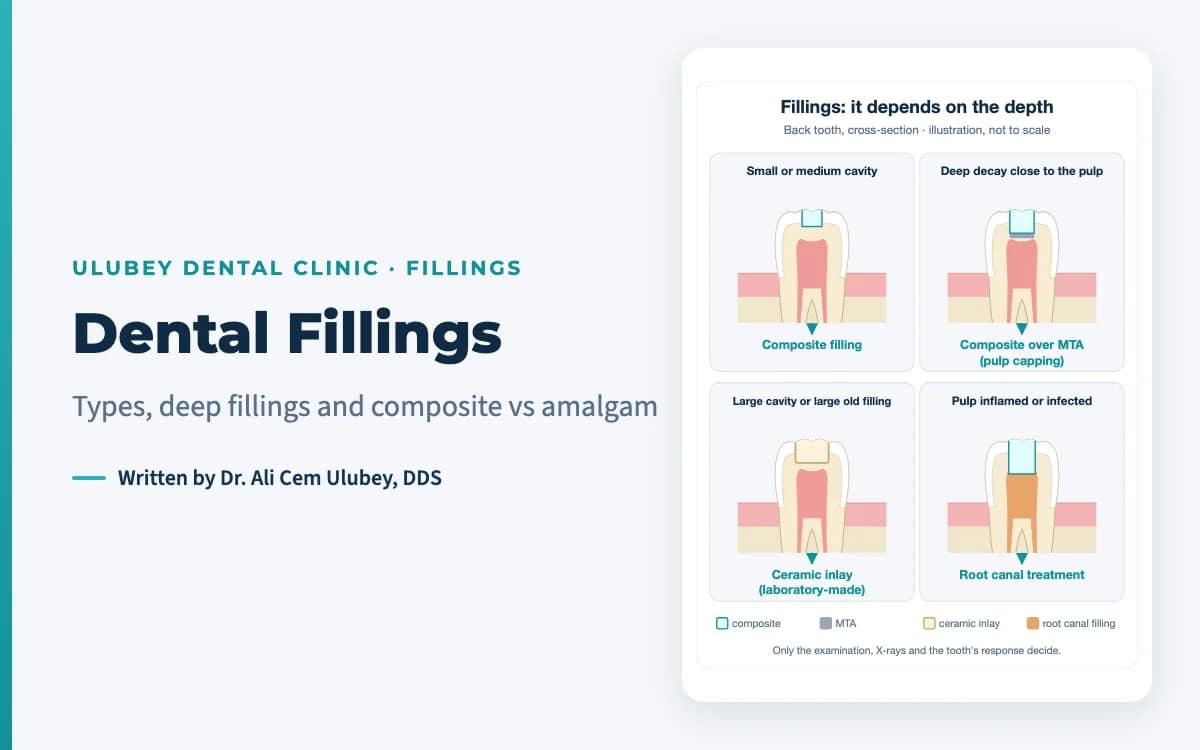
Filling types and prices are explained in dental fillings; the cleaning visit is described on professional teeth cleaning in Antalya; all fees are on our dental treatment prices page. If you have dentures, implants or bridges, see how to clean implants and bridges.
Frequently asked questions
Why do I have bad breath even though I brush my teeth?
Brushing the teeth does not clean the tongue, and a toothbrush does not reach the spaces between the teeth. In a study of 2,000 halitosis-clinic patients, a coated tongue was the most common cause, followed by gum disease. Clean your tongue once a day, clean between your teeth every day and have your gums checked if the odour persists for a few weeks.
Can bad breath come from the stomach?
Sometimes, but less often than people think. The NHS lists acid reflux among the medical causes, and in the Leuven series 4% of patients had an ear, nose and throat or other non-oral cause, while 76% had a cause in the mouth. A dentist should check the mouth first; if it is healthy, your doctor looks further.
Does tongue scraping work?
It is recommended by the NHS and it targets the most common source of bad breath, the coating on the tongue. The research is limited: a Cochrane review found only two small trials, with very uncertain evidence of a small benefit. Clean gently once a day, without making the tongue sore or bleed.
Which mouthwash is best for bad breath?
No single mouthwash has been shown to be the best. A Cochrane review of 44 trials found only low- to very low-certainty evidence for mouthwashes and other products, mostly over 1 to 4 weeks. An antibacterial mouthwash can help as an addition, used at a different time from brushing, but it does not replace cleaning or dental treatment.
How can I tell if I really have bad breath?
It is difficult to judge your own breath. In one halitosis clinic, 16% of the people who came had no bad breath that could be detected. A dental examination answers the question: the dentist checks the tongue, gums and teeth and tells you honestly what they find, and whether anything needs treatment.
Can gum disease cause bad breath?
Yes. The NHS lists bad breath and a bad taste in the mouth among the consequences of gum disease, and gingivitis or periodontitis was found alone or with a coated tongue in 29% of patients in the Leuven study. Treating the gums with professional cleaning and better daily cleaning is then part of treating the breath.
Sources
- NHS. Bad breath (page last reviewed 5 June 2025; accessed 26 October 2026). www.nhs.uk/symptoms/bad-breath
- Quirynen M, Dadamio J, Van den Velde S, et al. Characteristics of 2000 patients who visited a halitosis clinic. J Clin Periodontol. 2009;36(11):970-975. PMID 19811581. pubmed.ncbi.nlm.nih.gov/19811581
- Kumbargere Nagraj S, Eachempati P, Uma E, et al. Interventions for managing halitosis. Cochrane Database Syst Rev. 2019;12:CD012213. PMID 31825092. pubmed.ncbi.nlm.nih.gov/31825092
- NHS. Gum disease (page last reviewed 20 April 2026; accessed 26 October 2026). www.nhs.uk/conditions/gum-disease
- NHS. How to keep your teeth clean (page last reviewed 30 June 2025; accessed 26 October 2026). www.nhs.uk/live-well/healthy-teeth-and-gums/how-to-keep-your-teeth-clean
- Worthington HV, MacDonald L, Poklepovic Pericic T, et al. Home use of interdental cleaning devices, in addition to toothbrushing, for preventing and controlling periodontal diseases and dental caries. Cochrane Database Syst Rev. 2019;4:CD012018. PMID 30968949. pubmed.ncbi.nlm.nih.gov/30968949
This article is general patient information and does not replace a clinical examination or X-rays.
Editor contact: [email protected] · ulubeydental.com/contact-us