
How to Clean Dental Implants and Bridges at Home
Clean implants, bridges and All-on-4 or All-on-6 bridges every day with three tools: a toothbrush with fluoride toothpaste twice a day[5], a water flosser to rinse under the bridge and around each implant, and interdental brushes where they fit (floss where they do not). Plaque is the cause of inflammation around implants, which can progress to bone loss (peri-implantitis)[1]. At Ulubey Dental Clinic in Antalya we show each patient these tools hands-on, on their own restoration, before they fly home.
- 1. Why cleaning implants and bridges matters
- 2. The tools you need
- 3. A daily routine that works
- 4. Cleaning by type of restoration
- 5. Water flosser: what the evidence says
- 6. Warning signs to watch for
- 7. Check-ups and professional cleaning
- 8. How we teach home care at our clinic
- 9. Frequently asked questions
- 10. Sources
Why cleaning implants and bridges matters
An implant cannot decay, but the gum and bone around it can become inflamed. The 2017 World Workshop consensus describes strong evidence that plaque is the cause of peri-implant mucositis, an inflammation of the soft tissue around the implant, and defines peri-implantitis as a plaque-associated condition with inflammation and progressive loss of the supporting bone[1].
Bridges on natural teeth have a different weak point. In a pooled analysis, the most frequent complications of tooth-supported bridges were biological, such as decay of the supporting teeth and loss of pulp vitality[6]. Food and plaque collect under the pontic (the false tooth), where a toothbrush does not reach.
In both cases, daily home care and regular check-ups are what protect the investment. Our guarantees are conditional on attending recommended check-ups for the same reason; see the written dental guarantee.
The tools you need
We recommend a combination fitted to each patient, and we show it in the clinic on your own teeth. The basis is always the same:
| Tool | What it cleans | How we recommend it |
|---|---|---|
| Toothbrush and fluoride toothpaste | All outer, inner and chewing surfaces; the NHS says an electric or manual brush is equally good if you clean every surface[5] | Twice a day for about 2 minutes, including along the gum line of each implant crown |
| Water flosser (oral irrigator) | Under the pontic of a bridge, under a full-arch bridge and around each implant | For every implant and bridge patient, as part of the daily routine |
| Interdental brushes | Between teeth and implants where the gap allows; the NHS says the brush should fit snugly[5] | Where they fit; we choose the size with you |
| Floss | Between tight contacts where a brush does not fit | Where interdental brushes do not fit |

A daily routine that works
Evening: water flosser
Rinse along the gum line of each implant, between the teeth and under every pontic or full-arch bridge.Evening: interdental brushes or floss
Clean every gap where a brush fits; use floss in the tight contacts.Brush last thing at night
Brush for about 2 minutes with fluoride toothpaste; night-time brushing is important[5].Spit, don’t rinse
Spit out the excess toothpaste and do not rinse straight away, so the fluoride keeps working[5].Morning: brush again
Brush on one other occasion during the day[5]. If you use a fluoride mouthwash, use it at a different time, not straight after brushing[5].
Avoid wooden toothpicks for trapped food; the NHS warns they can damage the gums[5]. If you grind your teeth, wear the night guard we provide every night: our crown and bridge guarantees exclude fracture due to bruxism.
Cleaning by type of restoration
| Restoration | Where plaque collects | What to focus on |
|---|---|---|
| Single implant crown | At the gum line around the crown and in the gaps next to it | Brush along the gum line; interdental brush or floss on both sides; water flosser around the crown |
| Tooth-supported bridge | Under the pontic and at the edges of the crowns on the supporting teeth | Water flosser under the pontic every day; interdental brushes at the supporting teeth |
| Implant-supported bridge | Under the bridge and around each implant | Water flosser along the whole underside; interdental brushes beside each implant where they fit |
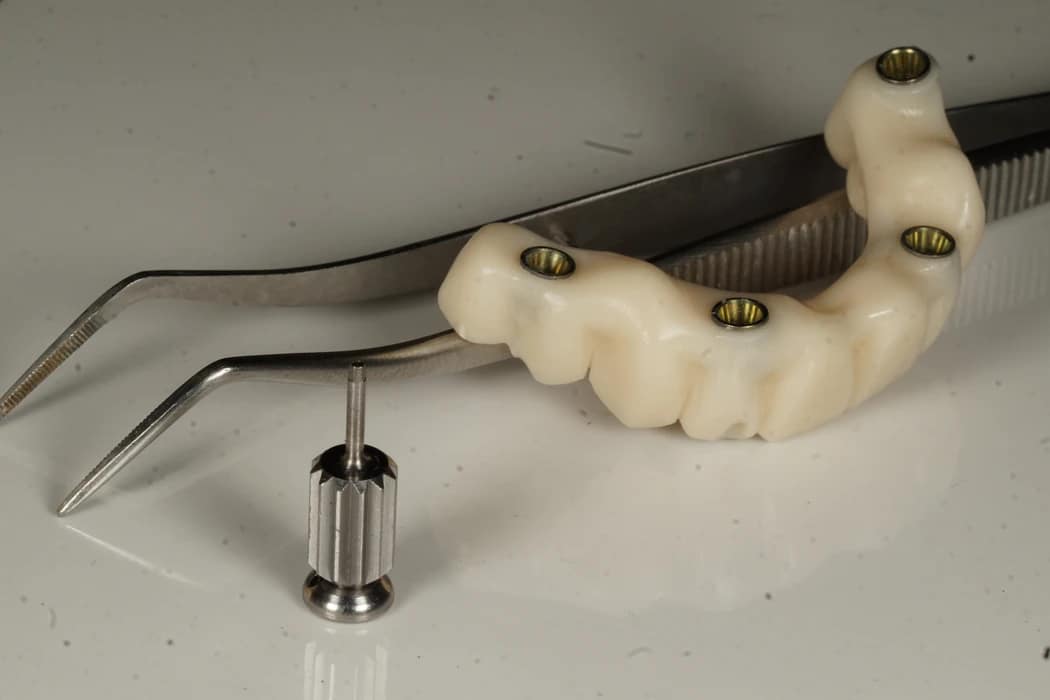
| All-on-4 or All-on-6 full-arch bridge | Under the whole bridge, where it meets the gum, and around the implants | Water flosser along the full underside every day; interdental brushes where the gap allows; brush the outer and inner surfaces |
A full-arch bridge is fixed and cannot be taken out at home, so the water flosser does most of the work underneath it. At your check-ups we look at the areas you find hard to reach and adjust your routine. See All-on-4 dental implants and All-on-6 dental implants for how these bridges are made.
Water flosser: what the evidence says
We recommend a water flosser to every implant and bridge patient because it reaches under bridges where string floss is awkward. The evidence is encouraging but limited. In a 30-day randomised trial in patients with implants, 18 of 22 implants (81.8%) in the water-flosser group showed reduced bleeding on probing, compared with 6 of 18 (33.3%) in the string-floss group; the trial was small, and one of its authors worked for a water-flosser manufacturer[3].

For natural teeth, a Cochrane review of 35 trials found that floss or interdental brushes, used in addition to toothbrushing, may reduce gum inflammation, that interdental brushes may be more effective than floss, and that evidence for oral irrigators was limited and inconsistent; overall certainty was low to very low[4]. That is why we combine tools instead of relying on one.
It rinses plaque and food from areas a brush cannot reach. Brushing with fluoride toothpaste twice a day and interdental brushes where they fit remain part of the routine.
Warning signs to watch for
Contact us, or your local dentist, if you notice any of these around an implant or bridge:
- bleeding when you brush or use the water flosser, which is the main sign of inflammation around implants[1];
- red or swollen gum, or pus around an implant[1];
- a bad taste or smell that does not go away with cleaning;
- a crown or bridge that feels loose or a change in your bite.
Send a photo and a short description on WhatsApp; we reply usually within 4 hours.
This page is general information and does not replace an examination.
Check-ups and professional cleaning
The European Federation of Periodontology guideline recommends that, once implants are in function, a supportive peri-implant care programme is structured, including periodical assessment of the tissues around the implants[2]. The 2017 consensus also recommends baseline X-ray and probing measurements once the implant restoration is completed[1].
- Our follow-up: we send WhatsApp check-ins 30, 90 and 365 days after treatment.
- Yearly check-up: at our clinic in Antalya (no fee), or with any licensed dentist where you live. For a home check-up, send a panoramic X-ray, 5 standard photos and the dentist’s note; Dr. Ali Cem Ulubey or Dr. Surur Ulubey reviews them within 7 days and confirms in writing.
- Professional cleaning: at our clinic this can include Guided Biofilm Therapy (Airflow) where suitable; see professional teeth cleaning.
Smoking, uncontrolled diabetes and gum health affect how implants do over time; a fixture guarantee does not mean every implant integrates. If something changes in your health, tell us at your check-up.
How we teach home care at our clinic
Before you leave Antalya, Dr. Ali Cem Ulubey or Dr. Surur Ulubey shows you, on your own implants or bridge, how to use the water flosser, which interdental brush sizes fit and where floss is needed. We would rather take the time for this at the chair than see avoidable inflammation at your first check-up.
If you had implants placed elsewhere and want them checked or restored, see restoring implants placed abroad. For implant warning signs and failure, see dental implant failure.
Frequently asked questions
How do I clean under an All-on-4 bridge?
A full-arch bridge is fixed, so you clean it in place. Use a water flosser along the whole underside every day, interdental brushes where the gap beside an implant allows, and a toothbrush with fluoride toothpaste on the outer and inner surfaces twice a day. We show you the angles on your own bridge before you fly home and check problem areas at your check-ups.
Is a water flosser better than floss for implants?
In one small 30-day trial, more implants showed less bleeding with a water flosser (81.8%) than with string floss (33.3%), but one author worked for a manufacturer and larger evidence on irrigators is limited. We recommend a water flosser for every implant and bridge patient, plus interdental brushes where they fit and floss where they do not.
Can implants get cavities?
No. An implant and its crown are not tooth tissue, so they cannot decay. The risk is inflammation of the gum and bone around the implant: plaque causes peri-implant mucositis, which can progress to peri-implantitis with bone loss. Natural teeth that support a bridge can still decay, especially under and at the edges of the bridge.
How often should implants be checked?
Guidelines recommend a structured supportive care programme once implants are in function, with periodic checks of the tissues around them. We ask for a yearly check-up, either at our clinic in Antalya with no fee or with any licensed dentist where you live, who sends us a panoramic X-ray, 5 photos and a note.
Should I use mouthwash on implants?
A mouthwash does not replace brushing and cleaning between the teeth. If you use a fluoride mouthwash, the NHS advises using it at a different time from brushing, not straight afterwards, so it does not wash away the fluoride from the toothpaste. In the first weeks after implant surgery, follow the written aftercare instructions we give you.
My implant bleeds when I clean it. What should I do?
Do not stop cleaning, but contact us or your local dentist. Bleeding on gentle probing is the main sign of inflammation around an implant, and plaque is its cause, so cleaning and a check are both needed. Send a photo on WhatsApp; we usually reply within 4 hours and tell you whether you need a check-up.
Sources
- Berglundh T, Armitage G, Araujo MG, et al. Peri-implant diseases and conditions: consensus report of workgroup 4 of the 2017 World Workshop on the Classification of Periodontal and Peri-Implant Diseases and Conditions. J Periodontol. 2018;89 Suppl 1:S313-S318. pubmed.ncbi.nlm.nih.gov/29926955
- Herrera D, Berglundh T, Schwarz F, et al. Prevention and treatment of peri-implant diseases: the EFP S3 level clinical practice guideline. J Clin Periodontol. 2023;50 Suppl 26:4-76. pubmed.ncbi.nlm.nih.gov/37271498
- Magnuson B, Harsono M, Stark PC, Lyle D, Kugel G, Perry R. Comparison of the effect of two interdental cleaning devices around implants on the reduction of bleeding: a 30-day randomized clinical trial. Compend Contin Educ Dent. 2013;34 Spec No 8:2-7. pubmed.ncbi.nlm.nih.gov/24568169
- Worthington HV, MacDonald L, Poklepovic Pericic T, et al. Home use of interdental cleaning devices, in addition to toothbrushing, for preventing and controlling periodontal diseases and dental caries. Cochrane Database Syst Rev. 2019;4:CD012018. pubmed.ncbi.nlm.nih.gov/30968949
- NHS. How to keep your teeth clean (page last reviewed 30 June 2025; accessed 25 October 2026). www.nhs.uk/live-well/healthy-teeth-and-gums/how-to-keep-your-teeth-clean
- Pjetursson BE, Brägger U, Lang NP, Zwahlen M. Comparison of survival and complication rates of tooth-supported fixed dental prostheses (FDPs) and implant-supported FDPs and single crowns (SCs). Clin Oral Implants Res. 2007;18 Suppl 3:97-113. pubmed.ncbi.nlm.nih.gov/17594374
This article is general patient information and does not replace a clinical examination or X-rays.
Editor contact: [email protected] · ulubeydental.com/contact-us