
Dental Implant Aftercare: Day-by-Day Guide to the First 14 Days
This page is general information and does not replace an examination.
After dental implant surgery, most people have some pain and swelling that starts to improve after 1–2 days and can last up to 2 weeks[1]. At Ulubey Dental Clinic we ask implant patients to keep to soft, cold or lukewarm food for 1 week, not to smoke for at least 1 week, and to take the antibiotic and the pain relief exactly as prescribed. Stitches are checked and, where possible, removed on day 7–8. The implant then needs about 3 months to heal before the final crown, or about 6 months after bone grafting or an open sinus lift.
- 1. What is normal after implant surgery?
- 2. Dental implant aftercare day by day: day 0 to day 14
- 3. What to eat and drink after dental implant surgery
- 4. Brushing and rinsing after implant surgery
- 5. Pain relief and antibiotics: what we prescribe
- 6. Smoking and vaping after implant surgery
- 7. Exercise, work, driving and flying
- 8. Stitches: what we use and when they come out
- 9. Warning signs: when to contact us
- 10. After day 14: healing until the final crown
- 11. How we plan aftercare at Ulubey Dental Clinic
- 12. Frequently asked questions
- 13. Sources
What is normal after implant surgery?
Implant surgery is minor oral surgery, and the first two weeks follow the same pattern as other oral surgery. NHS guidance after wisdom tooth removal describes what is usual for up to 2 weeks: some pain and swelling that should start to improve after 1 or 2 days, possible bruising on the cheek, a sore and stiff jaw, and chewing or swallowing that feels uncomfortable[1]. A small amount of blood in your saliva on the first day is also common[2].
What matters is the direction. Discomfort that slowly gets better each day is expected. Pain or swelling that keeps getting worse instead of improving after the first 1–2 days, bleeding that does not stop with pressure, a bad taste with a high temperature, or feeling unwell is not, and needs a dentist[1].
| What you notice | Usually expected | Contact your dentist |
|---|---|---|
| Pain | Sore for a few days, improving after day 1–2[1] | Severe or getting worse, and painkillers are not helping[1] |
| Swelling and bruising | Swelling and possible cheek bruising, settling within 2 weeks[1] | Swelling that keeps increasing instead of starting to improve after 1–2 days, or comes with a high temperature[1] |
| Bleeding | A little blood in the saliva on day 0[2] | Bleeding that does not stop after 30 minutes of firm pressure on gauze[2][3] |
| Taste and temperature | Normal taste, no fever | Pain with a bad taste, a high temperature or feeling unwell[1] |
| Stitches and gum | Stitches in place, gum slowly closing | A stitch that has come loose early, or the wound opening up |
Sources: NHS [1], Guy’s and St Thomas’ NHS Foundation Trust [2], SDCEP [3]. You may cite this table with a link to this page.
Dental implant aftercare day by day: day 0 to day 14
This plan is how we guide our own implant patients. Your instructions on the day may differ if you also had extractions, a bone graft or a sinus lift; then follow those, because the dentist adjusts them to what was done.

| When | Eating | Cleaning | Activity and smoking | Check |
|---|---|---|---|---|
| Day 0 (surgery day) | Soft, cold or lukewarm food once the numbness has worn off | No rinsing for the rest of the day[2]; brush other teeth gently | Rest; no exercise or heavy lifting[2]; no smoking, no alcohol[1] | Bite on gauze for 30 minutes if it bleeds[2] |
| Days 1–3 | Soft, cold or lukewarm food | Gentle salt-water rinses start; brush around the area with care[1][3] | No smoking; take the antibiotic and pain relief as prescribed | Swelling and stiffness are usual and should start to improve after 1–2 days[1] |
| Days 4–6 | Soft, cold or lukewarm food | Continue gentle rinses and careful brushing | No smoking; light normal activity | Discomfort should be clearly less each day |
| Day 7–8 | The soft-diet week ends; return to normal food step by step, as the dentist advises | If advised, a chlorhexidine mouthwash for a few days from 1 week after surgery | The minimum no-smoking week is complete; longer is better | Stitch check and, where possible, removal |
| Days 9–14 | Normal food, still avoiding very hard or crunchy food on the implant area | Normal brushing; clean the area as shown in the clinic | Normal activity | Any remaining swelling or bruising should be fading[1] |
Clinic protocol of Ulubey Dental Clinic; general recovery points from NHS [1], Guy’s and St Thomas’ [2] and SDCEP [3].
Day 0: the surgery day
- Gauze: if the area bleeds, roll up the gauze, place it over the wound and bite on it for 30 minutes; the bleeding should stop[2].
- Rest: rest while the local anaesthetic wears off and the blood clot forms, which usually takes 2–3 hours[3]. Try to relax for the rest of the day[2].
- No rinsing for the rest of the day, and no exercise or heavy lifting[2].
- Do not touch the wound with your fingers or tongue[2], and do not pull your lip or cheek to look at it.
- Food: wait until the numbness has gone, so you do not bite your lip or cheek. Then soft, cold or lukewarm food; examples are soup that has cooled down, smoothies, mashed potato or yoghurt[2].
- Medicines: start the antibiotic and the pain relief as written on your prescription.
Days 1–3: swelling, then the first improvement
Swelling and stiffness are usual in the first days and should start to improve after 1 or 2 days[1]. From the day after surgery, start gentle salt-water rinses: SDCEP’s post-treatment advice is a teaspoon of salt in a glass of warm water, 3 or 4 times a day for 5 days[3]. Rinse gently, and avoid sucking hard or anything else that disturbs the clot[3]. Keep cleaning your other teeth carefully and avoid brushing directly on the stitches[1].
Days 4–6: steady improvement
Most people feel clearly better by now. Keep the soft, cold or lukewarm diet and the no-smoking rule until the end of the first week. If pain is increasing instead of decreasing, or a bad taste appears, send us a message; do not wait for the stitch appointment.
Day 7–8: stitch check
For patients who are still in Antalya, we check the wound and, where possible, remove the stitches on day 7–8. Read more in the section on stitches below.
Days 9–14: back to normal life
The gum over or around the implant continues to mature. You can return to a normal diet step by step, but the implant is not yet carrying a final crown, so very hard or crunchy food directly on that area is still best avoided until the dentist says otherwise.
What to eat and drink after dental implant surgery
For 1 week after implant surgery we ask patients to eat soft food and to keep food and drinks cold or lukewarm. Hard food can press on the healing wound, and NHS guidance advises avoiding very hot drinks after oral surgery to reduce the risk of bleeding or scalding[1].
- Good choices: yoghurt, cooled soup, smoothies, mashed potato[2], scrambled eggs, soft pasta, rice, soft fish, hummus, ripe banana.
- Avoid: hard or crunchy food and food that can get stuck in the wound, such as nuts or seeds[1]; very hot drinks[1]; spicy food that stings.
- Alcohol: avoid it, to reduce the risk of bleeding[1]. It also does not mix well with some medicines.
- Straws and suction: avoid sucking hard, which can disturb the clot[3].
- Chewing side: chew on the other side where possible until the dentist tells you the area can take normal chewing[3].
If you wear a removable denture or a temporary over the implant area, the dentist tells you on the day whether and when you may wear it over the implant area.
Brushing and rinsing after implant surgery
Keeping the area clean matters. Plaque around an implant can, over time, lead to peri-implant disease, and a 2017 World Workshop review found strong evidence that poor plaque control and no regular maintenance care after implant therapy increase the risk of peri-implantitis[7].
The first week
- Day 0: no rinsing[2]. You may brush the other teeth gently.
- From day 1: clean your other teeth carefully and avoid the stitches and the clot[1]. Rinse gently with salt water[3]; we usually recommend salt-water rinses, or vinegar-water rinses, if you have no specific reason not to use them.
- Chlorhexidine: if the dentist recommends a chlorhexidine mouthwash, we use it only for a few days, starting 1 week after surgery, not straight away.
After healing: your long-term routine
Once the implant has healed and carries its crown, we recommend a combination fitted to your mouth: a water flosser (always), interdental brushes where they fit and floss where they do not, plus your toothbrush. We show this visually and hands-on in the clinic, on your own implants. Regular check-ups matter as much as home care[7].
Pain relief and antibiotics: what we prescribe
Your prescription is written for you by the dentist after reviewing your medical history and the medicines you already take. The clinic writes the prescription and you buy the medicines at a pharmacy; there is one right next door to our clinic. Take them exactly as written on your prescription and the package leaflet. Do not change the dose or stop early without asking us.
Pain relief
For most patients we prescribe an anti-inflammatory painkiller. The one we usually use is diclofenac potassium. When stronger pain is expected, we may use naproxen sodium instead, and sometimes dexketoprofen. Which one, and how often, is decided for each patient. Tell us before surgery about stomach problems, kidney disease, asthma, pregnancy, other painkillers you take, and any blood thinner.
Antibiotics
Every adult implant patient at our clinic receives an antibiotic after surgery: amoxicillin with clavulanic acid. A 2026 Cochrane review of 15 randomised trials found that antibiotic prophylaxis at implant placement probably reduces implant failures, from about 80 to 27 per 1,000 patients (moderate-certainty evidence)[4]. The trials in that review mostly tested a single dose of amoxicillin taken before surgery, and the review found the evidence insufficient to say which regimen is best; the post-operative course we prescribe is our clinic protocol, decided by the dentist. Patients who need antibiotic cover before procedures for a medical reason, for example the highest-risk heart conditions listed by the American Heart Association[9], receive a preventive antibiotic before surgery. If you are allergic to penicillin, tell us; the dentist then chooses a suitable alternative.
Do not stop or change an anticoagulant or antiplatelet medicine on your own. Before surgery we consult the physician who prescribed it and act after their approval; they decide whether anything needs adjusting. For pain relief after treatment, SDCEP advises patients on anticoagulant or antiplatelet medicines to use paracetamol as directed on the pack if they can take it, to avoid NSAIDs such as aspirin, ibuprofen or diclofenac or medicines containing them, and to ask the dentist for advice if paracetamol is not possible or not enough[3]. Our usual painkillers are anti-inflammatories, so tell us about your blood thinner before surgery; the dentist chooses your pain relief with this in mind.
Smoking and vaping after implant surgery
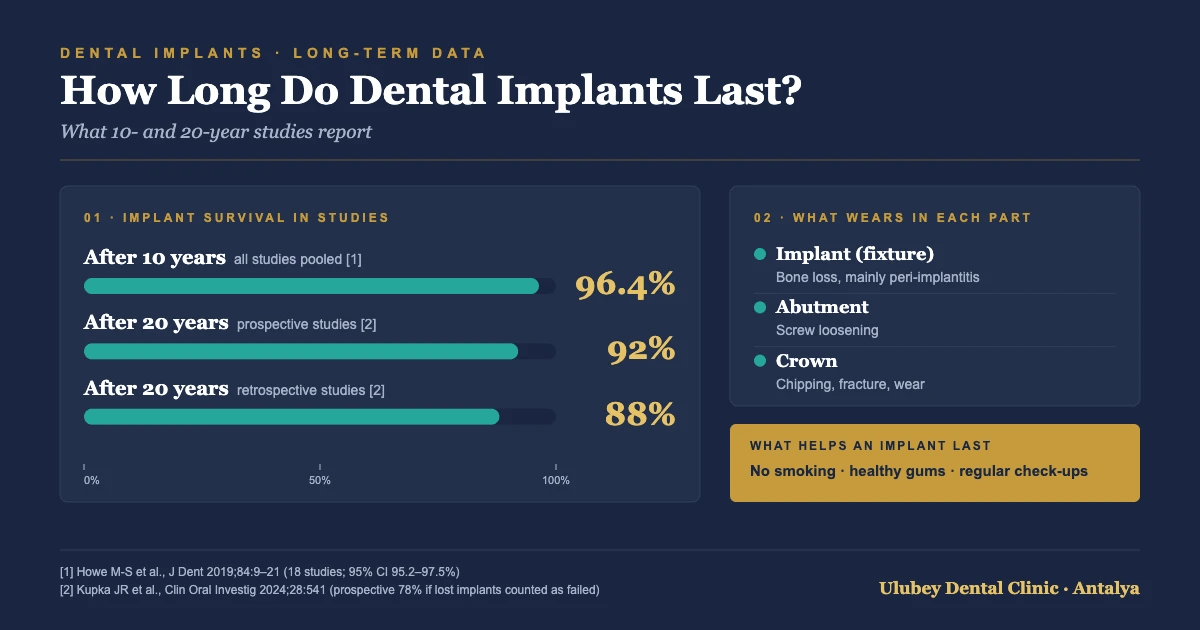
Smoking is one of the clearest risks for implants. A meta-analysis of 107 studies found implant failure in 6.35% of implants in smokers versus 3.18% in non-smokers; smokers also had more postoperative infections and more bone loss around the implant[5]. A 2026 systematic review of 44 studies confirmed lower implant survival and 0.64 mm more bone loss in cigarette smokers, and found too little data on smoke-free products to judge their risk[8].
- Before surgery: stop as early as possible, ideally at least 4 weeks before. In general surgery, stopping at least 3–4 weeks before an operation reduced wound-healing complications[6]. If you cannot stop, cut down as much as possible; we ask for no more than 6–8 cigarettes a day. This is a fallback, not a safe level.
- After surgery: no smoking for at least 1 week, until the wound has closed. Smoking reduces the blood supply to the healing tissue, and the suction of drawing on a cigarette can disturb the clot. For implants and bone grafts, staying smoke-free for longer is better.
Smoking is not an absolute bar to implants, but it raises the risk. The full picture of who is a good candidate is in our guide to who can get dental implants.
Exercise, work, driving and flying
- Exercise: no exercise or heavy lifting on the surgery day[2]. Return to light activity over the following days; leave hard training until swelling has settled.
- Work: after wisdom tooth removal, NHS guidance says people can usually return to normal activities the next day, and may need 1–3 days off after more difficult surgery[1]. Implant surgery is similar; the dentist tells you what applies after your procedure.
- Flying: after a single implant, flying is usually possible after 24–48 hours. After a closed sinus lift we advise 3–5 days, after an open (lateral) sinus lift 5–7 days, and after a complex surgical extraction or a graft 48 hours. Details are in our guide to flying after dental implants. On request we give you a signed fit-to-fly letter in English.
Stitches: what we use and when they come out
Where an implant needs stitches, we use fine 4-0 resorbable sutures, usually multifilament and monofilament in some cases. Although they are resorbable, we prefer to remove them when possible: for patients who are still in Antalya, the stitch check and removal is on day 7–8.
A first implant visit usually lasts 4–5 days, so many international patients fly home before day 7. Tell us your flight date before surgery. Resorbable stitches are designed to dissolve by themselves[1], and before you leave we tell you what to watch for and send a WhatsApp check-in. If a stitch feels sharp or loose at home, send us a photo; the dentist tells you whether anything needs doing.
Warning signs: when to contact us
Message us on WhatsApp, with a photo if you can, if you notice any of these:
- bleeding that does not stop after 30 minutes of firm pressure on gauze[2][3];
- pain and swelling that are severe or getting worse, and painkillers are not helping[1];
- pain with a bad taste in your mouth, a high temperature or feeling unwell[1];
- a rash or itching after starting a medicine: contact us or a doctor before the next dose; wheezing, trouble breathing, or swelling of the face, mouth or throat is an emergency (112 in Türkiye, 999 in the UK)[10];
- the wound opening up, or something that feels loose.
The clinic is open Monday to Saturday, 09:00–19:00, and patients in pain are seen the same day within opening hours. WhatsApp messages are answered 7 days a week, usually within 4 hours. Swelling that spreads towards the eye or neck, difficulty breathing or swallowing, or uncontrolled bleeding is a medical emergency: call 112 in Türkiye.
After day 14: healing until the final crown
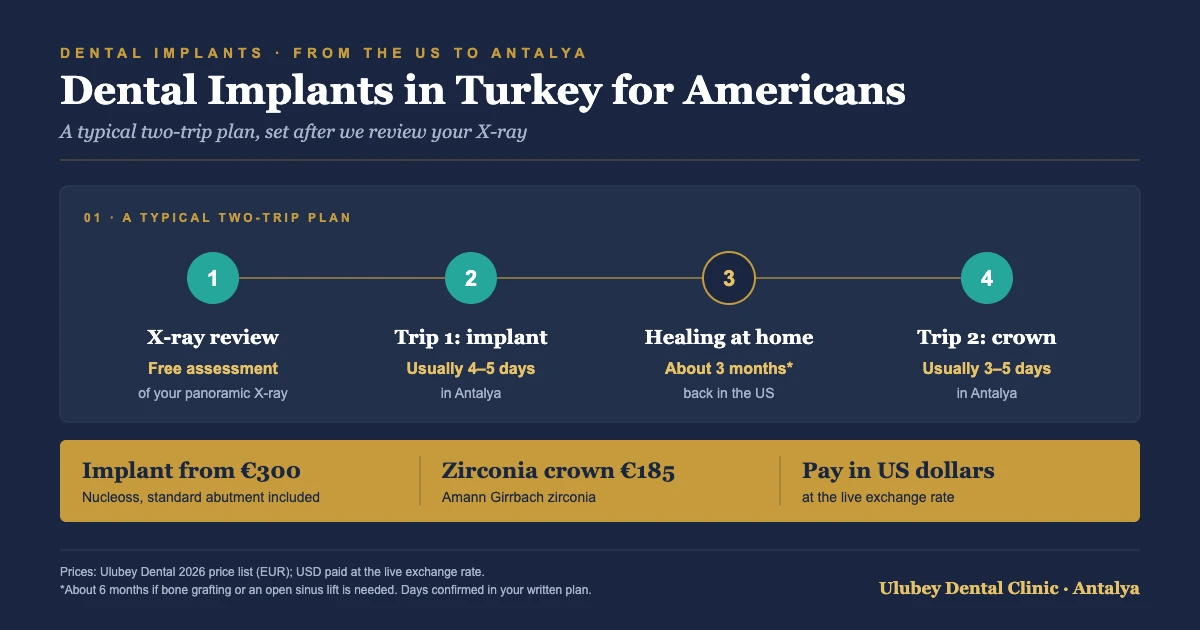
The first two weeks are about the wound. The next months are about the bone. An implant needs time to fuse with the jawbone, a process called osseointegration. At our clinic healing before the final crown takes about 3 months, planned individually, and about 6 months on average after bone grafting or an open sinus lift.

- Second visit: the crown visit usually takes 3–5 days. See how long to stay in Antalya for dental implants.
- Check-ins: we send WhatsApp check-ins 30, 90 and 365 days after treatment.
- Implant passport: you receive the manufacturer’s implant passport with the original label of each implant (brand, diameter, length, LOT and REF), so any dentist can identify it later.
- Yearly check-up: the manufacturer’s lifetime guarantee on the implant fixture is conditional on attending recommended check-ups. You can come to our clinic once a year (no fee for the check-up) or see any licensed dentist at home and send us an X-ray, 5 photos and your dentist’s note; Dr. Ali Cem Ulubey or Dr. Surur Ulubey reviews them in writing within 7 days. A fixture guarantee does not mean that every implant integrates: smoking, uncontrolled diabetes and gum health affect the result. See our written dental guarantee.
Our page on dental implant failure explains the signs and what happens next.
How we plan aftercare at Ulubey Dental Clinic
Good aftercare starts before surgery. Both of our dentists, Dr. Ali Cem Ulubey and Dr. Surur Ulubey, work in the clinic themselves; there are no rotating dentists.
- Routine blood tests before every implant patient, even without known disease: complete blood count, biochemistry, HbA1c, fasting glucose, vitamin D and calcium. These tests have often revealed a high HbA1c the patient did not know about.
- Medical history and medicines reviewed in detail; for blood thinners we consult the prescribing physician first.
- Implant stability is measured during treatment.
- Aftercare instructions on the day, adjusted to what was done (implant only, graft, sinus lift or extraction).
- A direct line: WhatsApp to the clinic for questions and photos during healing, and after you fly home.
For the implant treatment itself, costs and brands, see dental implants in Antalya and the single implant cost calculator.
Frequently asked questions
How long does it take to recover from dental implant surgery?
Most of the discomfort is in the first days: pain and swelling usually start to improve after 1–2 days and can last up to 2 weeks. The dentist tells you when you can return to work. The implant itself needs about 3 months to heal before the final crown, or about 6 months after bone grafting or an open sinus lift.
What can I eat after dental implant surgery?
For 1 week we ask our patients to eat soft food that is cold or lukewarm, such as yoghurt, cooled soup, smoothies, mashed potato, scrambled eggs or soft pasta. Avoid hard and crunchy food, nuts and seeds, very hot drinks and alcohol. After the first week you can return to normal food step by step, avoiding very hard food on the implant area.
When can I smoke after a dental implant?
Not for at least 1 week after surgery, until the wound has closed, and longer is better for implants and bone grafts. Smoking roughly doubles the implant failure rate in large reviews. Ideally stop at least 4 weeks before surgery; if you cannot, cut down as much as possible. We ask for no more than 6–8 cigarettes a day, which is a fallback, not a safe level.
Do I need antibiotics after a dental implant?
At our clinic, every adult implant patient receives an antibiotic after surgery, amoxicillin with clavulanic acid, unless an allergy means the dentist chooses another one. A 2026 Cochrane review found that antibiotic prophylaxis at implant placement probably reduces early implant failures, mainly from trials of a single dose before surgery; the best regimen is not settled. Take it exactly as prescribed and finish the course unless the dentist tells you otherwise.
When are the stitches removed after implant surgery?
We use fine 4-0 resorbable stitches. Although they dissolve by themselves, we prefer to remove them when possible, so patients still in Antalya have a stitch check and removal on day 7–8. If you fly home earlier, tell us your flight date before surgery; we explain what to watch for and check in with you on WhatsApp.
Can I use mouthwash after a dental implant?
Not on the surgery day. From the next day, rinse gently with salt water; we usually recommend salt-water or vinegar-water rinses. If the dentist advises a chlorhexidine mouthwash, we use it only for a few days, starting 1 week after surgery. In the first days avoid sucking hard or anything else that disturbs the clot.
When can I fly after a dental implant?
After a single implant, flying is usually possible after 24–48 hours. After a closed sinus lift we advise 3–5 days, after an open sinus lift 5–7 days, and after a complex surgical extraction or a graft 48 hours. The dentist confirms the timing for your case, and we give a signed fit-to-fly letter in English on request.
Sources
- NHS. Wisdom tooth removal: recovering from wisdom tooth removal (page last reviewed 12 June 2024; accessed 25 October 2026). www.nhs.uk/tests-and-treatments/wisdom-tooth-removal
- Guy’s and St Thomas’ NHS Foundation Trust. After your tooth has been removed (patient leaflet 5494/VER1, last reviewed October 2024; accessed 25 October 2026). www.guysandstthomas.nhs.uk/media/13895/Dental%2B%E2%80%93%2Bafter%2Byour%2Btooth%2Bhas%2Bbeen%2Bremoved
- Scottish Dental Clinical Effectiveness Programme (SDCEP). Post-treatment advice for dental patients taking anticoagulant or antiplatelet medication (March 2022; accessed 25 October 2026). www.sdcep.org.uk/media/bocnpjel/sdcep-post-treatment-advice-for-dental-patients.pdf
- Esposito MA, Visconti RF, Grusovin MG, Greco K. Interventions for replacing missing teeth: antibiotic prophylaxis for dental implant placement without bone augmentation procedures. Cochrane Database Syst Rev. 2026;9:CD004152. pubmed.ncbi.nlm.nih.gov/42677885
- Chrcanovic BR, Albrektsson T, Wennerberg A. Smoking and dental implants: a systematic review and meta-analysis. J Dent. 2015;43(5):487-498. pubmed.ncbi.nlm.nih.gov/25778741
- Wong J, Lam DP, Abrishami A, Chan MT, Chung F. Short-term preoperative smoking cessation and postoperative complications: a systematic review and meta-analysis. Can J Anaesth. 2012;59(3):268-279. pubmed.ncbi.nlm.nih.gov/22187226
- Schwarz F, Derks J, Monje A, Wang HL. Peri-implantitis. J Periodontol. 2018;89 Suppl 1:S267-S290. pubmed.ncbi.nlm.nih.gov/29926957
- Calciolari E, Corbella S, Dourou M, Ercal P, Donos N. Tobacco smoking and smoke-free products as risk factors for dental implants: a systematic review. Clin Oral Implants Res. 2026;37(3):262-286. pubmed.ncbi.nlm.nih.gov/41776304
- Wilson WR, Gewitz M, Lockhart PB, et al. Prevention of viridans group streptococcal infective endocarditis: a scientific statement from the American Heart Association. Circulation. 2021;143(20):e963-e978. pubmed.ncbi.nlm.nih.gov/33853363
- NHS. Antibiotics: side effects (page last reviewed 11 November 2022; accessed 26 October 2026). www.nhs.uk/conditions/antibiotics/side-effects
This article is general patient information and does not replace a clinical examination.
Editor contact: [email protected] · ulubeydental.com/contact-us