How Long Do Dental Implants Last? What 10- and 20-Year Data Show
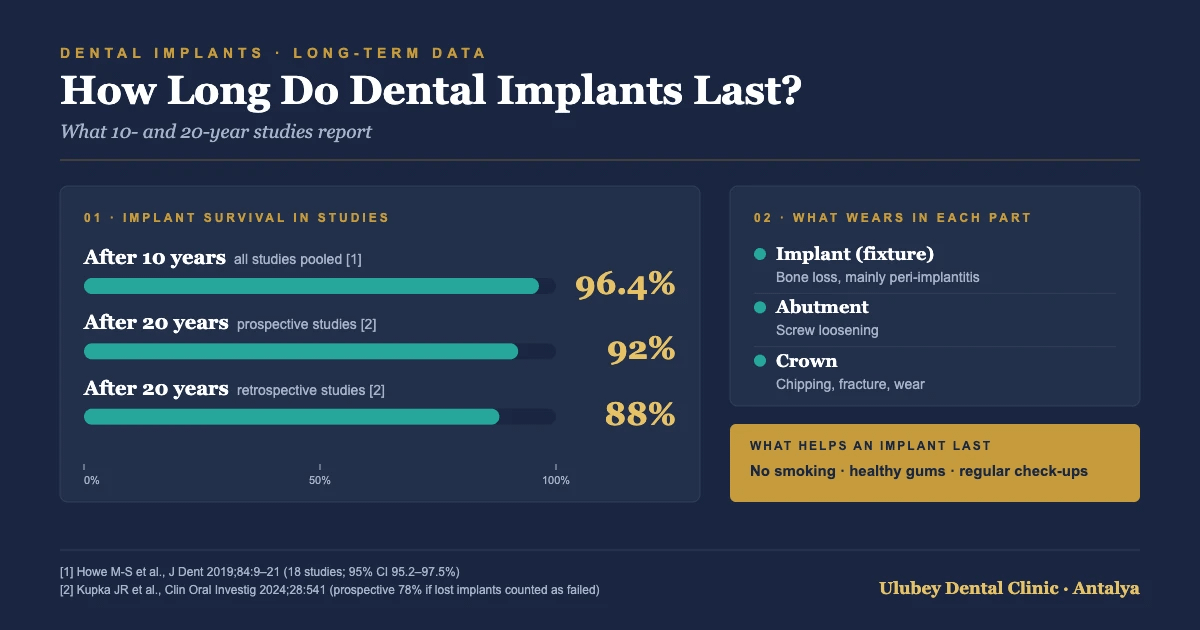
How long do dental implants last? Most last for decades. A 2019 systematic review in the Journal of Dentistry put 10-year implant survival at 96.4%, and a 2024 meta-analysis found 88–92% of implants still in place after 20 years in the reported data (78% once implants lost to follow-up were counted), which its authors sum up as about 4 out of 5. The crown usually needs attention sooner. At Ulubey Dental in Antalya, we focus on what can be influenced: gum health, smoking, check-ups and bite planning.
If you are weighing an implant against a bridge or a denture, the question behind “how long do dental implants last” is really “is it worth it”. This guide gives you the long-term numbers from systematic reviews, explains why the implant and the crown on top age differently, and lists what shortens or protects an implant’s life. The answers are the same ones we give patients in the chair in Antalya.
1. Implant, abutment and crown: three parts, three lifespans
A dental implant is not one object. It has three parts, and each one wears out in a different way:
- The implant (fixture) is the titanium screw that fuses with the jawbone. Once it has integrated, its main enemy is bone loss around it, mostly caused by inflammation (peri-implantitis).
- The abutment connects the implant to the crown. Its screw can loosen, and it can be tightened or replaced.
- The crown is the visible tooth. It takes the chewing load, so chipping, fracture and wear show up here first.
That is why “the implant lasted 20 years” and “the tooth needed no work for 20 years” are two different statements. If you want to know how the bone bonds to the implant in the first place, read how osseointegration works.
| Component | What wears or fails | Typical maintenance | Guarantee at Ulubey Dental* |
|---|---|---|---|
| Implant (fixture) | Bone loss around the implant, mainly from peri-implantitis | Check-ups with gum probing; X-rays when indicated; cleaning at the gum line | Manufacturer’s lifetime guarantee on the implant fixture |
| Abutment | Screw loosening | Screw and fit checked at check-ups; tightened or replaced if needed | — |
| Crown | Chipping, fracture, wear | Bite check and polishing; a night guard if you grind | Zirconia (Amann Girrbach): 10-year fracture guarantee. Other crown materials: 5-year clinic guarantee |
*All guarantees are conditional on attending the recommended check-ups. Crown guarantees cover the crown against fracture. No separate guarantee is published for the abutment. No guarantee can cover biology: smoking, uncontrolled diabetes and gum health affect every implant. Details in section 7.
2. How long dental implants last: the 10- and 20-year studies
Long-term evidence on how long dental implants last comes from systematic reviews that pool many long-term studies. Three of them answer most patient questions:
| Review | What was measured | Sample | Follow-up | Survival |
|---|---|---|---|---|
| Howe, Keys & Richards 2019, J Dent [1] | Implants | 18 studies | 10 years | 96.4% (95% CI 95.2–97.5%); 93.2% in the sensitivity analysis (90.1–95.8%) |
| Kupka et al. 2024, Clin Oral Investig [2] | Implants, prospective studies | 237 implants | 20 years | 92% (95% CI 82–97%); 78% after imputation (422 implants) |
| Kupka et al. 2024, Clin Oral Investig [2] | Implants, retrospective studies | 1,440 implants | 20 years | 88% (95% CI 78–94%) |
| Pjetursson et al. 2018, Clin Oral Implants Res [8] | Veneered zirconia-ceramic crowns on implants | 912 crowns | 5-year estimate | 97.6% (95% CI 94.3–99.0%) |
The 10-year picture
Howe and colleagues found 18 studies that met their criteria and estimated 10-year survival at 96.4%. They then ran a sensitivity analysis that accounts for patients lost to follow-up, which gave a more cautious 93.2%. Older age (65 and over) was a significant predictor in that analysis, at 91.5%. [1]
The 20-year picture
Kupka and colleagues pooled 20-year data on rough-surface titanium screw implants. Prospective studies showed 92% survival, falling to 78% when missing implants were imputed; retrospective studies showed 88%. The authors describe the result as “a remarkable 4 out of 5 implants success rate” and stress “the need for long-term follow-up care”. [2]
Survival is not the same as “no problems”
“Survival” only means the implant or crown is still in the mouth. It does not mean nothing ever needed fixing. In the 2018 crown review, 86.7% of metal-ceramic implant crowns and 83.8% of veneered zirconia-ceramic implant crowns (a small group of 76 crowns, 95% CI 61.6–93.8%) had no biological or technical complication over the whole observation period. Put simply, somewhere between one crown in eight and one in six had some complication during the study follow-up, with the zirconia figure resting on that small sample. Zirconia crowns had fewer aesthetic problems, but more of them failed through material fracture (2.1% vs 0.2%). [8]
Gum inflammation around implants is also common. Derks and Tomasi estimated a weighted mean prevalence of 43% for peri-implant mucositis (inflamed gum, reversible) and 22% for peri-implantitis (inflammation with bone loss). Peri-implantitis became more common the longer implants had been in function. [3] This is the strongest argument for regular check-ups, and it is why our guarantees depend on them.
3. What shortens an implant’s life
The 2017 World Workshop review on peri-implantitis is clear about where the strong evidence lies, and where it does not. [4]
Gum disease history, poor cleaning, missed check-ups
The review found “strong evidence” of a higher risk of peri-implantitis in patients with a history of chronic periodontitis, poor plaque control and no regular maintenance care after implant treatment. [4] These three are the factors you can influence most.
Smoking
A 2015 meta-analysis of 107 studies counted 6.35% failures among implants placed in smokers and 3.18% among non-smokers. Smokers also had more post-operative infections and more bone loss around implants. The authors add that the results should be read with caution because of uncontrolled confounding factors. [5]
Diabetes
Here the evidence is more mixed than many websites suggest. A 2014 systematic review found no significant difference in implant failure between diabetic and non-diabetic patients (risk ratio 1.07), but slightly more bone loss around implants in diabetic patients (mean difference 0.20 mm). [6] The 2017 World Workshop called the data on smoking and diabetes as risk factors for peri-implantitis “inconclusive”. [4] In practice, we want blood sugar well controlled before implant surgery and ask about it at the assessment.
Grinding and clenching (bruxism)
One meta-analysis counted 6.45% failures in implants placed in bruxers against 3.65% in non-bruxers. Its authors still concluded that the real effect of bruxism on implant survival “is still not well established”, because the studies were few and mostly lacked control groups. [7] Grinding puts heavy loads on crowns, so we recommend a night guard to patients who grind.
Implant position and crown design
The same review found limited evidence linking peri-implantitis to excess cement left under the gum, a lack of firm (keratinized) gum around the implant, and implant positions that make cleaning and maintenance difficult. [4] These are decisions made at the planning stage, before surgery.
Active gum disease, heavy smoking, poorly controlled diabetes, some medications and some medical conditions can change the plan or the timing. That is why every implant starts with an assessment of your X-ray and your medical history. We will tell you plainly if we think you should treat something else first, or if a bridge or denture would serve you better. Warning signs of a problem implant (bleeding or pus around the implant, a loose crown, pain on chewing) are covered in our guide to warning signs of a failing implant.
4. How to make your implant last
Most of what protects an implant happens at home and at your check-ups:
- Clean where the implant meets the gum. Brush twice a day and use interdental brushes or floss around the implant every day. Plaque at the gum line is what starts peri-implant inflammation.
- Keep your check-ups. Your dentist checks the gum, the bite and the screw, and takes X-rays when indicated. Lack of regular maintenance is one of the three risk factors with strong evidence behind it. [4] It is also the condition of every guarantee we give.
- Stop or cut down smoking, especially around surgery and healing. [5]
- Keep diabetes under control and tell your dentist about any change in your health or medication.
- Wear a night guard if you grind your teeth. It protects the crown and the natural teeth.
- Act early. Bleeding gums around an implant are a reason to book a check-up, not to wait. After treatment we check in with you on WhatsApp at 30, 90 and 365 days.
5. Does the implant brand matter?
The survival studies above pooled many implant systems and do not compare price tiers, so they cannot tell you that one brand lasts longer than another. What a brand does change is how easily a dentist can get compatible parts over the decades your implant should last. We work with eight implant systems, among them Straumann (BLT and BLX), Neodent, Medentika, Camlog, Nucleoss, Osstem, SIN and Nobel Biocare, and we name the system in your written quote. More on this in the implant brands we use.
6. How we plan for longevity at Ulubey Dental
Our clinic in Antalya is run by two dentists, Dr. Ali Cem Ulubey and Dr. Surur Ulubey. The same two doctors plan, treat and follow up your case, without rotating dentists. For implants, longevity is planned before surgery:
- Imaging: every patient has a panoramic X-ray on our Vatech unit. When 3D imaging is needed, a 3D CBCT scan for implant planning is evaluated by our dentists.
- Surgery: we measure implant stability and use computer-guided surgery when it is indicated.
- Healing: healing before the crown is usually about 3 months, planned individually; about 6 months on average when bone grafting or an open sinus lift is needed.
- Crown: impressions are digital (Dentsply Sirona Primescan). Zirconia crowns are made from Amann Girrbach blocks with our partner laboratory.
- Records: the implant system and materials are named in your written quote, so any dentist can identify them later.
We do not yet publish a clinic success percentage. Every implant placed since 2017 and every failure is recorded (implant passport with REF/LOT, X-ray follow-ups, failure file), and we will publish a counted figure once that count is complete. The review figures above are published pooled data, not our clinic’s results.
If you want to compare options first, see implants vs bridges, or read the full overview of dental implants in Antalya. At our clinic an implant starts at €300 (Nucleoss, standard abutment included) and a zirconia crown is €185; all brands are on the implant and crown price list.
7. Our guarantee, in plain words
- Implant fixture: the manufacturer’s lifetime guarantee on the implant fixture.
- Zirconia crowns: a 10-year fracture guarantee (all our zirconia is Amann Girrbach, made with our partner laboratory).
- Other crown materials: a 5-year clinic guarantee.
All guarantees are conditional on attending the recommended check-ups, because we cannot stand behind a process we do not see. Crown guarantees cover the crown against fracture. They do not cover biology: smoking, uncontrolled diabetes and gum health can affect any implant, and no clinic can honestly guarantee those. You will not find a blanket “10-year implant guarantee” here.
8. Frequently asked questions
Do dental implants last forever?
Not guaranteed. Long-term reviews show about 96% of implants still in place at 10 years and 88–92% at 20 years. Many implants are still in place after 20 years, but the bone and gum around an implant can still be lost to peri-implantitis, and the crown on top wears. Good cleaning, not smoking and regular check-ups give an implant the best chance of lasting decades.
How long does the crown on an implant last?
The crown usually needs attention sooner than the implant. A 2018 systematic review estimated 5-year survival of 97.6% for zirconia crowns on implants, with chipping and fracture as the main technical problems. We do not quote an average lifespan in years, because long-term data on today’s monolithic zirconia are still limited. Our Amann Girrbach zirconia crowns carry a 10-year fracture guarantee, conditional on check-ups.
Do implants last as long in older patients?
Age alone is not a reason to refuse implants, but the numbers are slightly lower. In the 2019 Journal of Dentistry review, the sensitivity analysis estimated 10-year survival of 91.5% for patients aged 65 and over. General health, medication, bone quality and the ability to clean around the implant matter more than age itself, so every patient is assessed individually.
Can smokers get implants that last?
Yes, many do, but the risk is higher. A 2015 meta-analysis of 107 studies found that 6.35% of implants in smokers failed, compared with 3.18% in non-smokers, and smokers had more infections and bone loss. The authors note possible confounding factors. If you smoke, stopping or cutting down before and after surgery is one of the most useful things you can do.
What happens if an implant fails after 10 years?
Late problems are usually linked to bone loss around the implant, often from peri-implantitis. Depending on the cause and the bone that remains, the implant can sometimes be treated. Otherwise it is removed, the site heals, with bone grafting if needed, and a new implant can be planned. Early signs include bleeding or pus around the implant, a loose crown and pain on chewing.
Does a cheaper implant brand last less long?
The survival studies quoted here pooled many implant systems and do not compare price tiers, so they cannot tell you whether one brand lasts longer than another. What a brand does change is how easily a dentist can find compatible parts for decades. We work with eight implant systems, including Straumann, Neodent, Medentika, Nucleoss, Osstem and Nobel Biocare, and we name the system in your written quote.
Send us your panoramic X-ray for an assessment. Dr. Ali Cem Ulubey or Dr. Surur Ulubey will look at your bone and gums and tell you honestly whether an implant is the right choice. Messages are usually answered within 4 hours; a written quote usually follows within 24 hours of receiving your X-ray or photos.
Sources
- Howe M-S, Keys W, Richards D. Long-term (10-year) dental implant survival: a systematic review and sensitivity meta-analysis. Journal of Dentistry. 2019;84:9–21. doi:10.1016/j.jdent.2019.03.008. PubMed 30904559 · University of Liverpool repository
- Kupka JR, König J, Al-Nawas B, Sagheb K, Schiegnitz E. How far can we go? A 20-year meta-analysis of dental implant survival rates. Clinical Oral Investigations. 2024;28:541. doi:10.1007/s00784-024-05929-3. PMC11416373
- Derks J, Tomasi C. Peri-implant health and disease. A systematic review of current epidemiology. Journal of Clinical Periodontology. 2015;42 Suppl 16:S158–S171. doi:10.1111/jcpe.12334. PubMed 25495683
- Schwarz F, Derks J, Monje A, Wang HL. Peri-implantitis. Journal of Clinical Periodontology. 2018;45 Suppl 20:S246–S266 (2017 World Workshop). doi:10.1111/jcpe.12954. PubMed 29926484
- Chrcanovic BR, Albrektsson T, Wennerberg A. Smoking and dental implants: a systematic review and meta-analysis. Journal of Dentistry. 2015;43(5):487–498. doi:10.1016/j.jdent.2015.03.003. PubMed 25778741
- Chrcanovic BR, Albrektsson T, Wennerberg A. Diabetes and oral implant failure: a systematic review. Journal of Dental Research. 2014;93(9):859–867. doi:10.1177/0022034514538820. PubMed 24928096
- Chrcanovic BR, Albrektsson T, Wennerberg A. Bruxism and dental implants: a meta-analysis. Implant Dentistry. 2015;24(5):505–516. doi:10.1097/ID.0000000000000298. PubMed 26218253
- Pjetursson BE, Valente NA, Strasding M, Zwahlen M, Liu S, Sailer I. A systematic review of the survival and complication rates of zirconia-ceramic and metal-ceramic single crowns. Clinical Oral Implants Research. 2018;29 Suppl 16:199–214. doi:10.1111/clr.13306. PubMed 30328190
Editor contact: [email protected] · ulubeydental.com/contact-us