Frenectomy: Lip-Tie and Tongue-Tie Release Explained
A frenectomy is a small operation that removes or releases a frenum, the fold of tissue that attaches the lip or the tongue to the gum or the floor of the mouth. It is needed only when the frenum causes a problem; a tongue-tie that causes no problems usually needs no treatment[1]. At Ulubey Dental Clinic in Antalya we perform frenectomy with a scalpel, mainly for orthodontic reasons and for the soft tissue around implants, for €150.
What is a frenectomy?
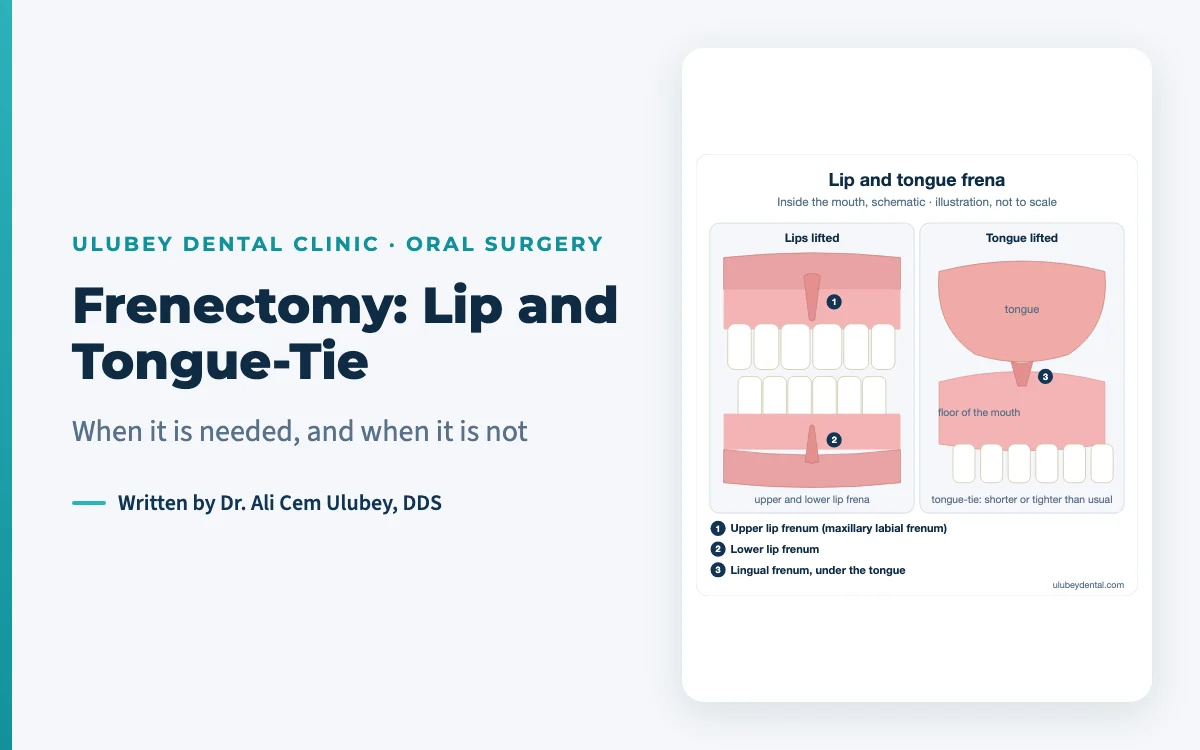
A frenum (or frenulum) is a small fold of soft tissue. Everyone has several: one under the tongue (the lingual frenum), one inside the upper lip (the maxillary labial frenum) and one inside the lower lip. A frenectomy removes or repositions a frenum that is too short, too tight or attached too close to the gum.
The term frenotomy is often used for simply cutting (releasing) a tight frenum, mostly in babies, while frenectomy usually means removing or reshaping it. In both cases the aim is to release movement or to stop the tissue from pulling on the gum.
Lip-tie and tongue-tie
| Where it is | Problems it can cause | What usually happens | |
|---|---|---|---|
| Tongue-tie (ankyloglossia) | Under the tongue; the tissue is shorter or tighter than usual[1] | Difficulty moving the tongue side to side, lifting it or sticking it out; feeding problems in babies[1] | No treatment if it causes no problems; a small operation if it does[1] |
| Upper lip-tie (maxillary labial frenum) | Inside the upper lip, attaching to the gum between the front teeth | May be involved in a gap between the upper front teeth (midline diastema)[3] | Often assessed with orthodontic treatment; orthodontists tend to suggest removal after the gap is closed[3] |
| Lower lip frenum | Inside the lower lip, attaching to the gum below the front teeth | A high attachment can pull on the gum margin | Assessed at the examination, for example before or around implants |

When is a frenectomy needed?
A frenum that looks tight is not, by itself, a reason for surgery. The evidence on lip-tie and tongue-tie is still developing: a 2020 expert consensus on ankyloglossia in children reached agreement on 41 of 89 statements, while many others did not reach consensus, reflecting knowledge gaps[2]. A systematic review of the upper lip frenum found that its role in gum recession is inconclusive and its role in problems around implants remains uncertain[3].
At our clinic, we perform frenectomy when it is needed for one of two reasons:
- Orthodontic reasons: a thick upper lip frenum may be involved in a gap between the front teeth[3]. When we close such a gap with fixed braces or Invisalign, the frenum is assessed as part of the plan.
- Soft tissue around implants: a frenum or attachment that pulls on the gum around an implant can make the area harder to keep clean. The 2017 World Workshop consensus notes that the evidence on firm (keratinised) gum around implants is equivocal, but that it may have advantages for comfort and ease of plaque removal[4].

For other concerns in older children and adults, we examine the frenum and explain honestly whether a frenectomy is likely to help, and you decide.
Babies with tongue-tie
Tongue-tie is most common in babies, and in babies it can make breastfeeding or bottle-feeding difficult[1]. The NHS advises speaking to a midwife, health visitor or GP if you think your baby has tongue-tie or is having difficulty feeding; treatment may include feeding advice from a trained health professional or a small operation[1].
We do not treat babies. Our clinic generally treats children from about 5–6 years of age, if the child cooperates, and treats adults.
The procedure at our clinic
Examination
We look at the frenum, how it moves and how it affects the teeth, gum or implants, and take a panoramic X-ray.Plan and consent
We explain what will be done, what the alternatives are and what to expect afterwards, and you decide.Frenectomy
The area is usually numbed with a local anaesthetic and the frenum is released or removed with a scalpel; the wound is usually closed with stitches[5].Aftercare
You receive written aftercare instructions, and we tell you whether and when any stitches need to be removed.
The procedure is done at our clinic by one of our two dentists; there are no visiting or rotating surgeons.
Aftercare and healing
- Pain relief: if needed, over-the-counter pain relief as directed on the package, if your physician or pharmacist has not told you otherwise.
- Smoking: do not smoke for at least 1 week, until the wound has closed.
- Cleaning: keep brushing the other teeth normally and clean gently near the wound, following your written instructions.
- Check: if anything worries you, send a photo on WhatsApp; we usually reply within 4 hours.
This page is general information and does not replace an examination.
Frenectomy cost in Antalya
A frenectomy at Ulubey Dental Clinic costs €150.
- Included: the frenectomy procedure (scalpel technique).
- No fee: the consultation and the panoramic X-ray.
- Not included: orthodontic treatment or implant treatment it is part of, which are quoted separately.
Prices are indicative; your final written quote follows the examination and X-rays and is valid for 30 days. Unless the treatment plan changes, the written price does not change.
All fees are listed on our dental treatment prices page. See also general dentistry in Antalya; for implant planning, see dental implants in Antalya.
Frequently asked questions
Do I need a frenectomy for a lip-tie?
Not necessarily. A frenum that looks tight is not a reason for surgery by itself. A frenectomy makes sense when the frenum causes a problem, for example when it is involved in a gap between the front teeth that is being closed with braces, or when it pulls on the gum around an implant. We examine it and explain honestly whether treatment is likely to help.
Do you treat tongue-tie in babies?
No. If your baby has difficulty feeding, the NHS advises speaking to a midwife, health visitor or GP first; treatment may include feeding advice from a trained professional or a small operation. Our clinic generally treats children from about 5–6 years of age, if the child cooperates, and adults.
How is a frenectomy done at your clinic?
The area is usually numbed with a local anaesthetic and the frenum is released or removed with a scalpel; the wound is usually closed with stitches. One of our two dentists performs it at our clinic. You receive written aftercare instructions, and we tell you whether and when any stitches need to be removed.
How much does a frenectomy cost in Antalya?
A frenectomy at Ulubey Dental Clinic costs €150. The consultation and the panoramic X-ray carry no fee. Orthodontic or implant treatment that the frenectomy is part of is quoted separately. Your written quote follows the examination and is valid for 30 days; unless the plan changes, the price does not change.
Can a frenectomy close the gap between my front teeth?
On its own, usually not. A thick upper lip frenum may be involved in a gap between the upper front teeth, and orthodontists tend to suggest removing it after the gap has been closed. The gap itself is closed with orthodontic treatment, which we offer with fixed braces or Invisalign. We assess both at the examination.
Why would I need a frenectomy around an implant?
A frenum or attachment that pulls on the gum around an implant can make the area harder to keep clean. The 2017 World Workshop consensus notes that a band of firm gum around implants may help comfort and ease of plaque removal, although the evidence on long-term health is equivocal. We decide case by case at the examination.
Sources
- NHS. Tongue-tie (page last reviewed 20 March 2024; accessed 25 October 2026). www.nhs.uk/conditions/tongue-tie
- Messner AH, Walsh J, Rosenfeld RM, et al. Clinical consensus statement: ankyloglossia in children. Otolaryngol Head Neck Surg. 2020;162(5):597-611. pubmed.ncbi.nlm.nih.gov/32283998
- Delli K, Livas C, Sculean A, Katsaros C, Bornstein MM. Facts and myths regarding the maxillary midline frenum and its treatment: a systematic review of the literature. Quintessence Int. 2013;44(2):177-187. pubmed.ncbi.nlm.nih.gov/23444184
- Berglundh T, Armitage G, Araujo MG, et al. Peri-implant diseases and conditions: consensus report of workgroup 4 of the 2017 World Workshop. J Periodontol. 2018;89 Suppl 1:S313-S318. pubmed.ncbi.nlm.nih.gov/29926955
- Devishree, Gujjari SK, Shubhashini PV. Frenectomy: a review with the reports of surgical techniques. J Clin Diagn Res. 2012;6(9):1587-1592. pubmed.ncbi.nlm.nih.gov/23285469
This article is general patient information and does not replace a clinical examination or X-rays.
Editor contact: [email protected] · ulubeydental.com/contact-us