Masseter Botulinum Toxin for Teeth Grinding and Jaw Pain: What the Evidence Shows
Masseter botulinum toxin treatment means injecting small doses of botulinum toxin type A into the masseter, the main chewing muscle at the angle of the jaw, and sometimes into the temporalis at the temple. It weakens these muscles for a few months, which can reduce the force of grinding and clenching and the muscle pain linked to it[6][7]. It does not cure bruxism: in a sleep study it reduced the strength of grinding episodes, not how often they happened[8]. The evidence is still limited in quality[14], use for bruxism and jaw disorders is outside the licensed indications of the medicine[4][5], and a night guard, jaw exercises and stress management come first[2][3].
- What masseter botulinum toxin treatment is
- When a dentist may consider it
- How it works
- What the research shows
- Options that come first
- Who should not have it
- What the procedure involves
- Doses used in studies
- When it starts working and how long it lasts
- Side effects and risks
- What it does not do
- If you are visiting from abroad
- Frequently asked questions
What masseter botulinum toxin treatment is
Botulinum toxin type A is a prescription-only medicine that relaxes the muscle it is injected into. Patients and search engines often call this treatment “masseter Botox”, after one brand of botulinum toxin type A; on this page we use the generic name, because several products contain botulinum toxin type A and their units are not interchangeable from one product to another[5].
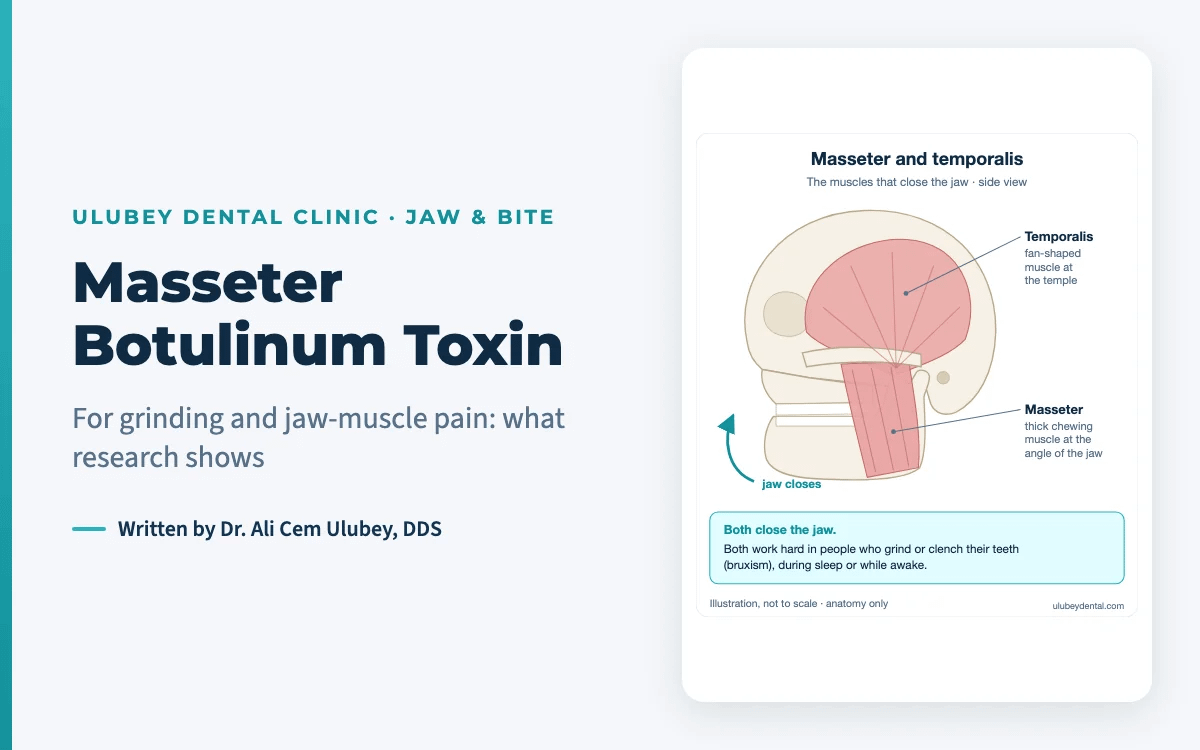
The masseter is the thick chewing muscle you can feel at the back of the jaw when you clench your teeth. The temporalis is the fan-shaped muscle at the temple. Both close the jaw, and both work hard in people who grind or clench. In dentistry, botulinum toxin is injected into these muscles to reduce their force for a limited time.

Bruxism itself is defined by international experts as repetitive jaw-muscle activity, either during sleep (sleep bruxism) or while awake (awake bruxism), such as clenching, grinding or bracing the jaw[1]. It is common and often linked to stress, anxiety, sleep problems, some medicines, smoking, alcohol and caffeine[2]. Treatment is not always needed[2].
When a dentist may consider it
We discuss botulinum toxin only as a therapeutic option, when an examination shows a dental or jaw-muscle problem that needs treatment. Typical situations described in the literature:
- Sleep or awake bruxism with symptoms: morning jaw stiffness, tired or painful chewing muscles, tension headaches at the temples, or wear and fractures of teeth and restorations[7][8].
- Jaw-muscle pain as part of a temporomandibular disorder (TMD), when conservative care has not helped enough. The evidence here is mixed (see below)[4][10][11].
- Enlarged, overworked chewing muscles with pain or functional complaints in a person who clenches. The aim is to relieve symptoms and protect the teeth, not to change the shape of the face.
- People who cannot use a night guard, or who need faster short-term relief: a 2023 meta-analysis described botulinum toxin as an option especially for bruxers who have difficulty wearing oral splints or want earlier symptom relief[6].
Licensing, stated plainly: bruxism and TMD are not among the licensed indications listed in the UK product information for botulinum toxin type A[5], and the US National Institute of Dental and Craniofacial Research notes that it is FDA-approved for some conditions, such as migraine, but not for TMD[4]. Use for bruxism is therefore off-label. Prescribing outside the licence is a decision the prescriber takes on their own responsibility: UK regulator guidance says the prescriber should be satisfied that there is a sufficient evidence base, take responsibility for monitoring and follow-up, and give the patient sufficient information about the proposed treatment[15]. That is why you should hear the evidence and the risks before you agree.
How it works
Botulinum toxin blocks the release of the chemical signal from nerve to muscle at the injection site, so the muscle contracts less strongly. Local muscle weakness is the expected effect of the medicine[5]. In the jaw, this lowers the maximum biting force for several weeks[6].
What it does not do is switch off the cause of bruxism. In a polysomnographic study of 20 people with sleep bruxism, a single injection did not reduce the number, bursts or duration of grinding episodes; it reduced the peak strength of the muscle activity in the injected muscles[8]. In other words, you may still grind, but with less force. A smaller randomised trial (12 participants) did find fewer bruxism events in the injected masseter, but not in the temporalis[9].
What the research shows
| Study | Design and size | Main finding |
|---|---|---|
| Ondo et al., 2018[7] | Double-blind placebo-controlled pilot trial; 23 randomised adults with sleep bruxism confirmed by sleep study | Global impression and patient-rated change favoured the active group at 4–8 weeks; sleep-study measures did not change significantly. Two of 13 treated participants reported a cosmetic change in their smile; no swallowing or chewing problems were reported. |
| Shim et al., 2014[8] | 20 adults with sleep bruxism who did not respond to a splint; video-polysomnography | Grinding episodes were not fewer, but their peak muscle activity was lower; 18 of 20 reported less morning jaw stiffness at 4 weeks. |
| Chen et al., 2023[6] | Systematic review and meta-analysis; 10 studies in the quantitative analysis | Lower biting force and pain than splints or saline at ≤1 and 3 months; effects peak at 5–8 weeks and last up to 24 weeks. A splint had the more enduring effect after 9–12 weeks. |
| Aldosari et al., 2026[13] | Systematic review and meta-analysis; 36 studies, adult sleep bruxism | Splints and botulinum toxin gave similar improvement in pain at intermediate follow-up; splints are preferred when protecting the teeth and keeping normal function are the goals. |
| Machado et al., 2020[10] | Systematic review of 12 randomised trials, painful TMD | Slightly better than placebo for pain at 1 month only; no significant difference at 3 and 6 months. Evidence quality low; insufficient to support routine use for painful TMD. |
| Coelho et al., 2025[14] | Overview of 14 systematic reviews on bruxism | Most reviews reported less pain, fewer events or lower bite force, but all were rated “low” or “critically low” in methodological quality, so no definitive conclusion can be drawn. |
Sources as numbered. You may cite this table with a link to this page.
Our honest summary: for bruxism-related muscle pain and biting force, botulinum toxin has a short-term effect in several trials, but the trials are small and the reviews are of limited quality. For TMD pain in general, the evidence is weaker still[10][11]. That is why it is a second-line option after a careful diagnosis, not a routine treatment.
Options that come first
The NHS advises that treatment for teeth grinding is not always needed, that a dentist may recommend a mouth guard or splint worn at night, and that stress, sleep, smoking, alcohol and caffeine are worth addressing[2]. For TMD, it lists self-care, relaxation and sleep measures, and referral to a physiotherapist for jaw exercises and massage[3]. Our approach follows the same order:
- Night guard (occlusal splint): we make a hard night guard in the clinic. If it is urgent, it can be ready within 2–3 hours. A night guard protects teeth, crowns and veneers from grinding damage; it is our first measure for bruxism.
- Jaw exercises: explained in the clinic for jaw-muscle pain and TMD.
- Stress and sleep: stress is the most common trigger the NHS names[2]; your doctor or a psychologist can help with this, and with snoring or suspected sleep apnoea.
- Physiotherapy: we refer advanced jaw-joint disorders to physiotherapy.
Grinding matters for dental work too. Our crown and bridge guarantees exclude fracture due to bruxism (teeth grinding), and patients who grind their teeth must wear the night guard we provide; see our written dental guarantee. Botulinum toxin does not replace the night guard for this purpose.
Night guard: €80 as a standalone treatment; included with veneers. Prices are indicative; your final written quote follows the examination and is valid for 30 days. See dental treatment prices.
Who should not have it, and who needs extra caution
The UK product information (Summary of Product Characteristics, SmPC) for botulinum toxin type A lists these points[5]:
| Situation | What the product information says |
|---|---|
| Allergy | Contraindicated with known hypersensitivity to botulinum toxin type A or any ingredient. |
| Infection at the injection site | Contraindicated. |
| Pregnancy | Not recommended in pregnancy, or in women of childbearing potential not using contraception. |
| Breastfeeding | Use cannot be recommended. |
| Neuromuscular or nerve disease | Myasthenia gravis, Lambert-Eaton syndrome, motor neuropathies such as ALS and other neurological disorders: increased sensitivity, risk of excessive weakness, swallowing and breathing problems; the product information calls for extreme caution and close supervision[5]. |
| Certain medicines | Aminoglycoside antibiotics, spectinomycin or other drugs affecting nerve-muscle transmission may increase the effect; a different botulinum toxin given within the previous months may add to the weakness. |
| Inflammation or weak muscle | Caution with inflammation at the injection site or when the target muscle is already very weak or wasted. |
Source: UK SmPC, botulinum toxin type A, sections 4.3–4.6 [5].
Before any decision, tell the dentist about all medicines (including blood thinners, because bruising and bleeding can occur at any injection site[5]), previous botulinum toxin treatments and any neurological condition. It may also not be the right choice if the main problem is the jaw joint itself rather than the muscles, if you have not yet tried a night guard, or if you cannot attend the follow-up visit (see below).
What the procedure involves
- Examination and diagnosis. History of grinding and clenching, jaw-muscle and jaw-joint examination, signs of wear on teeth and restorations. The diagnosis is written in your record.
- Options first. Night guard, exercises and stress or sleep measures are discussed; botulinum toxin is considered only if it is appropriate for you.
- Informed consent. Expected benefit, off-label status, side effects, the temporary nature of the effect and alternatives are explained, and you sign a written consent form.
- Injection. The injection points are planned on the masseter on both sides, usually with you clenching so the muscle can be felt. The product, dose and batch (lot) number are recorded in your file.
- Follow-up at about 10 days. The effect is checked; if needed, a small correction is made at this visit.
Follow the written aftercare instructions you receive at your visit.
Doses used in studies
There is no single standard dose for bruxism. The UK product information says that where generally valid optimum doses have not been established, an individual regimen should be drawn up by an appropriately qualified healthcare practitioner, that treatment should start at the lowest recommended dose and that recommended maximum doses should not be exceeded[5]. Bruxism is not a licensed indication, so the product information gives no dose for it; the figures below are the doses used in the trials cited on this page. Doses ranged from 25 units per masseter[8] to 60 units per masseter plus 40 units per temporalis (200 units in total)[7], using onabotulinumtoxinA units. Units of different products cannot be converted one to one[5]. The meta-analysis by Chen et al. found that higher doses were associated with greater pain reduction[6], but higher doses also mean more weakness, so your dose is set by the clinician after examination. These figures describe research; they are not a promise or a recommendation for you.
When it starts working and how long it lasts

| Time after injection | What studies report |
|---|---|
| First days | Side effects, if any, usually appear within the first few days[5]. |
| Under 4 weeks | Reduced biting force and pain become evident[6]. |
| 5–8 weeks | Peak effect[6]. |
| Up to about 24 weeks | The effect gradually fades; in the meta-analysis, splint therapy had the more lasting effect after 9–12 weeks[6]. |
Source: Chen et al. 2023 [6]; SmPC [5]. Individual responses vary.
Because the effect is temporary, symptoms can return. Whether to repeat treatment is a new decision each time. Evidence on repeated injections over years is limited[6][12], and the SmPC notes that repeated or excessive dosing can lead to neutralising antibodies that reduce the effect[5].
Side effects and risks
- Injection-related: local pain, tenderness, swelling, redness, bruising or bleeding, numbness or tingling, and rarely local infection; needle anxiety can cause fainting[5].
- Expected muscle weakness: chewing hard or tough food may feel more tiring for a while, because maximum bite force is reduced[6].
- Spread to nearby muscles: weakness of muscles next to, or distant from, the injection site has been reported[5]. In the Ondo trial, 2 of 13 treated participants noticed a change in their smile[7].
- Serious effects of toxin spread: swallowing, speech or breathing problems have been reported hours to weeks after botulinum toxin injections, with higher risk in people with neuromuscular disease; the product information notes that most such cases were reported with use for unapproved indications or injection sites, higher than recommended doses or unlicensed products, and advises seeking immediate medical advice if they occur[5].
- Jaw bone: a 2024 meta-analysis found about a 6% decrease in cortical bone thickness in mandibular regions in human studies after injection, with no evident change in bone volume or density; animal studies showed more bone loss. Long-term effects of repeated injections are not well studied[12].
Most side effects are temporary, but the SmPC notes they may last several months and, rarely, longer[5]. Overall, the TMD meta-analysis by Machado et al. did not find a significant increase in adverse events compared with controls, but the evidence was of low quality[10].
Emergency: if you develop difficulty swallowing, speaking or breathing after any botulinum toxin injection, this is a medical emergency: in Türkiye call 112; in the UK call 999; in Germany call 112.
What it does not do
- It does not cure bruxism or remove its cause; it reduces muscle force for a limited time[8].
- It does not replace a night guard for protecting teeth, crowns, veneers or implants, and it does not change our guarantee conditions.
- It is not offered at our clinic for facial shaping or “jaw slimming”, and it is not used for facial lines. A change in facial contour or smile can occur as a side effect of weaker muscles[7]; it is not the aim and is not promised.
- It does not guarantee pain relief: in TMD studies the benefit over placebo was small and short-lived[10].
We do not show before-and-after photos for this treatment.
If you are visiting from abroad
The follow-up at about 10 days is part of the treatment: it is when the effect is checked and a small correction can be made. If you will not be in Antalya for that visit, Dr. Surur Ulubey generally does not recommend the treatment for you. In that case a night guard, which can be made in 2–3 hours if urgent, is usually the more suitable option during a short stay, and you can discuss botulinum toxin with a qualified clinician at home who can see you again.
At Ulubey Dental
At Ulubey Dental Clinic in Antalya, this treatment is performed by Dr. Surur Ulubey, DDS, one of our two founding dentists, only for diagnosed bruxism or jaw-muscle pain and only after the options above have been discussed. Dr. Ali Cem Ulubey and Dr. Surur Ulubey treat their own patients; there are no rotating dentists.
- Price: €250 for both sides.
- Included: the follow-up visit at about 10 days and, if needed, a touch-up at that visit, at no extra fee.
- Not included: a night guard if you need one (€80).
- Prices are indicative; your final written quote follows the examination and is valid for 30 days.
Frequently asked questions
Does botulinum toxin stop teeth grinding?
Not completely. It weakens the jaw-closing muscles for a few months, so grinding and clenching become less forceful and muscle pain may ease. In a sleep study, the number of grinding episodes did not fall, but their strength did. It does not treat the cause, such as stress or a sleep problem, and the effect wears off.
Is a night guard or botulinum toxin better for bruxism?
They do different jobs. A night guard protects the teeth and restorations every night; botulinum toxin reduces muscle force for a limited time. A 2026 meta-analysis found similar pain improvement with both at intermediate follow-up and named the splint as the preferred conservative option when protecting the teeth is the goal. In our clinic a night guard comes first.
How long does masseter botulinum toxin last?
In pooled studies the effect became evident within 4 weeks, peaked at 5 to 8 weeks and lasted up to about 24 weeks, fading gradually. Individual responses vary, and evidence on repeated injections over many years is limited.
Is it approved for bruxism or TMD?
No. Bruxism and TMD are not among the licensed indications in the UK product information, and the US NIDCR states it is not FDA-approved for TMD. Use for these conditions is off-label, which is why a diagnosis, a discussion of alternatives and written consent come first.
Who should not have it?
According to the UK product information: people allergic to botulinum toxin type A or its ingredients, and anyone with an infection at the injection site. It is not recommended in pregnancy or while breastfeeding, and needs special caution in myasthenia gravis, Lambert-Eaton syndrome and other neuromuscular diseases, or with medicines such as aminoglycoside antibiotics.
Will it change the shape of my face?
It is not used for that purpose at our clinic. Because the chewing muscles become weaker, some people notice a change in facial contour or in their smile; in one trial 2 of 13 treated participants reported a change in their smile. This is a possible side effect, not an aim or a promise.
Can I have it during a short holiday in Antalya?
Only if you can return for the follow-up at about 10 days, when the effect is checked and corrected if needed. If you cannot, Dr. Surur Ulubey generally does not recommend it. A hard night guard, which can be made within 2 to 3 hours if urgent, is usually the more suitable option for a short stay.
Sources
- Verhoeff MC, Lobbezoo F, Ahlberg J, et al. Updating the bruxism definitions: report of an international consensus meeting. J Oral Rehabil. 2025;52(9):1335-1342. pubmed.ncbi.nlm.nih.gov/40312776
- NHS. Teeth grinding (bruxism). Page last reviewed 8 April 2026 (accessed 25 October 2026). www.nhs.uk/conditions/teeth-grinding
- NHS. Temporomandibular disorder (TMD) (accessed 25 October 2026). www.nhs.uk/conditions/temporomandibular-disorder-tmd
- National Institute of Dental and Craniofacial Research (NIH). TMD (temporomandibular disorders). Last reviewed September 2026 (accessed 25 October 2026). www.nidcr.nih.gov/health-info/tmd
- Summary of Product Characteristics (UK), botulinum toxin type A (onabotulinumtoxinA) 100 Allergan Units powder for solution for injection (emc product 859). Sections 4.1–4.8. Date of revision 1 May 2026. electronic medicines compendium (accessed 25 October 2026). www.medicines.org.uk/emc/product/859/smpc
- Chen Y, Tsai CH, Bae TH, et al. Effectiveness of botulinum toxin injection on bruxism: a systematic review and meta-analysis of randomized controlled trials. Aesthetic Plast Surg. 2023;47(2):775-790. pubmed.ncbi.nlm.nih.gov/36694050
- Ondo WG, Simmons JH, Shahid MH, Hashem V, Hunter C, Jankovic J. Onabotulinum toxin-A injections for sleep bruxism: a double-blind, placebo-controlled study. Neurology. 2018;90(7):e559-e564. pubmed.ncbi.nlm.nih.gov/29343468
- Shim YJ, Lee MK, Kato T, Park HU, Heo K, Kim ST. Effects of botulinum toxin on jaw motor events during sleep in sleep bruxism patients: a polysomnographic evaluation. J Clin Sleep Med. 2014;10(3):291-298. pubmed.ncbi.nlm.nih.gov/24634627
- Lee SJ, McCall WD Jr, Kim YK, Chung SC, Chung JW. Effect of botulinum toxin injection on nocturnal bruxism: a randomized controlled trial. Am J Phys Med Rehabil. 2010;89(1):16-23. pubmed.ncbi.nlm.nih.gov/19855255
- Machado D, Martimbianco ALC, Bussadori SK, Pacheco RL, Riera R, Santos EM. Botulinum toxin type A for painful temporomandibular disorders: systematic review and meta-analysis. J Pain. 2020;21(3-4):281-293. pubmed.ncbi.nlm.nih.gov/31513934
- Thambar S, Kulkarni S, Armstrong S, Nikolarakos D. Botulinum toxin in the management of temporomandibular disorders: a systematic review. Br J Oral Maxillofac Surg. 2020;58(5):508-519. pubmed.ncbi.nlm.nih.gov/32143934
- Moussa MS, Bachour D, Komarova SV. Adverse effect of botulinum toxin-A injections on mandibular bone: a systematic review and meta-analysis. J Oral Rehabil. 2024;51(2):404-415. pubmed.ncbi.nlm.nih.gov/37668276
- Aldosari LIN, Chauhan E, Kaur K, et al. Occlusal splints versus botulinum toxin for the management of clinical sequelae associated with adult sleep bruxism: a systematic review and meta-analysis. Cranio. 2026 (online ahead of print). pubmed.ncbi.nlm.nih.gov/42274300
- Coelho MS, Oliveira JMD, Polmann H, et al. Botulinum toxin for bruxism: an overview. Toxins (Basel). 2025;17(5):249. pubmed.ncbi.nlm.nih.gov/40423331
- Medicines and Healthcare products Regulatory Agency. Off-label or unlicensed use of medicines: prescribers’ responsibilities. Drug Safety Update, April 2009 (published online 11 December 2014; accessed 25 October 2026). www.gov.uk/drug-safety-update/off-label-or-unlicensed-use-of-medicines-prescribers-responsibilities
Botulinum toxin is a prescription-only medicine. This article is general patient information and does not replace a clinical examination.
Editor contact: [email protected] · ulubeydental.com/contact-us