Diet and Teeth: Sugar, Acidic Drinks and Tooth-Friendly Snacks
Diet affects teeth in two ways: sugar feeds tooth decay and acid causes erosion. For decay, how often you have sugar matters as much as how much. Every sugary snack or drink makes plaque bacteria produce acid, and saliva needs 20 to 40 minutes to bring the pH back[3]. Keep sugary food and drinks to mealtimes, limit fruit juice and smoothies to 150 ml a day with a meal, and choose water or milk between meals[3][4]. WHO recommends keeping free sugars below 10% of daily energy, ideally below 5% (about 25 g)[1]. Acidic drinks are a separate risk: they can erode enamel even without sugar[6][7].
- 1. Diet and teeth: two ways food and drink cause harm
- 2. How much sugar is too much?
- 3. Why how often matters
- 4. What counts as free sugar
- 5. Drinks compared: water, sparkling, juice, soft drinks
- 6. Snacks that are kinder to teeth
- 7. Acidic food and drink
- 8. Does sugar-free gum help?
- 9. A tooth-friendly day
- 10. Eating after dental treatment
- 11. Frequently asked questions
- 12. Sources
Diet and teeth: two ways food and drink cause harm
Diet affects teeth through two different processes, and the advice for each is slightly different.
| Tooth decay (caries) | Erosion | |
|---|---|---|
| What causes it | Plaque bacteria turn sugar into acid[3] | Acids in food and drink, or from reflux and vomiting, not produced by bacteria[7] |
| Main dietary driver | Amount and frequency of free sugars[2][3] | Acidic food and drinks: low pH and high buffering capacity[7] |
| What protects | Fewer sugar intakes, spaced apart; fluoride[3] | Fewer acid exposures, at mealtimes; calcium is protective[3][7] |
| Result | A hole (cavity) in the tooth | Loss of the natural surface shape and contour of the teeth[7] |
The erosion process itself, its signs and its treatment are covered in our guide to tooth wear and enamel erosion. This page focuses on choices: which foods and drinks, how much and how often.
How much sugar is too much?
The World Health Organization recommends that adults and children keep free sugars below 10% of total energy intake (a strong recommendation) and, for additional benefit, below 5%, roughly 25 grams or 6 teaspoons a day (a conditional recommendation)[1]. WHO notes higher rates of tooth decay when free sugars exceed 10% of energy[1].
The systematic review behind the guideline included 55 studies: 42 of 50 studies in children and all 5 in adults found at least one positive association between sugars and decay. Evidence that decay is lower below 10% was of moderate quality; for the 5% cut-off it was very low quality[2].
| Age | Maximum free sugars per day | About |
|---|---|---|
| Adults and children from 11 years | 30 g[3][4] | 7 sugar cubes |
| 7 to 10 years | 24 g[4] | 6 sugar cubes |
| 4 to 6 years | 19 g[4] | 5 sugar cubes |
For comparison, a can of cola can contain as much as 9 sugar cubes, more than the adult daily limit[4]; WHO notes a single can of sugar-sweetened soda can contain up to 40 g[1].
Why how often matters
After you eat or drink sugar, the pH in the plaque on your teeth falls within about a minute as bacteria turn the sugar into acid, and the tooth surface starts to lose minerals. Saliva then buffers and washes, and the pH recovers over 20 to 40 minutes[3]. This is shown by the Stephan curve.
If sugar comes many times a day, the pH stays low for long periods and there is not enough time for the enamel to recover. When sugar intakes are spaced some hours apart, remineralisation has a good chance, and it works better with fluoride[3]. A higher frequency of free-sugar foods and drinks is associated with more decay[3].
Saliva flow is much lower during sleep, so UK guidance advises avoiding sugary food and drinks at bedtime[3].
What counts as free sugar
“Free sugars” are all sugars added to food and drinks by the manufacturer, the cook or you, plus the sugars naturally present in honey, syrups, fruit juices and smoothies. Sugars naturally present in whole fresh fruit, vegetables and plain milk are not free sugars[3]. Sugars inside whole fruit and vegetables are less likely to cause decay because they are held within the structure; once fruit is juiced or blended, the sugars are released and can damage teeth[4].
Honey, smoothies, fresh fruit juice and dried fruit all contain sugars that cause decay and should not be eaten as between-meal snacks[3]. Most free sugars come from processed food and drinks, so check labels[3].
Drinks compared: water, sparkling, juice, soft drinks
| Drink | Sugar (decay) | Acid (erosion) | Practical advice |
|---|---|---|---|
| Still water | None | Very low; for several still mineral waters undetectable in the lab[5] | The first choice between meals |
| Plain sparkling mineral water | None | Slightly more than still water, but about 100 times less than soft drinks (lab)[5] | A reasonable alternative to soft drinks |
| Flavoured sparkling water | Check the label | pH 2.74–3.34; erosive potential similar to or greater than orange juice (lab)[6] | Treat it as an acidic drink, not as water; with meals |
| Fruit juice and smoothies | Free sugars[3][4] | Acidic; orange juice is an established erosive drink[6] | Maximum 150 ml a day in total, with a meal[3][4] |
| Sugar-sweetened soft drinks | High: a can of cola up to 9 sugar cubes[4] | Much higher than water in the lab[5] | Avoid between meals; swap for water or sugar-free drinks |
| Milk | Sugars naturally in plain milk do not count as free sugars[3] | Calcium is a major protective factor[7] | A good between-meal drink, unsweetened[3] |
| Tea and coffee | Without sugar: none | — | Count towards your fluids when taken without sugar[3] |
Laboratory results (extracted teeth, mineral powder) show erosive potential; they do not measure how much wear a person will get. How often and how long a drink stays in the mouth also matters.
Drinking about 6 to 8 glasses of fluid a day is recommended; water, lower-fat milk and sugar-free drinks, including tea and coffee, all count[3]. Surface stains are a cosmetic question rather than a health one: professional cleaning helps reduce surface staining (see professional teeth cleaning), and lighter shades are covered on our teeth whitening page.
Snacks that are kinder to teeth
UK guidance recommends that all food and drink containing sugars be eaten as part of a meal, not as a between-meal snack[3]. For snacks between meals it recommends fresh fruit, or frozen fruit or fruit canned in juice, rather than honey, smoothies, juice, dried fruit or fruit in sugary syrup[3].
- Between meals: fresh fruit, plain water or unsweetened milk[3].
- With meals: desserts, sweets and juice, if you have them[3][4].
- Before bed: nothing sugary after brushing[3].
For children, sugar-sweetened fizzy drinks, soft drinks, juice drinks and squashes have no place in the daily diet, according to the same guidance[3]. Our children’s dentist page covers fissure sealants, fluoride and check-ups.
Acidic food and drink
Acidity damages teeth in a different way from sugar: it dissolves the surface directly. Drinks and foods with a low pH and high buffering capacity carry the greatest risk, and calcium is protective[7]. Where tooth wear is present, UK guidance advises reducing how often you have acidic food or drinks, keeping them to mealtimes and avoiding swilling or swishing drinks around the mouth[3].
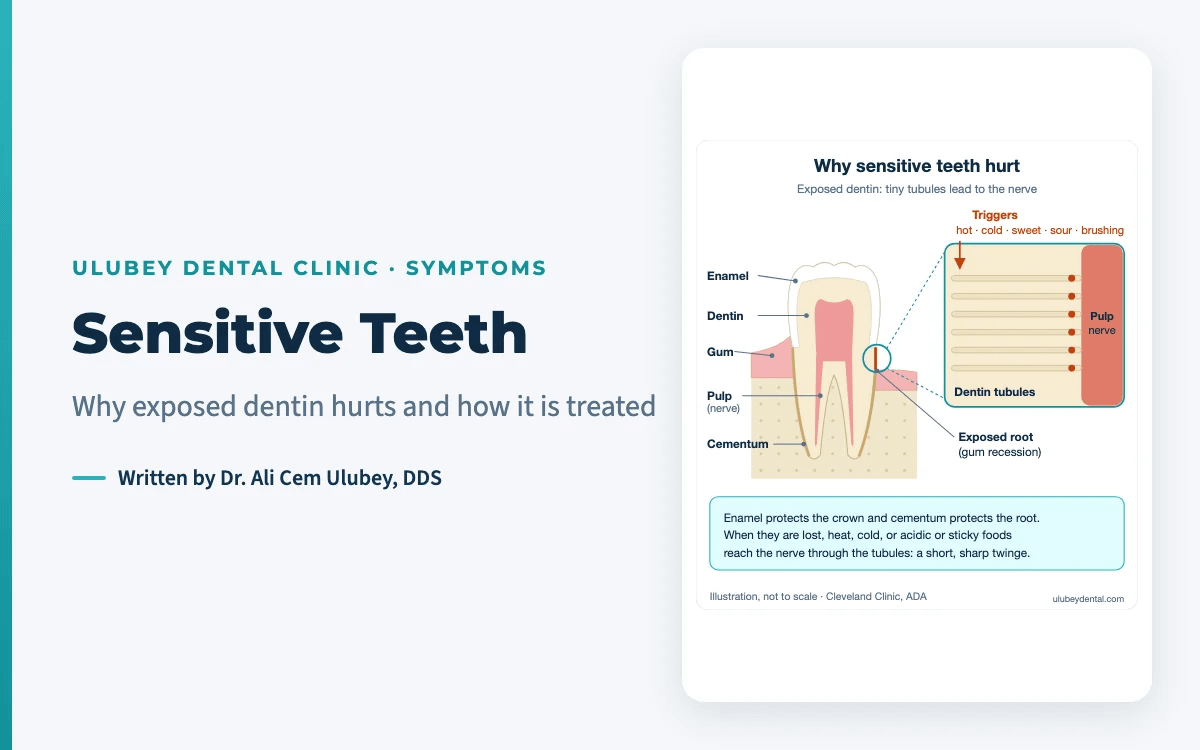
Signs, causes and treatment of erosion are covered in our separate guide to tooth wear and enamel erosion; if your teeth are sensitive, see sensitive teeth.
Does sugar-free gum help?
A systematic review of 12 studies found that chewing sugar-free gum reduced the increase in tooth decay, with a preventive fraction of 28% (95% CI 7% to 48%). The authors call this tentative evidence: the trials were of moderate quality and varied a lot[8]. Sugar-free gum after a meal can be a useful addition; it does not replace brushing with fluoride toothpaste.
A tooth-friendly day
Morning
Brush with fluoride toothpaste; spit, do not rinse[9]. Breakfast without sugary cereal; juice, if any, with the meal (maximum 150 ml)[3][4].Between meals
Water, plain milk, fresh fruit. Tea or coffee without sugar[3].Meals
Keep sweets, desserts and acidic drinks to mealtimes[3].Evening
Brush with fluoride toothpaste before bed and clean between your teeth; nothing sugary afterwards[3][9].
Eating after dental treatment
Some treatments come with their own short-term food rules at our clinic:
| Treatment | What we ask | More information |
|---|---|---|
| Teeth whitening | A light-coloured (“white”) diet for at least 3 days | Teeth whitening |
| Dental implant surgery | Cold or lukewarm, soft food for 1 week | Dental implant aftercare |
| Tooth extraction | Follow the aftercare rules, including diet, for 5–7 days | Tooth extraction aftercare |
At check-ups, Dr. Ali Cem Ulubey or Dr. Surur Ulubey can look at your diet together with your teeth, for example when there is new decay or signs of wear, and explain what to change first. The consultation and the panoramic X-ray taken at the examination have no separate fee.
Frequently asked questions
Is sparkling water bad for your teeth?
Plain sparkling mineral water is only slightly more erosive than still water in laboratory tests, and about 100 times less erosive than soft drinks. Flavoured sparkling waters are different: their pH was 2.74–3.34 and their erosive potential similar to or greater than orange juice. Treat flavoured versions as acidic drinks and have them with meals.
Is fruit juice bad for your teeth?
Juice and smoothies contain free sugars, because juicing or blending releases the sugar from the fruit, and they are acidic. UK guidance advises no more than 150 ml a day in total, with a meal. Whole fresh fruit is a better snack between meals because its sugars are held within the fruit’s structure.
How much sugar a day is safe for teeth?
WHO recommends keeping free sugars below 10% of daily energy and, ideally, below 5%, about 25 g. UK guidance sets a maximum of 30 g of free sugars a day for adults and children from 11, roughly 7 sugar cubes. How often you have sugar matters as much as the amount.
Is it better to eat sweets with a meal or on their own?
With a meal. Each sugar intake lowers plaque pH for 20 to 40 minutes. Eaten with a meal, sweets are part of one acid challenge; spread through the day, the same sweets cause many, keeping the pH low for long periods and leaving the enamel too little time to recover. Keep sugary food and drinks to mealtimes.
Are sugar-free soft drinks safe for teeth?
Swapping sugary drinks for sugar-free ones removes the sugar that causes decay, which UK guidance recommends. Acidity is a separate issue: a drink can be free of sugar and still acidic; flavoured sparkling waters, for example, were as erosive as orange juice in laboratory tests. Water and plain milk remain the safer choices between meals.
Does chewing gum help prevent cavities?
Sugar-free gum may help a little. A systematic review of 12 studies found it reduced the increase in tooth decay by about 28%, but the authors describe the evidence as tentative because the trials were of moderate quality and varied a lot. Use it after meals as an extra, not as a substitute for brushing with fluoride toothpaste.
Sources
- World Health Organization. WHO calls on countries to reduce sugars intake among adults and children (news release on the guideline “Sugars intake for adults and children”, 4 March 2015; accessed 26 October 2026). www.who.int/news/item/04-03-2015-who-calls-on-countries-to-reduce-sugars-intake-among-adults-and-children
- Moynihan PJ, Kelly SA. Effect on caries of restricting sugars intake: systematic review to inform WHO guidelines. J Dent Res. 2014;93(1):8-18. PMID 24323509. pubmed.ncbi.nlm.nih.gov/24323509
- Office for Health Improvement and Disparities (UK). Delivering better oral health: an evidence-based toolkit for prevention. Chapter 10: Healthier eating (updated 10 September 2025; accessed 26 October 2026). www.gov.uk/government/publications/delivering-better-oral-health-an-evidence-based-toolkit-for-prevention/chapter-10-healthier-eating
- NHS. Sugar: the facts (page last reviewed 19 May 2023; accessed 26 October 2026). www.nhs.uk/live-well/eat-well/food-types/how-does-sugar-in-our-diet-affect-our-health
- Parry J, Shaw L, Arnaud MJ, Smith AJ. Investigation of mineral waters and soft drinks in relation to dental erosion. J Oral Rehabil. 2001;28(8):766-772. PMID 11556958. pubmed.ncbi.nlm.nih.gov/11556958
- Brown CJ, Smith G, Shaw L, Parry J, et al. The erosive potential of flavoured sparkling water drinks. Int J Paediatr Dent. 2007;17(2):86-91. PMID 17263857. pubmed.ncbi.nlm.nih.gov/17263857
- Carvalho TS, Colon P, Ganss C, et al. Consensus report of the European Federation of Conservative Dentistry: erosive tooth wear — diagnosis and management. Clin Oral Investig. 2015;19(7):1557-1561. PMID 26121968. pubmed.ncbi.nlm.nih.gov/26121968
- Newton JT, Awojobi O, Nasseripour M, et al. A systematic review and meta-analysis of the role of sugar-free chewing gum in dental caries. JDR Clin Trans Res. 2020;5(3):214-223. PMID 31743654. pubmed.ncbi.nlm.nih.gov/31743654
- NHS. Gum disease (page last reviewed 20 April 2026; accessed 26 October 2026). www.nhs.uk/conditions/gum-disease
This article is general patient information and does not replace a clinical examination or X-rays.
Editor contact: [email protected] · ulubeydental.com/contact-us