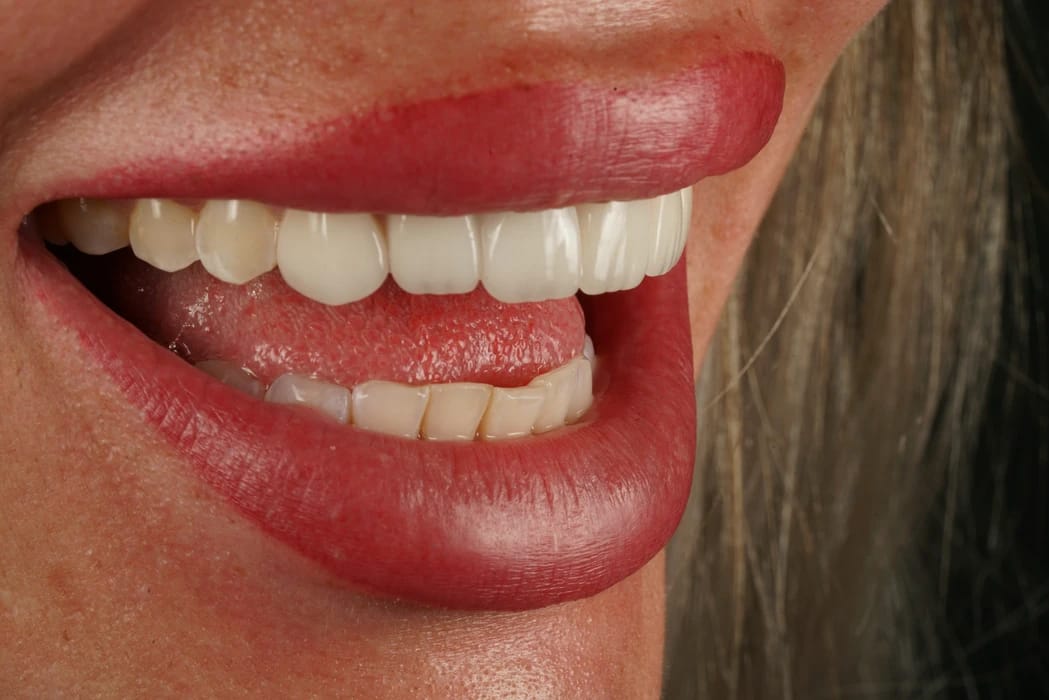
Full-Arch Bridge Materials: PMMA, Zirconia or Acrylic-Titanium
This page is general information and does not replace an examination.
A full-arch bridge on implants is usually made twice. After surgery you wear a fixed PMMA (acrylic resin) temporary bridge while the implants heal for about 3 months; then the permanent bridge is fitted. At Ulubey Dental Clinic in Antalya the permanent bridge is a 12-unit monolithic zirconia bridge from Amann Girrbach (€2,220 per arch). In studies, monolithic zirconia full-arch bridges had technical complication rates of 1–3%, versus up to 27% for veneered designs[1]; acrylic-titanium bridges show more wear than metal-zirconia bridges[3], and fracture and wear of the acrylic teeth are their most frequent long-term problems[4].
- 1. Why a full-arch bridge is made twice
- 2. The PMMA temporary bridge
- 3. Monolithic zirconia: our permanent bridge
- 4. Acrylic-titanium (hybrid) bridges
- 5. Veneered zirconia and metal-ceramic bridges
- 6. Full-arch bridge materials compared
- 7. The optional titanium bar
- 8. Caring for a full-arch bridge
- 9. Prices, what they include and the guarantee
- 10. Frequently asked questions
- 11. Sources
Why a full-arch bridge is made twice
In All-on-4 and All-on-6 treatment, 4 or 6 implants carry a fixed bridge that replaces all the teeth in one jaw. In a 2026 meta-analysis of 55 studies, both concepts showed similar long-term implant survival (98.14% for All-on-4 and 97.50% for All-on-6 at 5 years or more), and the authors noted that mechanical complications may be reduced with zirconia bridges[9]. Our guide to the differences between All-on-4 and All-on-6 compares the two.
The bridge itself is made in two stages:
| Temporary bridge | Permanent bridge | |
|---|---|---|
| Material | PMMA (acrylic resin) | Monolithic zirconia (Amann Girrbach); titanium bar optional |
| When | Fitted on visit 1, after the surgery | Fitted on visit 2, after about 3 months of healing |
| Stay in Antalya | Visit 1: about 4 nights | Visit 2: 5–6 nights |
| Purpose | Teeth while the implants integrate with the bone; tests the bite and the look | Long-term chewing, appearance and cleaning |
| Price | Included in the start price (from €1,900 per arch, All-on-4) | €2,220 per arch (12 units) |
Ulubey Dental Clinic, October 2026. Healing time is planned individually; with bone grafting or an open sinus lift it is about 6 months on average. A same-day temporary is possible only when the implants are stable enough to be loaded; it is never promised in advance.
The week-by-week healing after surgery is described in our All-on-4 recovery timeline.
The PMMA temporary bridge
PMMA (polymethyl methacrylate) is a strong acrylic resin. In All-on-4 and All-on-6 cases the fixed temporary bridge fitted after surgery is usually PMMA. It is screwed to the implants, so you do not take it out, and it lets you eat soft food, speak and smile while the bone heals.
It is a temporary, and it behaves like one. In a study of 191 immediately loaded All-on-4 arches, acrylic temporary bridges stayed in place for a mean of about 199 days, and 17.8% needed at least one repair during that time; patients were given specific dietary instructions for the first 7 days and for the weeks before the permanent bridge[7].
Follow the soft-food instructions you receive after surgery, avoid biting hard food with the front teeth, and tell us straight away if the temporary feels loose, cracks or changes your bite.
For partial cases, an implant-supported PMMA temporary is also available per tooth (€50); in All-on-4 and All-on-6 the full-arch temporary is already included in the start price.
Monolithic zirconia: our permanent bridge
“Monolithic” means the bridge is milled from one solid block of zirconia, without a layer of porcelain baked on top that could chip. Our permanent full-arch bridges are 12 units of Amann Girrbach zirconia, made at our partner laboratory.
- A 2026 systematic review of 13 studies (2,841 bridges, 3,940 implants) found that 99% of monolithic zirconia full-arch bridges were still in function after 12 to 62 months. Technical complications were 1–3% for monolithic designs and up to 27% for veneered designs; the certainty of the evidence was rated low, mainly because of methodological limitations (most studies were retrospective) and differences between the studies[1].
- A 2024 meta-analysis of 3,038 full-arch zirconia bridges found significantly fewer complications with monolithic zirconia (9.4%) than with porcelain-veneered zirconia (33.7%)[2].
- The German S3 guideline on all-ceramic implant restorations (DGI and DGZMK) states that for full-arch reconstructions only 3Y-TZP zirconia is supported by clinical evidence, that monolithic and micro-veneered designs reduce chipping, and that full-arch all-ceramic work still has clinical limitations[8].
- An umbrella review of 7 systematic reviews concluded that monolithic zirconia and screw-retained frameworks show lower technical complication rates[6].
Our pages on zirconia crowns and passive fit in full-arch implants explain how the bridge is designed to sit on the implants without strain.
Acrylic-titanium (hybrid) bridges
An acrylic-titanium bridge, also called a hybrid or metal-acrylic bridge, has acrylic teeth and pink acrylic “gum” processed onto a metal framework, usually titanium. It is a long-established full-arch design. What the research reports:
- A meta-analysis of studies with at least 5 years of follow-up found that metal-acrylic full-arch bridges developed various prosthetic complications over time; the most frequent were veneer fracture (chipping or breaking of the acrylic teeth) and material wear[4].
- A 2026 meta-analysis of 12 comparative studies found that metal-zirconia bridges had significantly less prosthetic wear than metal-acrylic bridges (risk ratio 0.29) and a lower risk of peri-implantitis (risk ratio 0.67). Implant survival, framework fractures, appearance and speech did not differ significantly. Most studies had a moderate to critical risk of bias[3].
At our clinic an acrylic-titanium bridge is used only as a temporary bridge, when a plan needs one, and it is then priced in your written quote. We do not offer it as the final bridge: we want to see more long-term evidence on the material first. Our permanent bridge is monolithic zirconia. If you are comparing quotes from several clinics, check which material each quote actually includes for the permanent bridge, and whether the “permanent” teeth are in fact a PMMA or acrylic bridge.
Veneered zirconia and metal-ceramic bridges
Two more designs appear in quotes and in the research:
- Veneered (layered) zirconia: a zirconia framework covered with porcelain for colour. It looks natural, but the porcelain layer is where chipping happens: complication rates of 33.7% versus 9.4% for monolithic zirconia[2], and veneer chipping of 15–35% in the umbrella review[6].
- Metal-ceramic: porcelain fused to a metal framework. In a review of studies with at least 5 years of follow-up, veneer fracture was the most common complication, with cumulative rates of 22.1% at 5 years and 39.3% at 10 years[5].
Full-arch bridge materials compared
| Material | Role | What the evidence shows | At Ulubey Dental Clinic |
|---|---|---|---|
| PMMA (acrylic resin) | Temporary, during healing | 17.8% of temporaries needed at least one repair over about 199 days[7] | Included in the All-on-4 / All-on-6 start price |
| Monolithic zirconia | Permanent | 99% in function at 12–62 months; technical complications 1–3%[1] | Our permanent bridge: 12 units, €2,220 per arch |
| Acrylic-titanium (metal-acrylic) | Permanent in the studies cited | Acrylic teeth fracture and wear most frequent[4]; more wear than metal-zirconia (RR 0.29)[3] | Temporary bridge only, priced in your written quote; not offered as the final bridge |
| Veneered zirconia | Permanent | Complications 33.7% vs 9.4% for monolithic[2] | Not our standard design |
| Metal-ceramic | Permanent | Veneer fracture 22.1% at 5 years, 39.3% at 10 years[5] | Not offered |
Sources as cited per cell. Studies differ in design, follow-up and patients; most full-arch material data are observational, and the certainty of evidence is often rated low.
The optional titanium bar
In some cases the zirconia bridge is supported by a titanium bar, for example when extra framework support is planned. Whether your case needs one is decided when your bridge is planned; the bar costs €500 per arch and is only added when your plan uses it. The 2026 comparative review above studied this kind of metal-supported zirconia bridge[3].
Caring for a full-arch bridge
A full-arch bridge does not decay, but the gums and bone around the implants can become inflamed if plaque stays under the bridge. We show each patient, hands-on, a combination that fits their bridge:
- a water flosser, always;
- interdental brushes where they fit, and floss where they do not;
- a toothbrush.
Our guide to cleaning implants and bridges shows the technique. If you grind your teeth, tell us: crown and bridge guarantees exclude fracture due to bruxism, and patients who grind must wear the night guard we provide. See also our page on teeth grinding.
Prices, what they include and the guarantee
| Item | Price |
|---|---|
| All-on-4, surgical stage with fixed PMMA temporary (Nucleoss, no extractions) | from €1,900 |
| All-on-6, surgical stage (same basis) | from €2,600 |
| Permanent monolithic zirconia bridge, 12 units (Amann Girrbach) | €2,220 |
| Titanium bar (optional) | €500 |
| All-on-4, finished (Nucleoss, incl. bridge) | from €4,120 |
| All-on-6, finished (Nucleoss, incl. bridge) | from €4,820 |
Ulubey Dental Clinic, October 2026; prices as listed on our dental treatment prices page. Neodent and Straumann tiers are on the same page.
- Surgical stage: the implants, multi-unit abutments and the fixed PMMA temporary bridge.
- Finished price: the surgical stage plus the permanent 12-unit monolithic zirconia bridge.
- No fee: the consultation and the panoramic X-ray.
- Only if your case needs them, listed in your quote: extractions, bone graft, sinus lift, a surgical guide or the titanium bar.
- Airport transfer is included in All-on-4 and All-on-6 plans; the hotel is confirmed in your written quote.
Prices are indicative; your final written quote follows the examination and X-rays and is valid for 30 days. Unless the treatment plan changes, the written price does not change.
Guarantee: 10-year fracture guarantee on Amann Girrbach zirconia crowns and bridges made at our partner lab; 5-year clinic guarantee on crowns and bridges in other materials; crown and bridge guarantees exclude fracture due to bruxism (teeth grinding), and patients who grind their teeth must wear the night guard we provide. All guarantees are conditional on attending recommended check-ups and cover the prosthesis, not the root canal or filling beneath it. Temporary bridges are not covered by the guarantee; the guarantee starts with your final bridge. For the implants, the manufacturer’s lifetime guarantee on the implant fixture is conditional on attending recommended check-ups. A fixture guarantee does not mean that every implant integrates: smoking, uncontrolled diabetes and gum health affect the result. Read the full terms in our written dental guarantee, and work out your own case with the full mouth implants cost calculator or on our dental treatment prices page.
Wondering about the implants themselves rather than the bridge? Our comparison of ceramic and titanium implants explains why our full-arch treatments are planned on titanium systems.
Frequently asked questions
Which material is recommended for a permanent All-on-4 bridge?
There is no single answer for everyone, but the evidence favours monolithic zirconia for the permanent bridge: a 2026 review found 99% of monolithic zirconia full-arch bridges still in function at 12–62 months, with technical complications of 1–3% versus up to 27% for veneered designs. At our clinic the permanent bridge is 12-unit monolithic Amann Girrbach zirconia.
Is the PMMA temporary bridge strong enough?
It is designed for the healing period, not for life. In one study of 191 All-on-4 arches, 17.8% of the acrylic temporary bridges needed at least one repair over about 199 days. Following the soft-food instructions, avoiding hard food with the front teeth and reporting any crack or looseness early protects both the temporary and the implants.
What is the difference between acrylic-titanium and zirconia bridges?
An acrylic-titanium (hybrid) bridge has acrylic teeth on a titanium framework; a monolithic zirconia bridge is milled from one block. Reviews report acrylic tooth fracture and wear as the most frequent problems with acrylic bridges, and a 2026 meta-analysis found less wear and a lower peri-implantitis risk with metal-zirconia bridges, although the evidence quality is limited. At our clinic an acrylic-titanium bridge is used only as a temporary bridge; the permanent bridge is monolithic zirconia.
How much does a permanent zirconia full-arch bridge cost?
At Ulubey Dental Clinic, the permanent 12-unit monolithic zirconia bridge (Amann Girrbach) costs €2,220 per arch. A finished All-on-4 with this bridge starts from about €4,120 per arch and a finished All-on-6 from about €4,820. An optional titanium bar is €500 per arch. Your written quote is valid for 30 days.
When is the permanent bridge fitted?
On the second visit, after about 3 months of healing; with bone grafting or an open sinus lift, about 6 months on average. Visit 1 lasts about 4 nights (surgery and the fixed PMMA temporary bridge) and visit 2 lasts 5–6 nights (the permanent bridge). Healing time is always planned individually after the examination.
Is the zirconia bridge covered by a guarantee?
Yes. Amann Girrbach zirconia crowns and bridges made at our partner lab carry a 10-year fracture guarantee. It excludes fracture due to bruxism (teeth grinding), and patients who grind must wear the night guard we provide. All guarantees are conditional on attending recommended check-ups, which can be at our clinic or with any licensed dentist. Temporary bridges are not covered by the guarantee; the guarantee starts with your final bridge.
Sources
- Matos ACM, Vieira FL, Marrara JR, Tirapelli C, Correia FD, Santiago-Junior JF. Are monolithic zirconia complete arch implant-supported prostheses reliable? A systematic review and meta-analysis. J Prosthet Dent. 2026;136(1):40-51. PMID 41813561. pubmed.ncbi.nlm.nih.gov/41813561
- Martakoush-Saleh S, Salgado-Peralvo AO, Peña-Cardelles JF, Kewalramani N, Gallucci GO. Evaluating the clinical behavior of veneered zirconia in comparison with monolithic zirconia complete arch implant-supported prostheses: a systematic review and meta-analysis. J Prosthet Dent. 2024;132(5):899-912. PMID 37696747. pubmed.ncbi.nlm.nih.gov/37696747
- Marinkovic D, Gutiérrez R, Frey M, Collao F, Moreno Y, Miranda C. Prosthetic and biological complications of metal-zirconia versus metal-acrylic implant-supported screw-retained complete-arch prostheses: a systematic review and meta-analysis. J Clin Exp Dent. 2026;18(5):e704-e715. PMID 42434215. pubmed.ncbi.nlm.nih.gov/42434215
- Bozini T, Petridis H, Garefis K, Garefis P. A meta-analysis of prosthodontic complication rates of implant-supported fixed dental prostheses in edentulous patients after an observation period of at least 5 years. Int J Oral Maxillofac Implants. 2011;26(2):304-318. PMID 21483883. pubmed.ncbi.nlm.nih.gov/21483883
- Wong CKK, Narvekar U, Petridis H. Prosthodontic complications of metal-ceramic and all-ceramic, complete-arch fixed implant prostheses with minimum 5 years mean follow-up period: a systematic review and meta-analysis. J Prosthodont. 2019;28(2):e722-e735. PMID 29665177. pubmed.ncbi.nlm.nih.gov/29665177
- Tomar S, Agnihotri N, Vhanmane G. Prosthetic complications of implant-supported complete arch prostheses: an umbrella review of systematic reviews. J Prosthet Dent. 2026;136(1):52-59. PMID 41927400. pubmed.ncbi.nlm.nih.gov/41927400
- Drago C. Frequency and type of prosthetic complications associated with interim, immediately loaded full-arch prostheses: a 2-year retrospective chart review. J Prosthodont. 2016;25(6):433-439. PMID 26372550. pubmed.ncbi.nlm.nih.gov/26372550
- Waltenberger L, Bishti S, Wolfart S. German S3 guideline on implant-supported all-ceramic restorations. Int J Implant Dent. 2025;11(1):53. PMID 40802222. pubmed.ncbi.nlm.nih.gov/40802222
- Shao WH, Chen R, Wang S, Duan SY, Zhang XD, Tang YL. All-on-4 and All-on-6 implant-supported fixed prostheses for the edentulous jaw: a systematic review and meta-analysis. Int J Oral Maxillofac Surg. 2026;55(9):1098-1112. PMID 42031576. pubmed.ncbi.nlm.nih.gov/42031576
This article is general patient information and does not replace a clinical examination or X-rays.
Editor contact: [email protected] · ulubeydental.com/contact-us