Ceramic (Zirconia) vs Titanium Implants: What the Evidence Shows
This page is general information and does not replace an examination.
Titanium implants have the longest track record: a meta-analysis of 18 studies found 96.4% of implants still in place after 10 years[1]. Ceramic (zirconia) implants are a metal-free alternative; a 2026 meta-analysis of comparative studies found survival and bone levels similar to titanium for up to 5 years, but long-term evidence is still insufficient[2]. At Ulubey Dental Clinic in Antalya we place both. Which one suits you is decided after the examination and X-rays, not from a brochure.
- 1. What ceramic and titanium implants are
- 2. What the evidence shows
- 3. Ceramic vs titanium implants compared
- 4. Titanium allergy: how common is it?
- 5. Who each material may suit
- 6. Ceramic and titanium implants at our clinic
- 7. Prices and what they include
- 8. Questions to ask before you choose
- 9. Frequently asked questions
- 10. Sources
What ceramic and titanium implants are
A dental implant is a screw-shaped post placed in the jawbone to replace the root of a missing tooth. The bone grows onto its surface (osseointegration), and a crown, bridge or full-arch bridge is fixed on top. Our guide to osseointegration explains this healing step.
- Titanium implants are the standard type. Almost all long-term implant research, including the 10-year survival data above, comes from titanium implants[1].
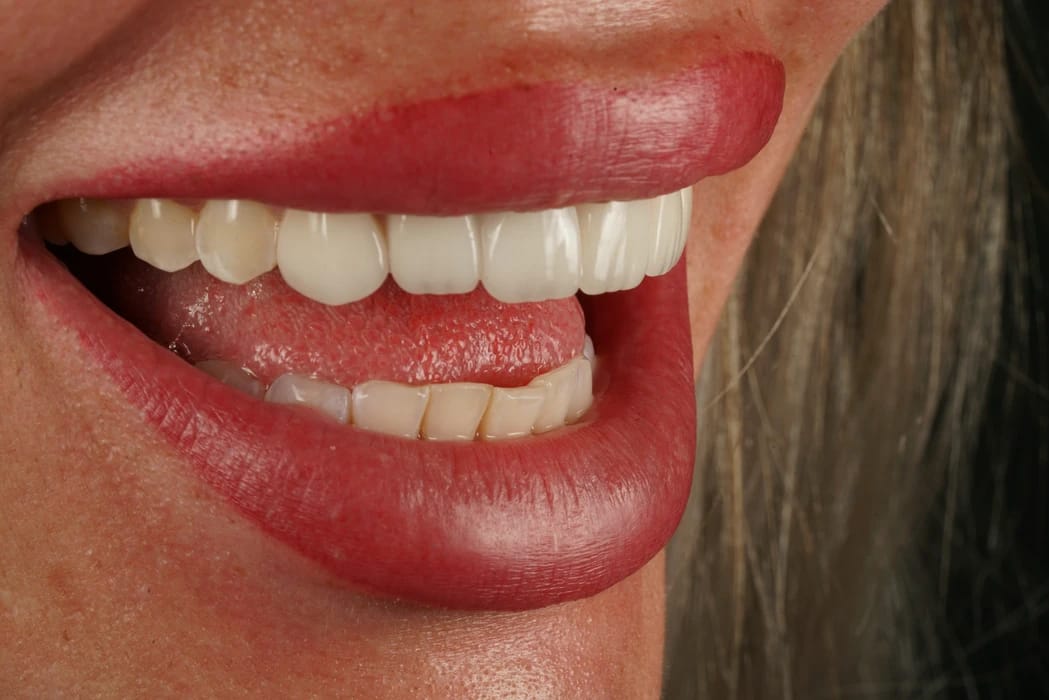
- Ceramic implants are made of zirconia (zirconium dioxide), a white, tooth-coloured ceramic. Patients usually ask for them because they want a metal-free option or are worried about a metal allergy. They are designed to integrate with the bone in the same way as titanium, but the range of shapes and components is narrower.
Ceramic implants come in two designs. In a one-piece implant, the part in the bone and the part that holds the crown are a single piece. A two-piece implant has a separate connecting part (abutment), like most titanium implants. The difference matters, because the two designs do not have the same track record[3][2].
Do not confuse a ceramic implant with a zirconia crown. Many titanium implants carry a zirconia crown on top; the material of the root and the material of the visible tooth are separate choices. The crown materials are compared in our guide to zirconia vs porcelain crowns.
What the evidence shows
The honest summary: ceramic implants look comparable to titanium in the short and medium term, but they have been studied for far fewer years and in far fewer patients.
Survival
- Titanium: a systematic review of 18 prospective studies found 96.4% of implants still in place after 10 years. A more cautious analysis that accounted for patients lost to follow-up estimated 93.2%, and patients aged 65 and over had a higher risk of implant loss[1].
- Zirconia: a 2023 meta-analysis of 25 studies (4,017 implants, 2,083 patients) calculated a 10-year cumulative survival rate of 95.1%. Only 7 of the studies followed patients for more than 5 years[3].
- Head to head: the 2026 ZrO Summit review pooled 9 comparative studies (222 zirconia and 213 titanium implants). In randomised trials survival did not differ at 1 year, and pooled survival did not differ at 3 years or at 5 years or more; one subgroup analysis suggested slightly lower 1-year survival for two-piece zirconia implants. The authors concluded that the evidence on long-term outcomes of zirconia implants remains insufficient, and that part of the data comes from older systems no longer on the market[2].
Design and fractures
- In the 2023 review, 26 of the 172 failed zirconia implants failed because the implant fractured, most of them narrow-diameter implants. Two-piece zirconia implants had lower survival than one-piece implants, and implants no longer sold did worse than current ones[3].
- A 2025 review of two-piece zirconia implants (6 studies, 298 implants) reported 96.31% survival, but stressed that the data come from the early stages of this design[7].
Bone and gums around the implant
- Bone loss around zirconia was slightly greater at 1 year in randomised trials (0.16 mm on average, an effect that weakened when only low-risk studies were kept), but similar to titanium at 5 years or more[2].
- Peri-implantitis (the implant equivalent of gum disease) was found around 2% of zirconia implants in studies of up to 5 years and 8% in studies longer than 5 years. Five randomised trials showed no significant difference from titanium[4].
Randomised trials
- A small randomised trial in Austria (31 implants, 22 patients) found no significant differences between two-piece zirconia and titanium implants after about 80 months; 2 zirconia implants and 1 titanium implant had been lost[5].
- A 2026 multicentre randomised trial (117 implants) found 100% crown survival on both materials after 1 year, with no difference in technical complications[6].
Bridges and full arches on ceramic implants
A 2025 review found that zirconia implants supporting 3-unit bridges had 93.2% survival after a mean of about 45 months, but zirconia implants supporting overdentures had only 69.5% survival after 12 months. The authors supported zirconia implants mainly for aesthetically demanding, low-load situations[8]. Full-arch evidence for ceramic implants is limited, which is why our All-on-4 and All-on-6 treatments are planned on titanium implant systems.
Ceramic vs titanium implants compared
| Titanium implants | Ceramic (zirconia) implants | |
|---|---|---|
| Long-term survival | 96.4% at 10 years (18 studies)[1] | 95.1% cumulative at 10 years, but only 7 studies over 5 years[3] |
| Compared directly | Reference material in the comparative trials[2] | Similar survival and bone levels up to 5 years[2] |
| Bone loss | Reference | Slightly more at 1 year (0.16 mm), similar at 5 years[2] |
| Peri-implantitis | Reference | About 2% up to 5 years, 8% beyond 5 years; no significant difference in 5 trials[4] |
| Implant fracture | Not analysed separately in the reviews cited here | 26 of 172 failures, mostly narrow implants[3] |
| Bridges and full arches | Used for our All-on-4 and All-on-6 treatments | 3-unit bridges 93.2%; overdentures 69.5%; full-arch data limited[8] |
| Components and options | Wide range of shapes, sizes and parts | Narrower range of shapes and components |
| Metal | Yes (titanium) | No (zirconia ceramic) |
| Strength of evidence | Strong: decades of data, large reviews | Moderate for up to 5 years; insufficient beyond that |
Sources as cited per cell. “Reference” means titanium was the comparison group in those studies. Results come from study populations and systems that may differ from yours.
Titanium allergy: how common is it?
A true allergy to titanium appears to be rare. In a Spanish clinic, 9 of 1,500 implant patients (0.6%) reacted positively on titanium allergy tests; most of the positive reactions were in patients who had unexplained implant failures or allergy-like symptoms after placement[9].
Testing is not straightforward. A systematic review found that skin tests and blood tests for titanium hypersensitivity gave inconsistent results and should be interpreted cautiously; the reactions seem to come mainly from inflammation caused by tiny titanium particles rather than a classic allergy, so clinical signs of inflammation matter more than a test result[10]. A 2026 review described titanium hypersensitivity as rare but clinically relevant, based mostly on case reports[11].
Tell us at the first contact and bring any allergy test results or letters from your doctor. We take the history seriously and discuss whether a ceramic implant suits your bone, your bite and the position of the gap. An allergy diagnosis comes from your doctor, so please bring the results.
Who each material may suit
Neither material is “better” for everyone. These are the situations in which each one is usually considered; your own plan depends on the examination, the X-rays and, where needed, a CBCT scan.
| Situation | Usually considered | Why |
|---|---|---|
| Single front tooth, strong wish for no metal | Ceramic or titanium | Zirconia has shown good results for single crowns; the evidence is shorter[2][6] |
| Documented reaction to titanium | Ceramic | Rare, but clinically relevant when present[9][11] |
| Several missing teeth, bridge on implants | Usually titanium | Fewer data for zirconia bridges; 93.2% at about 4 years[8] |
| Full arch (All-on-4, All-on-6) | Titanium | Full-arch evidence for zirconia implants is limited[8] |
| Overdenture on implants | Titanium | 69.5% survival for zirconia overdenture implants at 12 months[8] |
| Narrow gap that needs a thin implant | Usually titanium | Zirconia fractures occurred mostly in narrow implants[3] |
| Bone graft or sinus lift needed | Decided case by case | Depends on the bone, the healing plan and the system’s range of components |
A guide to the conversation, not a prescription. The final choice is made with your dentist after the examination.
Whatever the material, the same health factors matter: smoking, uncontrolled diabetes and gum disease raise the risk for every implant. Our guide to who can get dental implants covers them, and how long dental implants last explains survival figures in more detail.
Ceramic and titanium implants at our clinic
Ulubey Dental Clinic is run by two dentists, Dr. Ali Cem Ulubey and Dr. Surur Ulubey; there are no rotating dentists. What we actually do:
- Both materials: we place ceramic (zirconia) implants when the case is suitable, and titanium implants from 8 systems. The titanium systems are listed on our implant brands page.
- The decision follows the examination: we take a panoramic X-ray for every patient, and our dentists evaluate a CBCT scan when the case needs one. We explain the evidence above in plain words, including where it is thin.
- Surgical planning: when needed, we plan with a surgical guide. Healing time before the final teeth is planned individually; your dentist confirms the schedule at the examination.
- Traceability: every patient receives the manufacturer’s implant passport with the original label of each implant (brand, diameter, length, LOT and REF), so any dentist can identify it later.
- Implant removal: when an implant has failed or must come out, Dr. Ali Cem Ulubey performs the removal himself.
- Guarantee: for our titanium implant systems, the manufacturer’s lifetime guarantee on the implant fixture is conditional on attending recommended check-ups. A fixture guarantee does not mean that every implant integrates: smoking, uncontrolled diabetes and gum health affect the result. If a ceramic implant is planned for you, the system chosen for your case is set out in your written quote before treatment. Full terms are in our written dental guarantee.
Prices and what they include
| Implant | Material | Price |
|---|---|---|
| Nucleoss | Titanium | €300 |
| Osstem | Titanium | €350 |
| Neodent | Titanium | €400 |
| Medentika | Titanium | €550 |
| Straumann BLT | Titanium | €800 |
| Straumann BLX | Titanium | €1,000 |
| Ceramic (zirconia) implant | Zirconia | In your written quote after the examination |
Ulubey Dental Clinic, October 2026; titanium prices as listed on our dental treatment prices page. Ceramic implants are not on the published price list.
- Included: the implant, the standard abutment and the Ti-base.
- Priced separately: the crown on top (zirconia €185, E.max €250).
- No fee: the consultation and the panoramic X-ray.
- Only if your case needs them, listed in your quote: extractions, bone graft, sinus lift, a custom abutment or a surgical guide.
Prices are indicative; your final written quote follows the examination and X-rays and is valid for 30 days. Unless the treatment plan changes, the written price does not change.
For a single tooth, our single implant cost calculator adds the crown and extras to your own case; every item is on our dental treatment prices page.
Questions to ask before you choose
The UK General Dental Council suggests asking any clinic abroad about success and complication rates, whether there is a guarantee on the work and for how long, what aftercare is provided, and who pays for flights, hotel and remedial work if something goes wrong[12]. For an implant material decision, add these:
- Which implant system will be used, one-piece or two-piece, and what diameter?
- How long has this system been studied, and in how many patients?
- If it fails, which components are available to replace it, here and at home?
- What are the guarantee terms for this specific system, in writing?
- Will I receive the implant passport with the original labels?
If you are replacing several teeth or a whole arch, our guide to full-arch bridge materials compares the bridges that go on top of the implants.
Frequently asked questions
Are ceramic implants better than titanium implants?
Not as a rule. A 2026 meta-analysis of comparative studies found survival and bone levels similar for zirconia and titanium implants for up to 5 years, but long-term evidence for zirconia is still insufficient. Titanium has decades of data, including 96.4% survival at 10 years. Ceramic implants are an option for some patients, chosen after an examination, not a general upgrade.
Who should consider a ceramic (zirconia) implant?
Mainly patients who want a metal-free option for a single tooth, often in the front, and patients with a documented reaction to titanium. The evidence supports zirconia implants mainly for single crowns and short bridges in low-load areas. For full arches, overdentures and narrow gaps, titanium implants have more data. Your dentist decides with you after the X-rays.
How common is titanium allergy?
It appears to be rare. In one clinical study, 9 of 1,500 implant patients (0.6%) tested positive for titanium allergy, mostly patients with unexplained implant failures or allergy-like symptoms. Allergy tests for titanium give inconsistent results, so clinical signs of inflammation matter more. If you suspect an allergy, bring your doctor’s test results or letters to your consultation.
Do you place ceramic implants in Antalya?
Yes. At Ulubey Dental Clinic we place ceramic (zirconia) implants when the case is suitable, and titanium implants from 8 systems. The choice is made after the examination and a panoramic X-ray, with a CBCT scan when needed. Ceramic implants are not on our published price list; the price is in your written quote, which is valid for 30 days.
Can I have All-on-4 on ceramic implants?
Our All-on-4 and All-on-6 treatments are planned on titanium implant systems. The research on zirconia implants supporting full-arch bridges is limited, and a 2025 review found only 69.5% survival for zirconia implants supporting overdentures after 12 months. If you want to avoid metal, we discuss what is possible for your case at the examination.
How much does a titanium implant cost at your clinic?
From €300 (Nucleoss) to €1,000 (Straumann BLX) per implant, with the standard abutment and Ti-base included. The crown on top is priced separately: €185 for zirconia or €250 for E.max. The consultation and panoramic X-ray have no fee. Your written quote follows the examination and X-rays and is valid for 30 days.
Sources
- Howe MS, Keys W, Richards D. Long-term (10-year) dental implant survival: a systematic review and sensitivity meta-analysis. J Dent. 2019;84:9-21. PMID 30904559. pubmed.ncbi.nlm.nih.gov/30904559
- Pachiou A, Delgado-Ruiz R, Schnurr E, Kim DM, Romanos GE, Balmer M. ZrO Summit 2025, Group 1: Survival and clinical performance of zirconia compared to titanium implants: a systematic review and meta-analysis. Int J Oral Maxillofac Implants. 2026 (online ahead of print). doi:10.11607/jomi.11788. PMID 42139228. pubmed.ncbi.nlm.nih.gov/42139228
- Mohseni P, Soufi A, Chrcanovic BR. Clinical outcomes of zirconia implants: a systematic review and meta-analysis. Clin Oral Investig. 2023;28(1):15. PMID 38135804. pubmed.ncbi.nlm.nih.gov/38135804
- Moraschini V, de Moraes JB, de Oliveira Silva AM, et al. Prevalence of peri-implantitis around zirconia implants: a systematic review and meta-analysis of current evidence. Clin Implant Dent Relat Res. 2026;28(4):e70176. PMID 42516003. pubmed.ncbi.nlm.nih.gov/42516003
- Koller M, Steyer E, Theisen K, Stagnell S, Jakse N, Payer M. Two-piece zirconia versus titanium implants after 80 months: clinical outcomes from a prospective randomized pilot trial. Clin Oral Implants Res. 2020;31(4):388-396. PMID 31944420. pubmed.ncbi.nlm.nih.gov/31944420
- Balmer M, Fischer A, Kühl S, Bernauer SA, Steinwender A, Payer M. Zirconia versus titanium implants: 1-year prosthetic outcome of screw-retained single crowns in a randomized clinical trial. Clin Implant Dent Relat Res. 2026;28(3):e70160. PMID 42206453. pubmed.ncbi.nlm.nih.gov/42206453
- Bazal-Bonelli S, Castro-Janeiro M, Ríos-Barbero J, et al. Clinical behavior of two-piece zirconia implants: a systematic review. Med Oral Patol Oral Cir Bucal. 2025;30(3):e313-e321. PMID 40121684. pubmed.ncbi.nlm.nih.gov/40121684
- Monteiro CGJ, de Oliveira Silva AM, de Almeida DCF, et al. Clinical outcomes of zirconia implants supporting multi-unit and complete arch prostheses: a systematic review and meta-analysis. J Prosthet Dent. 2025;134(5):1631.e1-1631.e8. PMID 40781015. pubmed.ncbi.nlm.nih.gov/40781015
- Sicilia A, Cuesta S, Coma G, et al. Titanium allergy in dental implant patients: a clinical study on 1500 consecutive patients. Clin Oral Implants Res. 2008;19(8):823-835. PMID 18705814. pubmed.ncbi.nlm.nih.gov/18705814
- Müller-Heupt LK, Schiegnitz E, Kaya S, Jacobi-Gresser E, Kämmerer PW, Al-Nawas B. Diagnostic tests for titanium hypersensitivity in implant dentistry: a systematic review of the literature. Int J Implant Dent. 2022;8(1):29. PMID 35819566. pubmed.ncbi.nlm.nih.gov/35819566
- Restelli L, Uriarte X, Moreno X, et al. Titanium hypersensitivity in dental implants: a systematic review of updated clinical evidence and diagnostic strategies. J Prosthodont Res. 2026 (online ahead of print). PMID 41581901. pubmed.ncbi.nlm.nih.gov/41581901
- General Dental Council (UK). Going abroad for dental treatment (accessed 26 October 2026). www.gdc-uk.org/standards-guidance/information-for-patients-public/going-abroad-for-dental-treatment
This article is general patient information and does not replace a clinical examination or X-rays.
Editor contact: [email protected] · ulubeydental.com/contact-us