Dental Implant Abutment: Screw-Retained vs Cemented, Ti-Base
An implant abutment connects the implant in the bone to the crown or bridge on top. The crown is either screwed to the implant (screw-retained) or cemented onto the abutment. In a review of 73 studies, 5-year survival was similar (96.03% cemented, 95.55% screw-retained), with fewer complications for screw retention[2]. At Ulubey Dental Clinic in Antalya the standard abutment and Ti-base are included in the implant price; a custom abutment costs €100 and a multi-unit abutment €50, only when needed.
- 1. What an implant abutment is
- 2. Types of abutment and when each is used
- 3. Screw-retained vs cemented crowns
- 4. Why excess cement matters
- 5. Titanium or zirconia abutment for front teeth
- 6. Screw loosening and maintenance
- 7. Abutment prices in Antalya
- 8. How we choose and record abutments
- 9. Frequently asked questions
- 10. Sources
What an implant abutment is
An implant tooth has three parts: the implant (fixture) in the bone, the abutment, and the crown you see. The abutment sits on the implant at gum level, is held by a small screw, and carries the crown or bridge. Each part wears differently, as explained in how long dental implants last.
Two decisions shape the abutment: what it is made of and shaped like, and how the crown is fixed to it. Both affect how easy the tooth is to clean, how it looks at the gum line and how easily it can be repaired later. Short definitions are also in our dental glossary.
Types of abutment and when each is used
| Type | What it is | Typically used for | At our clinic |
|---|---|---|---|
| Stock (standard) abutment | Prefabricated titanium part from the implant manufacturer | Back teeth with average gum height | Included in the implant price |
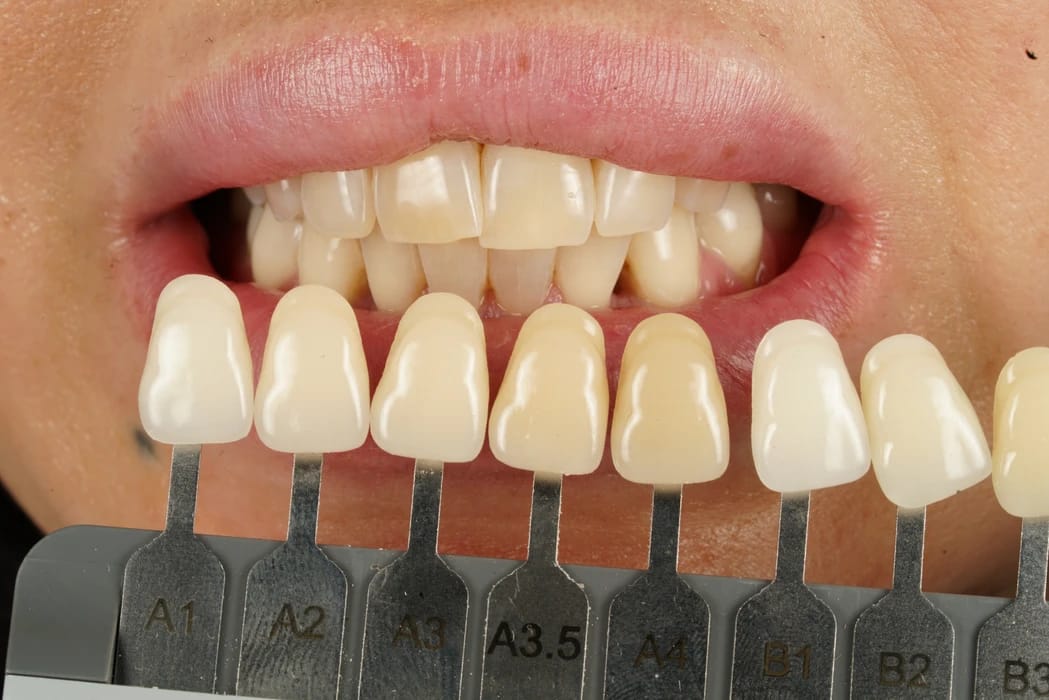
| Ti-base | A titanium base bonded under a zirconia or ceramic crown; the metal connects to the implant, the visible part is tooth-coloured | Single crowns made digitally; often screw-retained[5] | Included in the implant price |
| Custom abutment (titanium or zirconia) | Designed for one patient to follow the gum contour | Front teeth, deep or angled implants, thin gums | €100 each, only when needed |
| Multi-unit abutment | Angled or straight part that brings several implants to one level | Screw-retained full-arch bridges (such as All-on-4) | €50 each, only when used; included in All-on-4 / All-on-6 |
Prices are part of the itemised written quote. Prices are indicative; your final written quote follows the examination and X-rays and is valid for 30 days. Unless the treatment plan changes, the written price does not change.
A 2023 systematic review of single implant crowns on Ti-bases found an estimated 98.6% survival after one year in function across 857 crowns, and no survival difference from other abutments in six randomised trials; the mean follow-up was 31.2 months, so the data are short-term[5].
Screw-retained vs cemented crowns
A screw-retained crown has a small access hole through its biting surface; the screw is tightened through it and the hole is sealed with filling material. A cemented crown is cemented onto an abutment like a crown on a natural tooth, so there is no access hole, but it is harder to remove later.
| Screw-retained | Cemented | |
|---|---|---|
| 5-year survival (73 studies) | 95.55%[2] | 96.03%[2] |
| Complications | Fewer technical and biological complications overall[2] | More loss of retention; risk of excess cement under the gum[2][3] |
| Retrieval for repair | Easier: the screw can be undone[1] | Harder: the crown may have to be cut off[1] |
| Appearance | Access hole on the biting or back surface, sealed with filling material | No access hole |
| Bone loss over 2 mm at single crowns (5 years) | 0%[1] | 2.8%[1] |
Neither method is right for every case. A 2012 review concluded that neither fixation method was clearly advantageous, but that screw-retained work seemed preferable because it is retrievable and more biologically compatible[1].
Both reviews agree on the main point: survival is similar, and the difference lies in complications and repair[1][2]. The review of 59 studies found 5-year survival of 96.5% for cemented single crowns and 89.3% for screw-retained single crowns, but the confidence interval for screw-retained crowns was very wide (64.9%–97.1%) and the difference was not significant[1]. The same review found more technical complications at screw-retained single crowns (5-year incidence 24.4%, against 11.9% for cemented ones), while cemented work showed more of the serious biological complications, such as bone loss of more than 2 mm[1]. For full-arch bridges, screw retention is the usual choice because the bridge has to be removable for cleaning and checks; see passive fit in full-arch implants.
Why excess cement matters
When a crown is cemented, a little cement can be squeezed out below the gum line. If it is not removed, it can irritate the tissue around the implant. In a study of 39 patients with signs of peri-implant disease, excess cement was found at 34 of 42 affected implants and none of 20 healthy control implants; 30 days after the cement was removed, 25 of 33 treated sites showed no clinical or endoscopic signs of inflammation[4].
A 2017 systematic review called excess cement a possible risk indicator for peri-implant disease. It recommended crown margins at the level of the gum, so that the cement can be reached and removed, plus time for the gum to mature and early follow-up after the crown is fitted[3]. This is one reason why the abutment shape and the crown margin are planned together. Peri-implant disease itself is explained in dental implant failure.
- Attend the check-up after the crown is fitted, and the yearly check-ups.
- Clean around the implant every day; we show you how in the clinic. See how to clean implants and bridges.
- Tell us or your home dentist about bleeding, swelling or a bad taste around an implant.
Titanium or zirconia abutment for front teeth
On back teeth the abutment is hidden. On front teeth, thin gum can let a grey titanium abutment show through. A 2025 network meta-analysis of 34 studies with 950 patients found that zirconia, titanium and PEEK abutments all had high survival with no significant differences in bone loss or gum health; zirconia showed less soft-tissue discolouration and fewer technical complications than titanium[6]. Both titanium and zirconia were judged clinically successful and biologically acceptable[6].
In practice the choice depends on how thick the gum is, how the implant is angled and the crown material. Front-tooth planning is covered in detail in our guide to the front tooth implant.
Screw loosening and maintenance
The small screw that holds an abutment or a screw-retained crown can loosen. In a review of single implant crowns followed for at least 5 years, the 5-year cumulative incidence of screw loosening was 8.8%, of loss of retention 4.1% and of veneering-material fracture 3.5%[7]. A loose screw is usually a repair, not a failure: the crown is removed, the screw is checked or replaced and tightened again.
This is where a record of the parts matters. Every dentist who later works on your implant needs to know the system and the connection to order matching components. If your implants were placed at another clinic, see restoring implants placed abroad.
Abutment prices in Antalya
| Item | Price | Notes |
|---|---|---|
| Implant with standard abutment and Ti-base | €300–€1,000 | By brand: Nucleoss €300 · Neodent €400 · Straumann BLT €800 · Straumann BLX €1,000 |
| Custom / zirconia abutment | €100 each | Only when needed |
| Multi-unit abutment | €50 each | Only when your plan uses one; included in All-on-4 / All-on-6 |
| Scan body | Included | No separate line |
| Zirconia crown (Amann Girrbach) | €185 | Priced separately |
| E.max crown | €250 | Priced separately |
Prices are indicative; your final written quote follows the examination and X-rays and is valid for 30 days. Unless the treatment plan changes, the written price does not change.
Parts for implants placed at another clinic are priced after we identify the brand and the supplier quotes the parts. The full list is on our dental treatment prices page; the single implant cost calculator adds the crown and extras for one tooth.
How we choose and record abutments
We choose the abutment with the final crown in mind. Dr. Ali Cem Ulubey works with Ti-base, cemented and multi-unit designs and picks one according to the tooth, the gum and the crown material. Full-arch bridges on our All-on-4 and All-on-6 plans use multi-unit abutments, and every framework is checked chairside for passive fit.
- Genuine parts: all components come from official distributors or the manufacturer, in original sealed boxes with LOT and serial numbers. Parts are usually available the same day or the next day.
- Records: abutment labels go into your international implant passport in English, with the implant labels; see dental implants in Antalya.
- Your home dentist: on request we send X-rays, surgical notes and the brand, model and LOT/serial numbers.
Guarantee
The implant fixture carries the manufacturer’s lifetime guarantee. Amann Girrbach zirconia crowns and bridges made at our AG partner lab carry a 10-year fracture guarantee (AG-backed); crowns and bridges in other materials carry a 5-year clinic guarantee. Crown and bridge guarantees exclude fracture due to bruxism (teeth grinding), and patients who grind their teeth must wear the night guard we provide. All guarantees are conditional on attending the recommended check-ups and cover the prosthesis, not the root canal or filling beneath. Healing is biological: smoking, uncontrolled diabetes and gum health affect the result, and a fixture guarantee does not mean that every implant integrates. The full terms are on our written dental guarantee page.
Frequently asked questions
What is an implant abutment?
An implant abutment is the connector between the implant in the jawbone and the crown, bridge or denture on top. It sits at gum level and is held by a small screw. Abutments can be prefabricated, custom-made for one patient, a titanium base under a ceramic crown, or multi-unit parts for full-arch bridges.
Is a screw-retained or a cemented implant crown better?
Neither is right for every case. In a review of 73 studies, 5-year survival was 96.03% for cemented and 95.55% for screw-retained work. Screw-retained work showed fewer technical and biological complications overall and is easier to remove for repair; cemented crowns have no access hole but carry a risk of excess cement under the gum.
Is the abutment included in the implant price?
Yes. At Ulubey Dental Clinic the implant price of €300 to €1,000, by brand, includes the standard abutment and the Ti-base. A custom or zirconia abutment costs €100 and a multi-unit abutment €50, each only when your plan needs one. The crown is priced separately.
What is a Ti-base abutment?
A Ti-base is a titanium base bonded under a zirconia or ceramic crown, so the metal connects to the implant while the visible part stays tooth-coloured. A 2023 review of 857 single crowns on Ti-bases found 98.6% survival after one year in function; the follow-up was short-term.
Can excess cement cause problems around an implant?
It can. Cement left under the gum after a crown is fitted has been linked with inflammation around implants. In one study, excess cement was found at 34 of 42 inflamed implants, and most sites improved after it was removed. Crown margins at gum level and early check-ups help prevent it.
What happens if my abutment screw comes loose?
A loose screw is usually a repair, not an implant failure. The crown is removed, the screw is checked or replaced, and it is tightened again. In a review of single implant crowns, screw loosening occurred in 8.8% within 5 years. Your implant passport tells any dentist which parts to order.
Sources
- Sailer I, Mühlemann S, Zwahlen M, Hämmerle CH, Schneider D. Cemented and screw-retained implant reconstructions: a systematic review of the survival and complication rates. Clin Oral Implants Res. 2012;23 Suppl 6:163-201. PMID 23062142. pubmed.ncbi.nlm.nih.gov/23062142
- Wittneben JG, Millen C, Brägger U. Clinical performance of screw- versus cement-retained fixed implant-supported reconstructions: a systematic review. Int J Oral Maxillofac Implants. 2014;29 Suppl:84-98. PMID 24660192. pubmed.ncbi.nlm.nih.gov/24660192
- Staubli N, Walter C, Schmidt JC, Weiger R, Zitzmann NU. Excess cement and the risk of peri-implant disease: a systematic review. Clin Oral Implants Res. 2017;28(10):1278-1290. PMID 27647536. pubmed.ncbi.nlm.nih.gov/27647536
- Wilson TG Jr. The positive relationship between excess cement and peri-implant disease: a prospective clinical endoscopic study. J Periodontol. 2009;80(9):1388-1392. PMID 19722787. pubmed.ncbi.nlm.nih.gov/19722787
- Chantler JGM, Evans CDJ, Zitzmann NU, Derksen W. Clinical performance of single implant prostheses restored using titanium base abutments: a systematic review and meta-analysis. Clin Oral Implants Res. 2023;34 Suppl 26:64-85. PMID 37750524. pubmed.ncbi.nlm.nih.gov/37750524
- Al-Mohammad YN, Kelly C, Martinekova P, et al. Zirconia, titanium, and polyetheretherketone implant abutments show equal long-term clinical success: a systematic review and network meta-analysis. Periodontol 2000. 2025;99(1):268-283. PMID 41326963. pubmed.ncbi.nlm.nih.gov/41326963
- Jung RE, Zembic A, Pjetursson BE, Zwahlen M, Thoma DS. Systematic review of the survival rate and the incidence of biological, technical, and aesthetic complications of single crowns on implants reported in longitudinal studies with a mean follow-up of 5 years. Clin Oral Implants Res. 2012;23 Suppl 6:2-21. PMID 23062124. pubmed.ncbi.nlm.nih.gov/23062124
This article is general patient information and does not replace a clinical examination or X-rays.
Editor contact: [email protected] · ulubeydental.com/contact-us