Front Tooth Implant: Aesthetics, Timing and Cost in Antalya
A front tooth implant replaces one visible tooth with an implant, an abutment and a crown. How natural it looks depends mostly on the bone and gum around it[2]. An implant placed on the extraction day can work, but in eight studies it led to over 1 mm of gum recession in a median 26% of sites[1]. At Ulubey Dental Clinic in Antalya, a front tooth implant with a custom abutment and an E.max crown starts from €650, over two trips about 3 months apart.
- 1. Why a front tooth implant is different
- 2. Immediate, early or delayed placement
- 3. A temporary tooth on the same day?
- 4. Abutment, crown and shade
- 5. When bone or gum needs help first
- 6. Risks and honest limits
- 7. Timeline and length of stay
- 8. Front tooth implant cost in Antalya
- 9. Alternatives to an implant
- 10. Frequently asked questions
- 11. Sources
Why a front tooth implant is different
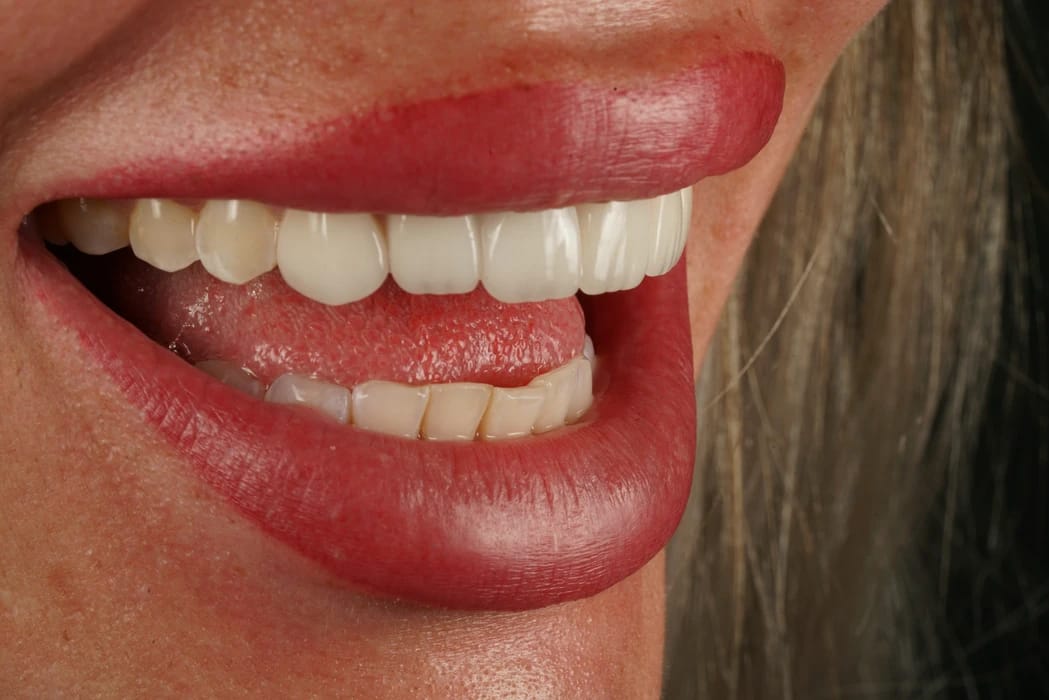
On a back tooth, an implant mainly has to chew. On a front tooth it also has to disappear into your smile: the gum line has to match the neighbouring teeth, the small triangles of gum between the teeth (papillae) should be present, and no grey metal should show through. These details depend on the bone and the gum around the implant, which is why the front of the upper jaw is called the aesthetic zone[2].
The bone on the outside of an upper front tooth is often very thin. After an extraction it can shrink, and the gum follows the bone. That is the main reason the timing of the implant matters more at the front than at the back[1][2]. The general implant process is explained on our dental implants in Antalya page.
Immediate, early or delayed placement
After a front tooth is removed, the implant can be placed on the same day (immediate), after the gum or the bone has partly healed (early), or after full healing (late). An ITI-led review grouped these with three loading timings, from a tooth on the same day to a crown after the usual healing period[3]:
| Placement | When | What the evidence shows |
|---|---|---|
| Immediate (type 1) | On the day of the extraction | More variable aesthetic results; gum recession over 1 mm in a median 26% of sites (range 9%–41%, eight studies)[1]. Survival with conventional loading 96.0%[3] |
| Early (types 2 and 3) | After soft-tissue healing (weeks) or partial bone healing (months) | No sites with recession over 1 mm in two studies; facial bone visible on CBCT in over 90% of sites in two studies with bone augmentation[1]. Survival with conventional loading 96.3%[3] |
| Late (type 4) | After full healing of the socket | Survival with conventional loading 97.7%[3] |
Survival figures are weighted cumulative survival rates from the review; they come from different study groups and are not a head-to-head comparison.
Immediate placement is not wrong; it is selective. Recent studies of immediate placement used strict selection criteria, including thick gum and an intact outer bone wall[1], and a 2017 review sets out when each timing suits which situation, based on the examination and 3D imaging[2]. In short: immediate placement is considered when the socket walls are intact and the gum is thick; when they are not, waiting a little usually gives a more predictable gum line[1][2].
A temporary tooth on the same day?
Many patients ask whether they will leave with a tooth. A temporary crown can be fixed on the implant on the day of surgery only if the site is suitable for loading and the implant achieves sufficient insertion torque. That is decided during the operation and is never guaranteed. The review above classed immediate restoration of an implant placed in a healed site as clinically documented, with 97.9% survival[3].
An implant-supported temporary crown (PMMA) costs €50 per tooth on our price list and appears in your written quote. If a fixed temporary is not possible, we discuss how the gap is covered during the healing months at the examination. In that case we use a removable or bonded temporary, such as a flipper (a removable temporary tooth) or a resin-bonded (Rochette-type) temporary bridge. Our guide to same-day dental implants explains what “same day” can and cannot mean, and the immediate loading protocol explains the stability checks.
Abutment, crown and shade
On a front tooth the abutment, the connector between implant and crown, is often custom-made to follow the gum contour. A 2025 network meta-analysis found that zirconia abutments caused less soft-tissue discolouration and fewer technical complications than titanium, with similar survival and gum health[5]. The parts are explained in our guide to the dental implant abutment.
| Option | Price | Notes |
|---|---|---|
| Standard abutment + Ti-base | Included in the implant price | When the gum hides the connection well |
| Custom / zirconia abutment | €100 | Only when needed, for example with thin gum |
| E.max crown (Ivoclar IPS e.max) | €250 | Glass ceramic, often chosen for front teeth |
| Zirconia crown (Amann Girrbach) | €185 | Made at our AG partner lab |
The right material depends on your gum, your bite and the neighbouring teeth; it is chosen with you at the examination. Prices are indicative; your final written quote follows the examination and X-rays and is valid for 30 days. Unless the treatment plan changes, the written price does not change.
Matching a single front tooth to its neighbours is a demanding shade task. We measure the shade with a VITA Easyshade digital spectrophotometer, use cross-polarised photography, and take into account the remaining natural teeth, your age, the white of the eyes and your skin tone. More on this in our tooth shade guide and zirconia vs porcelain crowns.
When bone or gum needs help first
If the outer bone wall is missing or thin, a graft may be placed before or with the implant; see dental bone graft. Treatments that rebuild bone lengthen healing: about 6 months on average instead of about 3 months, planned individually. Gum disease is treated before any implant.
Before surgery we take a panoramic X-ray. When a case needs a 3D (CBCT) scan, Dr. Ali Cem Ulubey reviews it to check the thickness of the outer bone wall and the position of the neighbouring roots.
Risks and honest limits
Implant crowns survive well, but complications are common enough to plan for. In a review of single implant crowns followed for at least 5 years[4]:
- implant survival was 97.2% at 5 years and 95.2% at 10 years; crown survival was 96.3% and 89.4%;
- the 5-year cumulative rate of aesthetic complications was 7.1%, soft-tissue complications 7.1% and screw loosening 8.8%.
- Gum recession that exposes the edge of the crown or a grey shadow, more often after immediate placement[1].
- Missing gum triangles (papillae) between the teeth, which can leave a dark space.
- Smoking, uncontrolled diabetes and gum disease, which affect healing; see who can get dental implants.
- Grinding and heavy biting on the front teeth; see teeth grinding (bruxism).
Timeline and length of stay
| Step | Time | What happens |
|---|---|---|
| Visit 1 | 4–5 days | Examination, X-ray, implant placement; a temporary if the conditions allow |
| Healing at home | About 3 months (about 6 months with bone grafting) | The implant fuses with the bone; planned individually |
| Visit 2 | 3–5 days | Scan, abutment and final crown |
Most patients can fly 24–48 hours after a single implant; your dentist confirms your flight day.
Our dental treatment stay planner and the guide on flying after dental implants help you plan the trips.
Front tooth implant cost in Antalya
| Combination | Price | Includes |
|---|---|---|
| Nucleoss implant + standard abutment + zirconia crown (Amann Girrbach) | From €485 | Implant, standard abutment and Ti-base, zirconia crown |
| Nucleoss implant + custom abutment + E.max crown | From €650 | Implant, custom aesthetic abutment, E.max crown |
| Straumann BLT implant + zirconia crown | €985 | Implant with standard abutment (€800) + zirconia crown (€185) |
| Implant-supported temporary crown (PMMA) | €50 | Only if a fixed temporary is possible |
| Bone graft (particulate) | €150 per cc | Only when needed |
Prices are indicative; your final written quote follows the examination and X-rays and is valid for 30 days. Unless the treatment plan changes, the written price does not change.
Your quote lists every item separately; the consultation and panoramic X-ray have no separate fee. See the full list on our dental treatment prices page or estimate your case with the single implant cost calculator.
Guarantee
The implant fixture carries the manufacturer’s lifetime guarantee. Amann Girrbach zirconia crowns and bridges made at our AG partner lab carry a 10-year fracture guarantee (AG-backed); crowns and bridges in other materials carry a 5-year clinic guarantee. Crown and bridge guarantees exclude fracture due to bruxism (teeth grinding), and patients who grind their teeth must wear the night guard we provide. All guarantees are conditional on attending the recommended check-ups and cover the prosthesis, not the root canal or filling beneath. Healing is biological: smoking, uncontrolled diabetes and gum health affect the result, and a fixture guarantee does not mean that every implant integrates. The full terms are on our written dental guarantee page.
Alternatives to an implant
An implant is not the only way to replace a front tooth. A bridge uses the neighbouring teeth as supports; this makes sense mainly when they already need crowns. A resin-bonded (Maryland) bridge is used only when really necessary, because it can come loose, so it suits patients who live nearby. Our comparison of dental implant vs bridge sets out the trade-offs.
Frequently asked questions
How much does a front tooth implant cost in Antalya?
At Ulubey Dental Clinic, a single front tooth implant with a Nucleoss implant, a custom aesthetic abutment and an E.max crown starts from €650. With a standard abutment and an Amann Girrbach zirconia crown it starts from €485. Bone grafting or a temporary crown is added only when needed. The written quote is valid for 30 days.
Can I get a front tooth implant on the same day as the extraction?
Sometimes. Immediate placement is considered when the socket walls are intact and the gum is thick. In a review of eight studies, immediate implants led to more than 1 mm of gum recession in a median 26% of sites, so when the bone or gum is thin, waiting a little usually gives a more predictable result.
Will I leave with a tooth after front implant surgery?
Only if the site is suitable for loading and the implant achieves sufficient insertion torque; this is decided during surgery and is never guaranteed. An implant-supported temporary crown costs €50. If a fixed temporary is not possible, we discuss how the gap is covered during healing at the examination.
How long does a front tooth implant take?
Usually two trips. The first visit takes 4 to 5 days for the examination and implant placement. After about 3 months of healing, or about 6 months with bone grafting, the second visit of 3 to 5 days is for the abutment and the final crown. Healing is planned individually.
Will a front tooth implant look natural?
It can, but the result depends mostly on the bone and gum around the implant. Reviews report a 7.1% cumulative rate of aesthetic complications at 5 years. A custom abutment, careful shade matching and the right placement timing reduce the risk; we explain your individual situation at the examination.
Is a zirconia or titanium abutment better for a front tooth?
Both are clinically successful. A 2025 network meta-analysis found similar survival and gum health, with less soft-tissue discolouration and fewer technical complications for zirconia. Zirconia is often chosen when the gum is thin; a custom or zirconia abutment costs €100 at our clinic.
Sources
- Chen ST, Buser D. Esthetic outcomes following immediate and early implant placement in the anterior maxilla: a systematic review. Int J Oral Maxillofac Implants. 2014;29 Suppl:186-215. PMID 24660198. pubmed.ncbi.nlm.nih.gov/24660198
- Buser D, Chappuis V, Belser UC, Chen S. Implant placement post extraction in esthetic single tooth sites: when immediate, when early, when late? Periodontol 2000. 2017;73(1):84-102. PMID 28000278. pubmed.ncbi.nlm.nih.gov/28000278
- Gallucci GO, Hamilton A, Zhou W, Buser D, Chen S. Implant placement and loading protocols in partially edentulous patients: a systematic review. Clin Oral Implants Res. 2018;29 Suppl 16:106-134. PMID 30328194. pubmed.ncbi.nlm.nih.gov/30328194
- Jung RE, Zembic A, Pjetursson BE, Zwahlen M, Thoma DS. Systematic review of the survival rate and the incidence of biological, technical, and aesthetic complications of single crowns on implants reported in longitudinal studies with a mean follow-up of 5 years. Clin Oral Implants Res. 2012;23 Suppl 6:2-21. PMID 23062124. pubmed.ncbi.nlm.nih.gov/23062124
- Al-Mohammad YN, Kelly C, Martinekova P, et al. Zirconia, titanium, and polyetheretherketone implant abutments show equal long-term clinical success: a systematic review and network meta-analysis. Periodontol 2000. 2025;99(1):268-283. PMID 41326963. pubmed.ncbi.nlm.nih.gov/41326963
This article is general patient information and does not replace a clinical examination or X-rays.
Editor contact: [email protected] · ulubeydental.com/contact-us