Tooth Decay: Signs, Stages and Treatment Options
This page is general information and does not replace an examination.
Tooth decay (dental caries) is a disease in which plaque bacteria turn sugars into acid that slowly dissolves the tooth[1][2]. It often causes no symptoms at first; later you may notice white, brown or black spots, sensitivity to sweet, hot or cold, or toothache[3]. Early decay can be stopped with fluoride and better cleaning; a cavity usually needs a filling, and decay that reaches the nerve may need root canal treatment[3]. Only an examination with X-rays shows how deep it goes.
What is tooth decay?
Tooth decay, or dental caries, is damage to the hard tissues of the tooth caused by acid. Plaque that stays on the tooth surface converts free sugars from food and drink into acids, and over time those acids destroy the tooth[2].
It is not a one-way process. A review in Nature Reviews Disease Primers describes caries as a “biofilm-mediated, sugar-driven, multifactorial, dynamic disease” with phases of demineralisation and remineralisation[1]. That is why very early decay can be stopped, while a cavity that has broken through the surface cannot heal by itself.
Decay can affect children’s and adults’ teeth throughout life, and in later life also exposed root surfaces[1].
Signs and stages of tooth decay
Tooth decay may not cause any symptoms at first. As it gets worse, a hole (cavity) can form, and you may notice toothache, sharp pain with hot, cold or sweet food and drink, or white, brown or black spots on the tooth[3]. The table shows what usually happens at each depth. It is a guide, not a way to diagnose yourself.
| Stage | What happens | What you may notice | What a dentist may do |
|---|---|---|---|
| Early lesion in enamel | Minerals are lost from the enamel surface, but there is no hole yet[1] | Often nothing; sometimes a chalky white spot[3] | Fluoride treatment and better cleaning to stop it[3] |
| Cavity in enamel and dentine | The surface breaks down and a hole forms[3] | Sensitivity to sweet, hot or cold; a brown or black spot[3] | Remove the decay and place a filling[3] |
| Deep decay near the pulp | Decay approaches the soft tissue in the centre of the tooth | Stronger or longer-lasting pain | A filling with a protective layer over the pulp, or root canal treatment if the pulp is affected[3] |
| Pulp involved or infection | Decay has reached the pulp; infection can form a dental abscess[3][5] | Toothache, swelling, a bad taste, sometimes fever[5] | Root canal treatment; extraction if the tooth cannot be saved[3] |
Sources: Pitts 2017 [1], NHS [3][5]. You may cite this table with a link to this page.
What causes tooth decay?
WHO names three drivers: a continued high intake of free sugars, inadequate exposure to fluoride, and plaque that is not removed by toothbrushing[2]. The Cochrane review on fluoride toothpaste describes the same balance between plaque bacteria and fermentable carbohydrates, mainly sugars, over time[4].
- A continued high intake of free sugars. Free sugars include sugar added to food and drink plus the sugars in honey, syrups and fruit juices[2].
- Plaque left on the teeth, especially between the teeth and along the gum line.
- Too little fluoride in toothpaste or water[2].
- Exposed roots in later life are more vulnerable than enamel[1].
The balance between these harmful and protective factors is why dentists speak of a personal “caries risk” and adapt prevention to it[1].
How a dentist checks for decay
A dentist looks at each tooth, checks sensitive areas and uses X-rays to see what the eye cannot: decay between teeth, under old fillings and how close it is to the pulp. At our clinic every patient has a panoramic X-ray as the basis of diagnosis, and we take periapical X-rays in the clinic when a tooth needs a closer look. A tooth that looks sound can still have decay underneath, and a dark spot is not always active decay; only the examination decides.
Treatment options by depth
Treatment depends on how severe the decay is[3]. The aim is always to keep as much healthy tooth as possible.
| Option | When it is used | What to know |
|---|---|---|
| Fluoride treatment and prevention | Early decay without a cavity | A dentist can prescribe fluoride treatments to reverse early decay[3] |
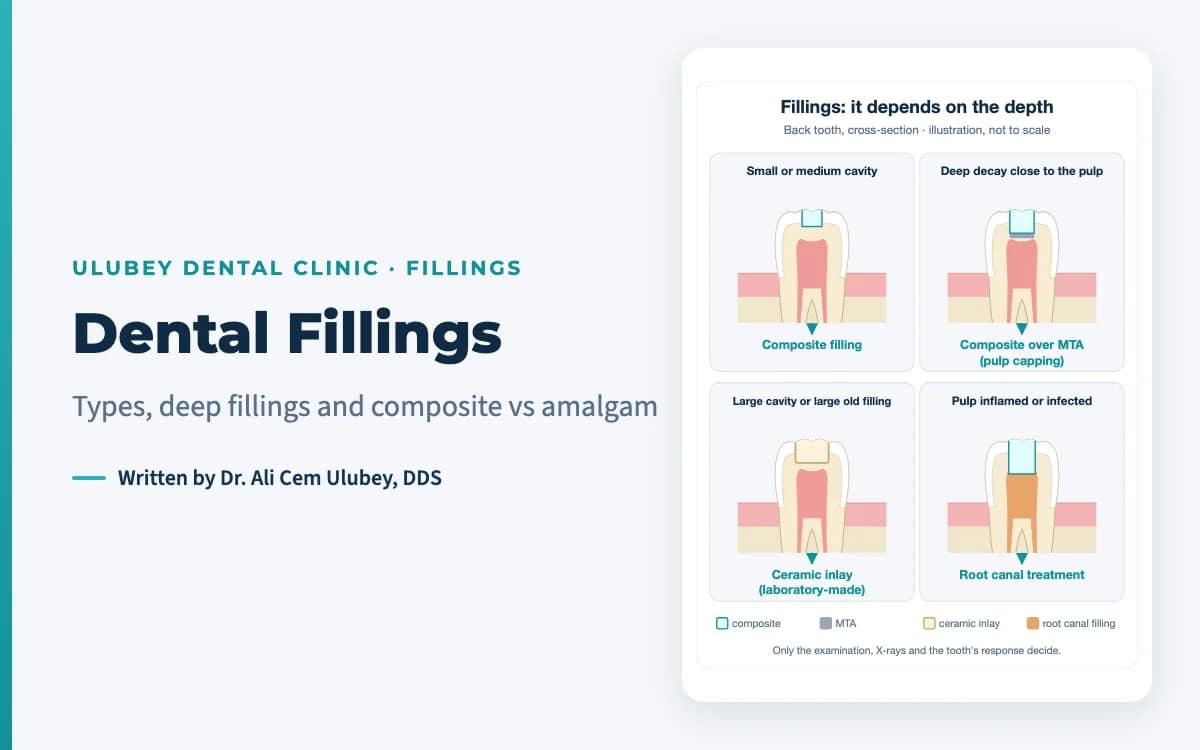
| Composite filling | A cavity of small to medium size | Tooth-coloured resin bonded to the tooth and hardened with a curing light |
| Filling with pulp protection (MTA) | Deep decay close to the nerve | A protective layer is placed over the pulp under the filling to help keep it alive |
| Ceramic inlay or onlay | A large cavity in a back tooth where a direct filling may not last well | Made to measure and bonded; an onlay also covers cusps |
| Crown | Too little tooth left for a filling or inlay | Covers the whole tooth; see zirconia crowns |
| Root canal treatment | Decay has reached the pulp[3] | Cleans and seals the canals so the tooth can be kept; see root canal treatment |
| Extraction | The tooth cannot be saved[3] | The gap can later be replaced, for example with an implant or a bridge |
Prices for fillings, inlays, crowns and root canal treatment are listed on our dental treatment prices page. Your written quote follows the examination and X-rays.
Decay around crowns, veneers and implants
A crown or veneer does not decay, but the natural tooth underneath and at its edges still can. In a systematic review of porcelain and glass-ceramic veneers (13 studies, median follow-up 9 years), secondary caries occurred in about 1% of veneers[6]. Cleaning along the edges of restorations is therefore just as important as for natural teeth.
Dental implants are not tooth tissue, so they cannot decay. The risk around implants is different: plaque can inflame the tissues around them and, in peri-implantitis, lead to progressive bone loss[7]. See dental implant failure for the warning signs.
Our crown, bridge and veneer guarantees cover the prosthesis, not the root canal or filling beneath it, and are conditional on attending recommended check-ups; see our written dental guarantee.
Prevention that works
- Fluoride toothpaste every day. Regular brushing with fluoride toothpaste is the main non-professional measure to prevent decay; higher fluoride concentrations are associated with more caries control, but they raise the risk of enamel fluorosis in developing teeth, so children’s toothpaste strength follows your dentist’s advice[4].
- Fewer free sugars. WHO links a continued high intake of free sugars to caries[2].
- Clean between the teeth with floss or interdental brushes, where a toothbrush does not reach.
- Regular check-ups, even without symptoms[3].
How we treat decay at our clinic
Both of our dentists, Dr. Ali Cem Ulubey and Dr. Surur Ulubey, treat decay themselves; there are no rotating dentists. The workflow:
- Diagnosis: examination plus a panoramic X-ray for every patient; periapical X-rays in the clinic when needed.
- Isolation: we use rubber dam isolation, which keeps the tooth dry while composite is bonded.
- Materials: tooth-coloured composites (Tokuyama Estelite, GC, 3M), cured with a Dentsply Sirona SmartLite Pro light; MTA when the pulp needs protection.
- Larger restorations: inlays, onlays and crowns are designed from a Dentsply Sirona Primescan digital scan with our partner laboratory.
- Children: we treat children, generally from about 5–6 years of age if the child cooperates.
Frequently asked questions
Can tooth decay be reversed?
Early decay, before a hole has formed, can be stopped and the enamel can remineralise with fluoride and better cleaning. A dentist can prescribe fluoride treatments for this. Once a cavity has broken through the surface, it cannot heal by itself and usually needs a filling. Only an examination with X-rays shows which stage a tooth is at.
Does tooth decay always hurt?
No. Tooth decay may not cause any symptoms at first, which is why check-ups and X-rays matter. Pain, sensitivity to sweet, hot or cold, or a visible dark spot usually appear once a cavity has formed. Severe pain, swelling or a bad taste can mean the pulp is involved or an abscess has formed, which needs prompt dental treatment.
What does a cavity look like?
Early decay may show as a chalky white spot. A cavity often looks like a brown or black spot or a small hole, but decay between teeth or under old fillings is usually invisible to the eye and is found on X-rays. A dark line is not always active decay, so a dentist should examine the tooth before anything is drilled.
Can I have a cavity filled while I am on holiday?
Yes. At our clinic a composite filling is usually completed in one appointment, and there is no flight restriction afterwards. If the decay is deep, the tooth may need root canal treatment or an inlay, onlay or crown, which can take more time. We confirm the plan and the written quote after the examination and X-rays, before any treatment starts.
Can a tooth with a crown still get decay?
The crown itself cannot decay, but the natural tooth at its edges and underneath can. A systematic review of ceramic veneers found secondary caries in about 1% of veneers over a median of 9 years. Brushing along the gum line, cleaning between the teeth and regular check-ups protect the tooth beneath any crown or veneer.
How can I prevent tooth decay?
Brush twice a day with fluoride toothpaste, clean between the teeth, cut down on sugary food and drinks, and keep regular check-ups even without symptoms. Daily fluoride toothpaste is considered the main reason decay has declined worldwide. Your dentist can adjust prevention to your personal risk, for example if you have exposed roots or many fillings.
Sources
- Pitts NB, Zero DT, Marsh PD, et al. Dental caries. Nat Rev Dis Primers. 2017;3:17030. pubmed.ncbi.nlm.nih.gov/28540937
- World Health Organization. Oral health (fact sheet; accessed 25 October 2026). www.who.int/news-room/fact-sheets/detail/oral-health
- NHS. Tooth decay (accessed 25 October 2026). www.nhs.uk/conditions/tooth-decay
- Walsh T, Worthington HV, Glenny AM, Marinho VC, Jeroncic A. Fluoride toothpastes of different concentrations for preventing dental caries. Cochrane Database Syst Rev. 2019;3:CD007868. pubmed.ncbi.nlm.nih.gov/30829399
- NHS. Dental abscess (accessed 25 October 2026). www.nhs.uk/conditions/dental-abscess
- Morimoto S, Albanesi RB, Sesma N, Agra CM, Braga MM. Main clinical outcomes of feldspathic porcelain and glass-ceramic laminate veneers: a systematic review and meta-analysis of survival and complication rates. Int J Prosthodont. 2016;29(1):38-49. pubmed.ncbi.nlm.nih.gov/26757327
- Berglundh T, Armitage G, Araujo MG, et al. Peri-implant diseases and conditions: consensus report of workgroup 4 of the 2017 World Workshop. J Periodontol. 2018;89 Suppl 1:S313-S318. pubmed.ncbi.nlm.nih.gov/29926955
This article is general patient information and does not replace a clinical examination or X-rays.
Editor contact: [email protected] · ulubeydental.com/contact-us