
Children’s Dentist in Antalya: Sealants, Fluoride, Check-ups
This page is general information and does not replace an examination.
At Ulubey Dental Clinic in Antalya, children are treated by Dr. Surur Ulubey, generally from about 5–6 years of age if the child cooperates. We check teeth, treat cavities, and protect teeth with fissure sealants and fluoride. A Cochrane review found that sealants on permanent back teeth reduced decay by between 11% and 51% at 24 months[2]. Families living in or visiting Antalya can come Monday to Saturday, 09:00–19:00; children’s treatment is priced in a written quote after the examination.
- 1. A children’s dentist in Antalya
- 2. What we do for children
- 3. Fissure sealants
- 4. Fluoride for children
- 5. Cavities in children’s teeth
- 6. Caring for baby and new adult teeth at home
- 7. Your child’s first visit with us
- 8. Accidents and urgent problems
- 9. Families living in or visiting Antalya
- 10. Frequently asked questions
- 11. Sources
A children’s dentist in Antalya
Children at Ulubey Dental Clinic are seen by Dr. Surur Ulubey, DDS, one of the clinic’s two founding dentists. We generally treat children from about 5–6 years of age, if the child is able to cooperate with treatment. If your child is younger, write to us first and we will tell you honestly whether we are the right place.
Neither of our dentists holds a formal specialist title in paediatric dentistry; Dr. Surur is a general dentist who treats our child patients.
What we do for children
| Service | What it involves | When it is used |
|---|---|---|
| Check-up | Looking at every tooth and the gums, cleaning advice for parent and child | Regular check-ups as advised by the dentist |
| Fissure sealants | A thin protective coating on the grooves of the back teeth | Once the permanent back teeth have started to come through, usually at about 6–7 years, and again at 11–14 years[1] |
| Fluoride application | A high-fluoride preparation painted onto the teeth | To help prevent decay; the NHS says children from age 3 should be offered fluoride varnish at least twice a year[1] |
| Fillings | Tooth-coloured composite fillings for cavities | When decay has formed a hole in the tooth |
| Orthodontic assessment | We offer fixed braces and Invisalign | When the bite or tooth position needs correction; timing is decided at the examination |
Children’s treatment is not listed on our price page; it is priced in a written quote after the examination.
Fissure sealants
The chewing surfaces of the back teeth have deep grooves (fissures) where food and bacteria collect. A fissure sealant is a thin plastic coating that covers these grooves to keep germs and food out; the NHS says it protects the teeth from decay and lasts up to 4 years[1].

The evidence is solid. A Cochrane review of 38 trials with 7,924 children found that resin-based sealants on the first permanent molars of children aged 5 to 10 prevented decay; at 24 months they reduced decay by between 11% and 51% compared with no sealant (moderate-quality evidence), and the benefit continued up to 48 months[2]. No adverse effects occurred where these were reported[2].
Sealing usually needs no drilling or injection: the tooth is cleaned and dried, and the sealant is painted into the grooves and hardened with a light. Because a sealant lasts up to about 4 years[1], it is checked again at later check-ups.
Fluoride for children
Fluoride strengthens tooth enamel and makes it more resistant to decay[1]. A Cochrane review of 22 trials (12,455 children and adolescents) found that fluoride varnish reduced decayed, missing and filled surfaces by 43% in permanent teeth and by 37% in baby teeth, compared with placebo or no treatment (moderate-quality evidence)[3].
At home, fluoride toothpaste is the daily foundation. The NHS advises children’s fluoride toothpaste with at least 1,000 ppm fluoride and only a smear of toothpaste under 3 years, a pea-sized amount from 3 to 6 years, and 1,350–1,500 ppm from age 7[1]. Children should spit out after brushing and not rinse, so the fluoride keeps working[1].
Cavities in children’s teeth
Tooth decay may cause no symptoms at first; later a child may complain of toothache or sensitivity to sweet, hot or cold, or you may see white, brown or black spots on the teeth[6]. The NHS notes that tooth decay is common in children and advises seeing a dentist as soon as possible if you think your child has it[6].
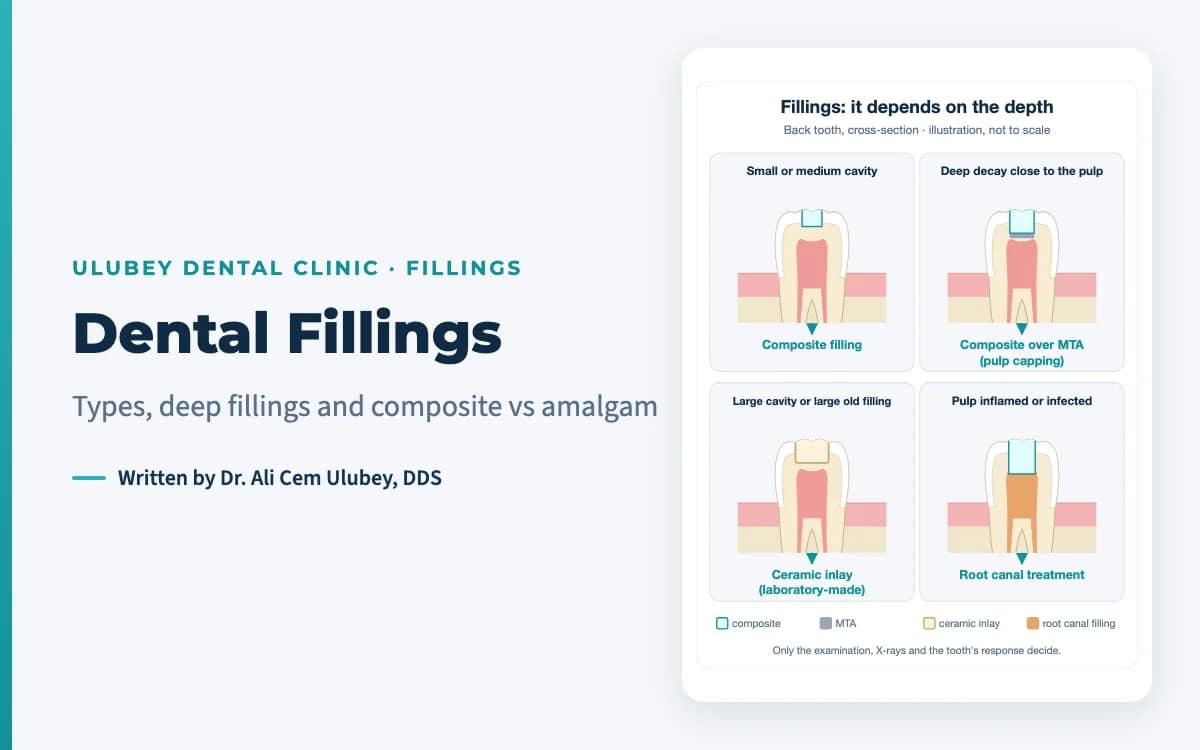
When we find a cavity, we explain to the child, in simple words, what we are going to do before we do it. Small cavities are usually treated with a tooth-coloured composite filling. Each tooth is assessed at the examination, and we discuss the options with you before any treatment.
Tooth decay is often caused by too much sugary food and drink and not cleaning the teeth and gums regularly[6]. The NHS advises not having too much sugary food or drink, using sugar-free medicines, and cleaning between the teeth every day with floss or interdental brushes[6].
Caring for baby and new adult teeth at home
- Brush twice a day for about 2 minutes, last thing at night and at one other time[1].
- Help or supervise brushing until your child is at least 7 years old[4].
- Use a small, soft toothbrush and small circular movements, including the gums and the backs of the teeth[1].
- Spit, don’t rinse after brushing[1].
- Watch the new molars: the first permanent back teeth come through behind the baby teeth at about 6–7 years and are easy to miss when brushing; they are the teeth sealants protect[1].

Your child’s first visit with us
The first visit is mainly about getting to know each other. Being positive about the visit at home helps; the NHS advises parents to make the trip fun so the child does not worry about future visits[1].
- Meet first: Dr. Surur talks with you and your child before anything is done.
- Explain, then do: every step is explained honestly and clearly, in words a child understands.
- A stop signal: we agree a signal, such as raising a hand, that pauses treatment at any time.
- No pressure: if a child is not ready, we do not force treatment; we agree with you when to continue.
- A calm setting: a quiet treatment room, and your child can listen to their own music.
Please bring any previous dental records or X-rays, and tell us about medicines, allergies or medical conditions.
Accidents and urgent problems
Children often chip or knock out teeth while playing. The NHS advises that a knocked-out baby tooth should not be put back, because it could damage the adult tooth growing underneath[5]. A knocked-out or badly broken adult tooth needs treatment as soon as possible, ideally within 30 minutes to 1 hour; if the tooth is whole and clean, try to put it back without touching the root, or keep it in milk[5].
We see urgent problems the same day within clinic hours, Monday to Saturday, 09:00–19:00. On Sundays the clinic is closed; write to us on WhatsApp for urgent cases. For swelling, fever or difficulty breathing or swallowing, use the emergency numbers at the top of this page. See also Emergency dental care in Antalya.
Families living in or visiting Antalya
Our clinic is near the Lara hotels, at Barınaklar Bulvarı No:109A, Çağlayan, Muratpaşa, about 300 m from Düden Park and about 12 km (about 15 minutes by car) from Antalya Airport. There is parking at the building and a public-transport stop at the clinic door.
- Expat families: children can have regular check-ups, sealants and fluoride with the same dentist over the years.
- Families on holiday: walk-in patients are welcome Monday to Saturday, 09:00–19:00; see dentist in Antalya on holiday.
- Persian-speaking families: Dr. Surur is a native Farsi speaker; see Iranian dentist in Antalya.
- Parents’ treatment: parents can have their own check-up or treatment with Dr. Ali Cem Ulubey or Dr. Surur Ulubey; see general dentistry in Antalya.
Children’s treatment is priced in a written quote after the examination; we do not publish children’s prices. Payment is made at the clinic for the treatment done.
Frequently asked questions
From what age do you treat children?
Dr. Surur Ulubey treats children at our clinic, generally from about 5–6 years of age, if the child is able to cooperate with treatment. If your child is younger, write to us first on WhatsApp with your child’s age and the problem, and we will tell you honestly whether we are the right place or whether another practice would suit better.
Are fissure sealants worth it?
For many children, yes. A Cochrane review of 38 trials found that resin sealants on the first permanent molars reduced decay by between 11% and 51% at 24 months compared with no sealant, with the benefit continuing up to 48 months. Sealing usually needs no drilling or injection, and the NHS notes a sealant lasts up to about 4 years, so it is checked again at later check-ups.
Is fluoride safe for my child?
Fluoride used as directed is the main tool for preventing decay. Professionally applied fluoride varnish reduced decay in children’s permanent teeth by 43% in trials. At home, follow the toothpaste amounts for your child’s age: a smear under 3 years and a pea-sized amount from 3 to 6. Make sure children do not eat or lick toothpaste from the tube.
My child is scared of the dentist. Can you help?
Yes. Dr. Surur meets your child first and explains each step honestly before doing it. We agree a stop signal, such as raising a hand, which pauses treatment at any time. We do not force treatment: if your child is not ready, we agree with you when to continue. Your child can also listen to their own music.
Can you see my child while we are on holiday in Antalya?
Yes. Walk-in patients are welcome Monday to Saturday, 09:00–19:00, and urgent problems are seen the same day within clinic hours. On Sundays the clinic is closed, but you can write to us on WhatsApp for urgent cases. Please bring any dental records or X-rays and tell us about medicines and allergies.
How much does children’s dental treatment cost?
We do not publish fixed prices for children’s treatment. After the examination, you receive a written quote for the treatment your child needs, such as sealants, fluoride or fillings, before anything is done. The consultation carries no fee. No deposit is required for treatment; you pay at the clinic for the treatment done.
Sources
- NHS. Children’s teeth (page last reviewed 30 June 2025; accessed 25 October 2026). www.nhs.uk/live-well/healthy-teeth-and-gums/taking-care-of-childrens-teeth
- Ahovuo-Saloranta A, Forss H, Walsh T, Nordblad A, Mäkelä M, Worthington HV. Pit and fissure sealants for preventing dental decay in permanent teeth. Cochrane Database Syst Rev. 2017;7:CD001830. pubmed.ncbi.nlm.nih.gov/28759120
- Marinho VC, Worthington HV, Walsh T, Clarkson JE. Fluoride varnishes for preventing dental caries in children and adolescents. Cochrane Database Syst Rev. 2013;7:CD002279. pubmed.ncbi.nlm.nih.gov/23846772
- NHS. How to keep your teeth clean (page last reviewed 30 June 2025; accessed 25 October 2026). www.nhs.uk/live-well/healthy-teeth-and-gums/how-to-keep-your-teeth-clean
- NHS. Dental treatments (page last reviewed 8 July 2026; accessed 25 October 2026). www.nhs.uk/live-well/healthy-teeth-and-gums/dental-treatments
- NHS. Tooth decay (accessed 25 October 2026). www.nhs.uk/conditions/tooth-decay
This article is general patient information and does not replace a clinical examination or X-rays.
Editor contact: [email protected] · ulubeydental.com/contact-us