Tooth Shade Guide: VITA Chart, B1, Bleach Shades, Turkey Teeth Colour
Quick answer: A tooth shade guide is the set of reference tabs a dentist holds next to your teeth to match the colour of crowns and veneers. The VITA classical guide has 16 natural shades, A1 to D4, in four hue groups[1]. Bleach shades go beyond the natural tabs: VITA’s are 0M1, 0M2 and 0M3[1], while BL1–BL4 belong to Ivoclar’s guide[2]. At Ulubey Dental Clinic in Antalya, Dr. Ali Cem Ulubey and Dr. Surur Ulubey measure the shade with a VITA Easyshade spectrophotometer and cross-polarized photography.
Many patients ask us for “the whitest shade”. This guide explains how the shade charts work, what the codes mean (A1, B1, 0M1, BL1), why a chart on a screen cannot be used to choose a shade, and what to ask any clinic before a shade is agreed. The first half answers patient questions; the second half keeps the clinical detail for readers who want it.
📋 Contents
- 1. Teeth shade chart: the guides dentists use
- 2. “Turkey teeth colour chart”: what clinics in Turkey use
- 3. Is B1 too white? B1, A1 and bleach shades
- 4. How to choose a natural veneer or crown shade
- 5. What to ask a clinic before you agree a shade
- 6. How we choose your shade at Ulubey Dental
- 7. Hue, value and chroma
- 8. VITA classical A1–D4 in detail
- 9. VITA 3D-MASTER in detail
- 10. Bleach shades: 0M1–0M3 (VITA) and BL1–BL4 (Ivoclar)
- 11. Translucency, opalescence and fluorescence
- 12. Light, eye fatigue and metamerism
- 13. Spectrophotometers, photos and ΔE
- 14. Facial harmony: why the shade is judged in person
- 15. Stump shade: the colour under a veneer
- 16. Shade code decoder
- 17. FAQ
- 18. Sources
Planning Veneers or a Smile Makeover in Antalya?
Calculate treatment estimates and evaluate ceramic materials with our clinical tools:
👉 Hollywood Smile & Veneers Cost Calculator |
👉 Antalya Dental Treatment Prices 2026 Directory
Teeth shade chart: the tooth shade guides dentists actually use
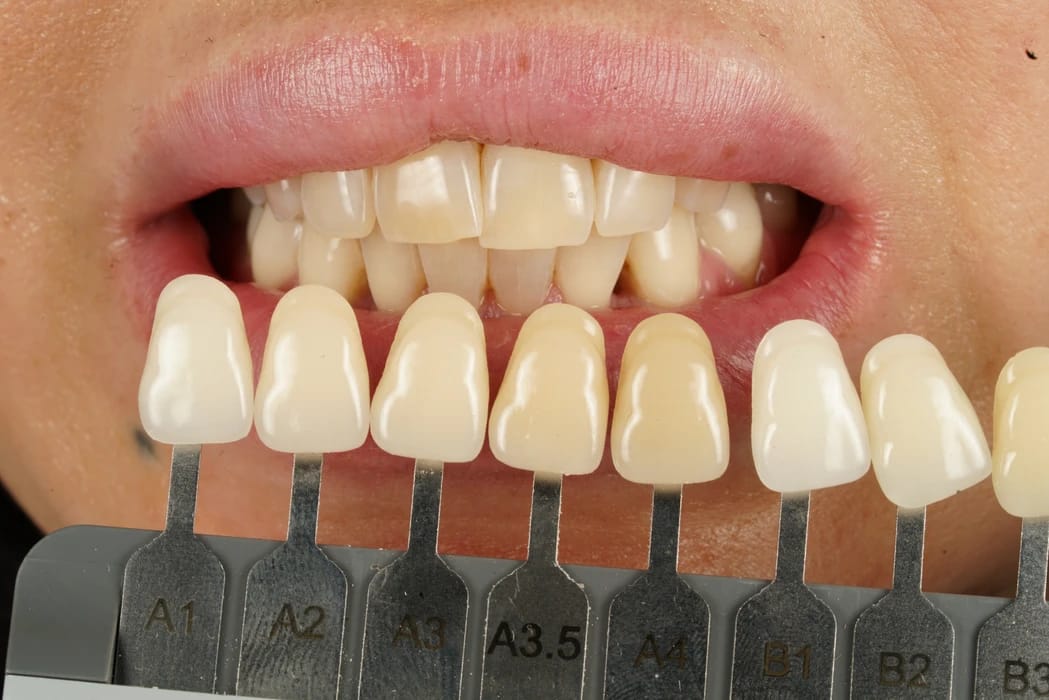
A teeth shade chart is a physical set of tooth-shaped tabs. The dentist holds a tab next to your tooth and picks the closest match. The tab code then goes to the dental laboratory so the crown or veneer is made in that colour.
The VITA classical A1–D4 guide has 16 tabs in four hue groups, named by the maker as: A reddish-brownish, B reddish-yellowish, C greyish and D reddish-greyish[1]. Within each group the tabs are arranged by chroma, meaning how intense the colour is[13].
The VITA 3D-MASTER guide is organised differently. You first choose lightness from five groups, then chroma, then whether the tooth is more yellowish (L) or more reddish (R) than the middle tab[9]. A code such as 2L1.5 therefore reads: lightness group 2, hue L, chroma 1.5[5]. More detail is in VITA 3D-MASTER in detail.
A chart on a phone or monitor is not a shade guide. Screens and cameras change colour. In one study summarised in a 2023 systematic review, colour values read from a computer screen differed from a colorimeter reading (ΔE 2.3)[12]. The VITA instructions describe holding the physical tab next to the tooth, preferably in natural daylight or under a standardised daylight lamp[1]. Use online charts to learn the codes, not to choose.
| Guide | Maker | Shade codes | What it is used for | Source |
|---|---|---|---|---|
| VITA classical A1–D4 | VITA Zahnfabrik | 16 tabs: A1, A2, A3, A3.5, A4 · B1, B2, B3, B4 · C1, C2, C3, C4 · D2, D3, D4 | Matching natural tooth colour for crowns, veneers, fillings | [1] |
| VITA Bleached Shades (add-on to classical) | VITA Zahnfabrik | 0M1, 0M2, 0M3 (taken from 3D-MASTER) | Determining the shade of bleached teeth | [1] |
| VITA Toothguide 3D-MASTER | VITA Zahnfabrik | Lightness group + hue (L/M/R) + chroma, e.g. 1M1, 2L1.5, 3M2 | Step-by-step matching: lightness, then chroma, then hue | [9] |
| A–D shade guide with Bleach shades | Ivoclar | 16 A–D shades + 4 bleach shades BL1–BL4 | Shade selection for the A–D and Bleach system (used with IPS e.max) | [2] |
| IPS Natural Die Material guide | Ivoclar | ND1–ND9 | Shade of the prepared tooth (stump), for all-ceramic restorations | [2] |
“Turkey teeth colour chart”: what clinics in Turkey use
There is no special “Turkey teeth colour chart”. Clinics in Turkey use the same international guides as clinics in the UK or Germany: the VITA classical A1–D4 guide, the VITA 3D-MASTER guide and a bleach extension[1][2][9].
A common mix-up, corrected. Many web pages and some AI answers describe BL1–BL4 as “VITA bleach shades”. They are not. VITA’s bleached shades are 0M1, 0M2 and 0M3, taken from the VITA 3D-MASTER system[1]. BL1–BL4 are the four bleach shades of Ivoclar’s A–D guide[2]. In the manufacturer documents we checked, there is no official one-to-one conversion between a BL tab and a 0M tab, so a quote that says “BL1” and one that says “0M1” are not automatically the same colour. Ask which guide was used.
The shade code is only one part of the “Turkey teeth” look. For what the term means and how it happens, read what "Turkey teeth" really means.
Is B1 too white? B1, A1 and the bleach shades compared
Two terms help: value is how light or dark a tooth is; hue is which colour family it belongs to[13]. B1 and A1 are both light natural tabs. They differ in hue: A is reddish-brownish, B is reddish-yellowish[1].
In the lightness (value) order of the VITA classical guide used in published studies, B1 is listed first (lightest) and A1 second[16][19]. That order is a guide, not a law: when 15 observers sorted the classical tabs by eye from lightest to darkest, their order matched the suggested order for only 7 of the 16 tabs[10].
So is B1 too white? Not by itself. B1 is a natural tab. Whether it looks right on you depends on your remaining natural teeth, your age (teeth tend to become darker and more yellow with age[6]) and how many teeth are being restored. Lightness matters most to how a smile is rated: in a 2025 study of digitally edited smile photos, changes in lightness (L*) had the largest effect on attractiveness scores, and the raters’ background, sex and age changed how colour was judged[7]. That study does not show that lighter is always better or worse.
Whether any shade, including a bleach shade (BL or 0M), suits you is judged with the physical tab next to your teeth, not from a chart[1].
| Shade | Guide | Hue family | Where it sits | Reachable with whitening? |
|---|---|---|---|---|
| A1 | VITA classical | Reddish-brownish (A)[1] | Light natural tab | Varies per person; cannot be promised to a specific tab[11] |
| B1 | VITA classical | Reddish-yellowish (B)[1] | Light natural tab; listed lightest in the value order used in studies[16][19] | Varies per person; cannot be promised to a specific tab |
| 0M1, 0M2, 0M3 | VITA Bleached Shades (from 3D-MASTER) | M (middle hue)[9] | Bleach shades beyond the natural tabs[1] | Varies per person; cannot be promised |
| BL1–BL4 | Ivoclar A–D guide with Bleach shades | – (bleach set) | Bleach shades beyond the A–D tabs[2] | Varies per person; cannot be promised |
How to choose a natural veneer or crown shade
Start from your own teeth. Natural teeth are not pure white, and they vary. In 1,361 Spanish people aged 16–89 measured with a spectrophotometer, the most frequent shade was 3M1 (7.05%), followed by 1M1.5 (6.91%) and 2L1.5 (6.02%)[5]. In 674 Korean people aged 16–89, the most frequent shade was 2L1.5; teeth became darker and more yellow with age, and women’s incisors were on average lighter than men’s[6].
If you are restoring only a few teeth, the new crowns or veneers have to match the teeth that stay. A shade far lighter than your other teeth will stand out.
If you want your own teeth lighter too, whiten first. Whitening works on natural teeth only; tooth-coloured crowns, veneers and fillings do not change colour[11]. So the order is whitening first, then matching the restorations to the whitened teeth. See whitening before veneers.
Think about the tooth underneath. Thin veneers let some colour through from the prepared tooth: in a laboratory study, both veneer thickness and the shade of the tooth underneath changed the result[21] (see stump shade).
Full smile or a few teeth? When every visible tooth is restored there is no natural neighbour to match, and the choice becomes more personal. This is where a full smile design plan and an honest conversation help. Compare options on our porcelain veneers in Antalya page.
What to ask a clinic before you agree a shade
Use these questions with any clinic, in Turkey or at home.
| Question | Why it matters | Source |
|---|---|---|
| Which shade guide will you use (VITA classical, 3D-MASTER, Ivoclar BL)? | Codes from different guides are not interchangeable; “BL1” and “0M1” come from different makers | [1][2] |
| Will you take the shade before you prepare my teeth? | After preparation the tooth looks lighter because it dries out | [1] |
| What light do you use for shade taking? | The maker recommends daylight or a standardised daylight lamp (5500–6500 K), not normal room light; light source changes the match | [1][8] |
| Do you check the shade by eye and with an instrument? | Instrumental and visual matching complement each other | [4] |
| Will I see a try-in before the restorations are finished? | You can judge colour and shape in your own mouth before the work is fixed | Practical question |
| Will the shade code be written in my treatment records? | You or a future dentist can match a repair to the same code | Practical; see treatment record handover checklist |
How we choose your shade at Ulubey Dental (Antalya)
Your shade is chosen by the two dentists who treat you, Dr. Ali Cem Ulubey and Dr. Surur Ulubey. Dr. Surur’s clinical focus is aesthetic dentistry.
- Measured, not guessed. We measure the shade with a VITA Easyshade spectrophotometer and photograph the teeth with cross-polarized photography, which removes surface glare so the laboratory can see the inner colour.
- Your face, not only your teeth. We also look at the white of your eyes and your skin tone (see facial harmony).
- Try-in for crowns. In our fully digital crown workflow, the crown is usually tried in one day after preparation, before it is finished, so you see colour and shape in your own mouth first.
- Materials. Our glass-ceramic is Ivoclar IPS e.max; our zirconia is Amann Girrbach.
- Guarantee (written conditions). Under our written terms, zirconia crowns and bridges made of Amann Girrbach material at our partner lab carry a 10-year fracture guarantee; crowns and bridges in other materials carry a 5-year clinic guarantee. Crown and bridge guarantees exclude fracture due to bruxism (teeth grinding), and patients who grind their teeth must wear the night guard we provide. E.max veneers carry a 5-year guarantee against fracture or debonding (excl. trauma, bruxism without night guard), conditional on attending check-ups. All guarantees are conditional on attending the recommended check-ups and cover the prosthesis, not the root canal or filling beneath it. Full terms: our written dental guarantee.
- Prices are not repeated here; see current veneer and crown prices or estimate your veneer cost. For crowns in zirconia see zirconia crowns.
Hue, value and chroma: the three dimensions of tooth colour
Dental shade analysis uses Albert Munsell’s three-dimensional colour system, as described in the prosthodontic literature[13]:
Hue is the colour family, set by which wavelengths of light the tooth reflects. In natural teeth it lies mainly in the yellow-red range. The VITA classical guide names its groups A reddish-brownish, B reddish-yellowish, C greyish and D reddish-greyish[1].
Measures lightness or darkness along an achromatic scale from black to white. In a 2025 study, changes in lightness (L*) had the largest effect on rated smile attractiveness[7].
Represents the purity or concentration of the Hue. Within each VITA classical group, the tabs are arranged by chroma[13].
VITA classical A1–D4 in detail
The VITA classical A1–D4 guide from VITA Zahnfabrik organises 16 tabs in four hue groups[1]:
- Group A (reddish-brownish): A1, A2, A3, A3.5, A4.
- Group B (reddish-yellowish): B1, B2, B3, B4.
- Group C (greyish): C1, C2, C3, C4.
- Group D (reddish-greyish): D2, D3, D4.
The classical tabs can also be arranged by lightness instead of hue (B1, A1, B2, D2, A2, C1, C2, D4, A3, D3, B3, A3.5, B4, C3, A4, C4)[16][19]. Studies found no clear benefit from that arrangement: dentists matched equally well with hue-ordered and value-ordered guides (58% vs 57.6% accurate)[17], and students did not choose correct shades more often with a lightness arrangement[18]. Observers sorting the tabs by eye agreed with the suggested lightness order for only 7 of 16 tabs[10]. This is one reason we check visual matches with an instrument[4].
VITA 3D-MASTER in detail
VITA introduced the Toothguide 3D-MASTER® as a second shade system. VITA describes the system as having lightness, chroma and hue steps positioned at equal distances from each other[9]. The guide is used in three steps[9]:
- Step 1, lightness: choose the closest of five lightness groups, using the top row of tabs 1M1, 2M1, 3M1, 4M1, 5M1[9]. (The bleached tabs 0M1–0M3 sit beyond group 1[1].)
- Step 2, chroma: within that lightness group, choose from three chroma levels[9].
- Step 3, hue: check whether the tooth is more yellowish (L) or more reddish (R) than the middle (M) tab[9].
Example: a shade of 2M2 means lightness group 2, middle hue (M) and chroma level 2, which gives the laboratory a reproducible code. Population studies report shades in this notation, e.g. 3M1 and 2L1.5[5][6].
Bleach shades: 0M1–0M3 (VITA) and BL1–BL4 (Ivoclar)
Bleach shades were added because natural shade guides had no tabs light enough for bleached teeth[1][10]. VITA’s bleached tabs are 0M1, 0M2 and 0M3, taken from the 3D-MASTER system[1]. Ivoclar’s A–D guide adds four bleach shades, BL1 to BL4[2]. Ivoclar’s IPS e.max CAD blocks are supplied in BL shades among others[2]. Our glass-ceramic material is Ivoclar IPS e.max.
There is no official conversion between BL and 0M tabs in the documents we checked; each code must be read in its own guide.
Translucency, opalescence and fluorescence
Natural teeth show translucency, opalescence and fluorescence, and restorations aim to reproduce all three[20].
A. Incisal translucency and internal characterisation
The incisal third of natural anterior teeth consists primarily of enamel without underlying dentin, allowing partial light transmission. Beneath the surface, vertical lobes known as mamelons create subtle optical variations, framed by a delicate incisal halo.
B. Opalescence
Opalescence: enamel can look slightly bluish in reflected light and warmer, amber-toned when light shines through it[20].
C. Fluorescence
Fluorescence: natural teeth give off a faint blue-white glow under ultraviolet light, so restorative materials include fluorescent components[20].
Light, eye fatigue and metamerism
Visual shade matching is affected by the light, the eyes and the surroundings:
- Eye fatigue: the VITA instructions advise deciding quickly and accepting the first decision, because the eyes begin to tire after about 5–7 seconds[1].
- Metamerism: two colours can match under one light and not under another[12]. Several overlapping light sources can encourage metamerism[15]. The maker recommends natural daylight or standardised daylight lamps of 5500–6500 K, not typical indoor lighting[1]. In a study in which one observer matched the teeth of 100 people, the light source significantly changed visual shade selection, and visual matching worked best under a colour-matching light[8].
- Surroundings: the area should be as colour-neutral as possible; lipstick or cosmetics are removed and strong-coloured clothes covered with a grey cape[1].
Spectrophotometers, photos and ΔE
Instruments and photographs help make shade matching less subjective:
A. Digital spectrophotometry (VITA Easyshade)
Spectrophotometers are documented in dental research as reliable instruments for objective colorimetry[14]. By emitting a controlled light burst and analysing spectral reflectance across wavelengths, they provide numerical CIELAB coordinates (L*, a*, b*):
A multicentre study with 175 observers (dentists, students, auxiliaries, technicians and lay people) measured when half of observers notice a difference between two dental ceramics and when half judge it unacceptable[3]:
• Perceptibility threshold: ΔE00 0.8 (CIELAB ΔEab 1.2)
• Acceptability threshold: ΔE00 1.8 (CIELAB ΔEab 2.7)
ΔE00 is the newer CIEDE2000 formula; the two scales are not interchangeable[3].
Instruments and visual matching should be used together where possible; they complement each other[4]. A 2023 systematic review found no single gold standard for shade matching[12].
B. Cross-polarized dental photography
Surface reflections from wet enamel can obscure underlying dentin details. Polarising filters on macro lenses remove surface glare, so clinicians and ceramists can see internal saturation, subtle hypocalcifications, and mamelon distribution[12].
Facial harmony: why the shade is judged in person
Tooth colour changes with age[6], and people judge the same tooth colour differently depending on their background, sex and age[7]. This is why the shade is agreed with you in person, with the tab next to your teeth[1].
When we choose your shade, we also take into account the white of your eyes (the sclera) and your skin tone, together with your remaining natural teeth and your age. We look at your whole face, not only your teeth, so the shade suits you rather than following a generic bright white.
Stump shade: the colour under a veneer
Thin ceramic veneers are semi-translucent. So the colour of the prepared tooth underneath affects the final shade.
Ivoclar’s IPS Natural Die Material guide (ND1–ND9) records the shade of the prepared tooth, selected at its most discoloured part[2].
The shade of the tooth underneath and the thickness of the veneer both change the final colour and translucency[21]. When the prepared tooth is dark, the restoration has to mask it; your dentist explains the options before treatment.
Shade code decoder
| Code pattern | Guide | How to read it | Example | Source |
|---|---|---|---|---|
| Letter + number (A1–D4) | VITA classical | Letter = hue group (A reddish-brownish, B reddish-yellowish, C greyish, D reddish-greyish); number = position by chroma within the group | B1, A3.5 | [1][13] |
| 0M + number | VITA Bleached Shades | Bleach shade taken from 3D-MASTER | 0M1, 0M3 | [1] |
| Number + L/M/R + number | VITA 3D-MASTER | Lightness group · hue (L yellowish, M middle, R reddish) · chroma | 2L1.5, 3M1 | [9][5] |
| BL + number | Ivoclar A–D guide with Bleach shades | One of four bleach shades | BL1, BL4 | [2] |
| ND + number | Ivoclar IPS Natural Die Material | Shade of the prepared tooth (stump) | ND3 | [2] |
Not sure which shade suits you?
Send us a daylight photo of your smile and the shade you are considering on WhatsApp. Dr. Ali Cem Ulubey and Dr. Surur Ulubey review it; messages are usually answered within 4 hours. The final shade is always confirmed in person at the clinic.
Ask about your shade on WhatsAppConsultations in English, Turkish, Persian/Farsi and Azerbaijani.
Frequently Asked Questions (FAQ)
Is B1 too white for veneers?
B1 is a natural tab on the VITA classical guide, not a bleach shade. Whether it looks too white depends on your other natural teeth, your age and how many teeth are restored. If only a few teeth are restored, the new shade has to match the teeth that stay. The final shade is agreed with you in person, with the physical tab next to your teeth.
Which is whiter, A1 or B1?
In the lightness order of the VITA classical guide used in published studies, B1 is listed first (lightest) and A1 second. The two also differ in hue: A is reddish-brownish and B is reddish-yellowish. Observers do not always see the suggested order the same way, so the tab is checked against your own teeth.
What is the normal colour of healthy teeth?
Healthy teeth are not pure white. In large spectrophotometer studies, the most frequent shades were 3M1 in 1,361 Spanish people and 2L1.5 in 674 Korean people (both aged 16–89), both mid-light shades on the VITA 3D-MASTER scale. Teeth also become darker and more yellow with age, and women’s teeth were lighter on average than men’s.
What are BL1 and BL2, and which looks more natural?
BL1 to BL4 are the four bleach shades of Ivoclar’s A–D shade guide. They are not VITA shades; VITA’s bleached tabs are 0M1, 0M2 and 0M3. Which one looks natural is individual and is judged with the physical tab next to your teeth, not from a chart.
What shade do clinics in Turkey use for “Turkey teeth”?
There is no special Turkish shade chart. Clinics in Turkey use the same international guides as elsewhere: VITA classical, VITA 3D-MASTER and a bleach extension, either VITA’s 0M1–0M3 or Ivoclar’s BL1–BL4. The shade code is only one part of the “Turkey teeth” look; read what "Turkey teeth" really means.
Can I choose my shade from a photo or an online chart?
No. Screens and cameras change colour, and an online chart is not calibrated. The VITA instructions describe holding the physical tab next to the tooth, preferably in natural daylight or under a standardised daylight lamp of 5500–6500 K. A photo is still useful to start the conversation; the final shade is confirmed in person at the clinic.
Sources: [1]
Can veneers or crowns be whitened later?
No. Whitening works on natural teeth only; tooth-coloured restorations such as crowns, veneers and fillings do not change colour. If you want your natural teeth lighter as well, whiten first and match the new restorations to the whitened shade afterwards. What whitening can achieve is explained on our teeth whitening in Antalya page.
Sources: [11]
What is a stump shade and why does it matter?
The stump shade is the colour of your tooth after it has been prepared. Thin veneers are semi-translucent, so a dark stump can show through. Dentists record it with a guide such as Ivoclar’s IPS Natural Die Material (ND1–ND9), chosen at the most discoloured part of the tooth, so the laboratory can plan how much masking is needed.
Sources
- VITA Zahnfabrik. VITA classical A1–D4 Instructions for use (920-26298 v02). Link
- Ivoclar. Product catalog chairside, Edition 2026, pp. 4–5 (A–D shade guide with Bleach shades; IPS Natural Die Material shade guide). Link
- Paravina RD, Ghinea R, Herrera LJ, et al. Color difference thresholds in dentistry. J Esthet Restor Dent. 2015;27 Suppl 1:S1-9. PMID 25886208. Link
- Chu SJ, Trushkowsky RD, Paravina RD. Dental color matching instruments and systems. Review of clinical and research aspects. J Dent. 2010;38 Suppl 2:e2-16. PMID 20621154. Link
- Gómez-Polo C, Gómez-Polo M, Martínez Vázquez de Parga JA, Celemín Viñuela A. Study of the most frequent natural tooth colors in the Spanish population using spectrophotometry. J Adv Prosthodont. 2015;7(6):413-22. PMID 26816571. Link
- Kim HK. A study on the color distribution of natural teeth by age and gender in the Korean population with an intraoral spectrophotometer. J Esthet Restor Dent. 2018;30(5):408-414. PMID 30267604.
- Ruan C, Xiong J, He X, et al. Effects of L*a*b* color parameters on perceived smile attractiveness. J Prosthet Dent. 2025;133(4):1081.e1-1081.e8. PMID 39893115.
- Śmielecka M, Dorocka-Bobkowska B. Effects of different light sources on tooth shade selection. Dent Med Probl. 2020;57(1):61-66. PMID 32068979.
- VITA North America. VITA Toothguide 3D-MASTER (product page, shade determination steps; accessed October 2026).
- Paravina RD. New shade guide for tooth whitening monitoring: visual assessment. J Prosthet Dent. 2008;99(3):178-84. PMID 18319088.
- American Dental Association. Whitening (Oral Health Topics, updated 16 Aug 2022). Link
- Rashid F, et al. Digital Shade Matching in Dentistry: A Systematic Review. Dent J (Basel). 2023;11(11). PMID 37999014. Link
- Alnusayri MO, et al. Shade Selection in Esthetic Dentistry: A Review. Cureus. 2022;14(3):e23331. PMID 35464532 (PMC9015060).
- Preethi Suganya S, et al. Spectrophotometric Evaluation of Shade Selection with Digital and Visual Methods. J Pharm Bioallied Sci. 2020;12(Suppl 1):S319-S323. PMID 33149479 (PMC7595466).
- Ahmed MA, et al. Assessing the shade matching accuracy among dental students through visual and instrumental methods. Pak J Med Sci. 2024;40(8):1770-1775. PMID 39281259 (PMC11395361).
- Perou C, Petalas A, Stoupi M, Hadjichristou C. Effectiveness of Lighting Conditions on Shade Matching Accuracy Among Dental Students. Dent J (Basel). 2025;13(3):130. PMID 40136758. Link
- Yılmaz B, Yuzugullu B, Cınar D, Berksun S. Effects of shade tab arrangement on the repeatability and accuracy of shade selection. J Prosthet Dent. 2011;105(6):383-6. PMID 21640239.
- Khashayar G, Dozic A, Kleverlaan C, Feilzer AJ. Clinical success of shade guides arranged according to lightness measured digitally. Int J Prosthodont. 2012;25(4):410-2. PMID 22720294.
- Roderjan DA, Stanislawczuk R, Soares DG, et al. Effect of medium or high concentrations of in-office dental bleaching gel on the human pulp response in the mandibular incisors. Restor Dent Endod. 2023;48(2):e12. PMID 37284347 (PMC10240089).
- Villarroel M, Fahl N, De Sousa AM, De Oliveira OB Jr. Direct esthetic restorations based on translucency and opacity of composite resins. J Esthet Restor Dent. 2011;23(2):73-87. PMID 21477031.
- Jurado CA, Alhotan A, Mekled S, Cho SH, Afrashtehfar KI. Impact of restoration thickness and tooth shade background on the translucency of zirconia laminate veneers: an in vitro comparative study. Saudi Dent J. 2024;36(1):140-145. PMID 38375383.
Related Aesthetic & Travel Guides
- Teeth whitening in Antalya: Philips Zoom and Opalescence
- What "Turkey teeth" really means
- Turkey teeth gone wrong: red flags
- How veneers are bonded
- Smile Design vs. Veneers: Complete Suitability Guide
- Hollywood Smile & Veneers Cost Calculator (Instant Estimate)
- Antalya Dental Treatment Prices 2026 Directory
- Meet Our Clinical Team: Dr. Ali Cem Ulubey & Dr. Surur Ulubey
Editor contact: [email protected] · ulubeydental.com/contact-us