Dental Anxiety: How We Make Dental Visits Easier
Dental anxiety is common: a meta-analysis of 72,577 adults estimated that 15.3% have dental fear and anxiety and 3.3% have severe fear[1]. Reviews show that good communication, building trust and a step-by-step pace help anxious patients get the care they need[2]. At Ulubey Dental Clinic in Antalya, anxious patients first meet the dentist for a talk, agree a stop signal, hear every step explained honestly, and decide themselves when to start. You can also bring your own music.
What is dental anxiety?
Dental anxiety is worry or fear about dental visits or treatment. For some people it is a mild unease in the waiting room; for others it is strong enough to avoid the dentist for years. A systematic review of 31 population studies with 72,577 adults estimated the worldwide prevalence of dental fear and anxiety at 15.3%, high fear at 12.4% and severe fear at 3.3%, with higher rates among women and younger adults[1].

If you feel this way, you are far from alone, and it is not something to be embarrassed about. Telling your dentist about it is the most useful first step, because a review of anxiety management stresses that identifying the fear and understanding where it comes from comes first[2].
Why it matters for your teeth
The meta-analysis on dental fear notes that evidence suggests fear negatively affects how people use dental care and their oral health[1]. Avoiding check-ups often means problems are found later, when treatment is bigger. Breaking that cycle, even with a simple first visit just to talk, is worth more than waiting until something hurts.
What helps, according to research
A review in the Australian Dental Journal describes non-pharmacological techniques for anxious patients, ranging from good communication and establishing rapport to systematic desensitisation; many of them can be used for every patient. It concludes that managing fearful patients requires understanding, good communication and a phased treatment approach[2].
Structured behavioural treatment also works. A meta-analysis of 38 studies found that self-reported dental anxiety improved in 36 of them after behavioural interventions, with medium to large effects, and that on average 77% of patients were still attending the dentist more than 4 years later[3].
| Approach | What it means in practice | At our clinic |
|---|---|---|
| Communication and rapport | Time to talk, questions answered, trust built before treatment[2] | A get-to-know-you talk before any treatment |
| Explanation | Knowing what will happen and why | Every step explained in detail, honestly and clearly |
| Control | A way to pause treatment at any moment | An agreed stop signal |
| Phased approach | Treatment at a pace the patient can manage[2] | You decide when to start; no pressure |
| Environment | Fewer triggers in the room | A calm setting and your own music |
| Behavioural therapy | Structured programmes such as systematic desensitisation[2][3] | Offered by qualified therapists outside the clinic; we work alongside it at your pace |
How we work with anxious patients
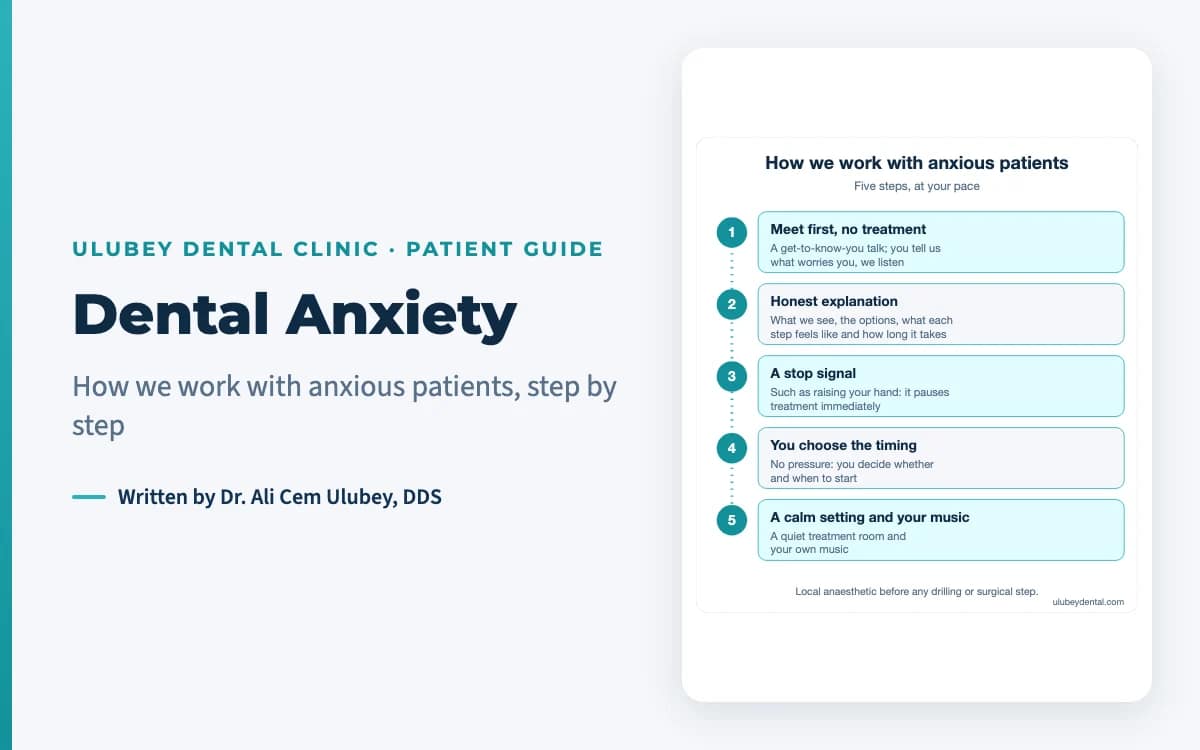
Ulubey Dental Clinic is run by two dentists, Dr. Ali Cem Ulubey and Dr. Surur Ulubey, who treat their patients themselves; you will not meet a different dentist at every visit. With anxious patients we work in a fixed way:

Meet first, no treatment
A get-to-know-you talk with the dentist before any treatment. You tell us what worries you; we listen.Honest explanation
We explain everything in detail, honestly and clearly: what we see, what the options are, what each step feels like and how long it takes.A stop signal
Before we start, we agree a signal, such as raising your hand, that pauses treatment immediately.You choose the timing
No pressure. You decide whether and when to start, and we look together for solutions and alternatives that suit your fear.A calm setting and your music
A quiet treatment room, and you can listen to your own music during treatment.
You can also choose which of our two dentists treats you; some patients prefer to be treated by a female dentist, Dr. Surur Ulubey. For children, see our children’s dentist page.
Before any drilling or surgical step, the area is numbed with a local anaesthetic. If you feel discomfort, use the stop signal and we pause.
Before your visit: what you can do
- Tell us in advance that you are anxious, in your first message. It changes how we plan your visit.
- Write down your questions so you do not forget them in the chair.
- Send photos or X-rays first if you have them, so the first meeting can be about the plan, not surprises.
- Bring headphones and the music or podcast that calms you.
- Choose a time when you are not rushed; walk-in patients are welcome Monday to Saturday, 09:00–19:00, but an agreed time is often easier for anxious patients.
Anxious and travelling for treatment
Travelling for dental treatment adds its own stress: a new place, a new dentist and a fixed flight home. We plan for that:
- Before you travel, you can talk to us on WhatsApp; messages are usually answered within 4 hours, and a written quote usually within 24 hours after photos or X-rays arrive.
- On arrival, the first appointment is the talk and the examination; you decide whether and when treatment starts.
- Plan a day or two of margin in your stay so you never feel pushed by the calendar; the dental treatment stay planner shows typical stays per treatment.
- Persian-speaking patients can be treated in Farsi by Dr. Surur Ulubey; see Iranian dentist in Antalya.
Read more about the clinic in is Ulubey Dental Clinic safe? and meet the dentists on meet the dentists.
When fear is severe
If your fear is so strong that you cannot sit in a dental chair, or it causes panic, structured behavioural treatment with a qualified therapist can help: in the meta-analysis above, patients who took part reported a significant and generally lasting reduction in fear[3]. We are happy to work alongside such treatment, at your pace.
This page is general information and does not replace an examination.
Frequently asked questions
I have not been to a dentist for years. Will you judge me?
No. Many people avoid the dentist because of fear, and a meta-analysis estimated that about 15% of adults have dental fear and anxiety. Our first step is a talk, not treatment: we listen, examine only when you are ready, and explain honestly what we see and what the options are. You decide what happens next and when.
Can I stop the treatment if I panic?
Yes. Before we start, we agree a stop signal, such as raising your hand, and treatment pauses as soon as you use it. We explain each step before we do it, so nothing comes as a surprise. If you need a break, we take one, and if you are not ready to continue, we agree with you when to come back.
Can I listen to music during treatment?
Yes. You can bring your own headphones and listen to your own music or a podcast during treatment. We also keep the treatment room calm and quiet. If something in particular worries you, tell us before we start, so we can explain it first.
Can I meet the dentist before any treatment?
Yes. For anxious patients, the first appointment is a get-to-know-you talk with the dentist, without treatment. We talk about your worries, look at your teeth if you are ready, and explain the plan honestly. You can also choose which of our two dentists treats you, including a female dentist, Dr. Surur Ulubey.
I am travelling to Antalya for treatment and I am nervous. What do you suggest?
Tell us in your first WhatsApp message, and send photos or X-rays if you have them, so we can discuss the plan before you travel. Plan a day or two of margin in your stay, so you can meet us first and decide when to start without pressure. Our stay planner shows typical stays per treatment.
What helps with severe dental phobia?
Structured behavioural treatment with a qualified therapist has good evidence: in a meta-analysis of 38 studies, anxiety improved in 36 of them, and on average 77% of patients were still attending the dentist more than 4 years later. We are happy to work alongside such treatment, at your pace, with a stop signal and step-by-step explanations.
Sources
- Silveira ER, Cademartori MG, Schuch HS, Armfield JA, Demarco FF. Estimated prevalence of dental fear in adults: a systematic review and meta-analysis. J Dent. 2021;108:103632. pubmed.ncbi.nlm.nih.gov/33711405
- Armfield JM, Heaton LJ. Management of fear and anxiety in the dental clinic: a review. Aust Dent J. 2013;58(4):390-407. pubmed.ncbi.nlm.nih.gov/24320894
- Kvale G, Berggren U, Milgrom P. Dental fear in adults: a meta-analysis of behavioral interventions. Community Dent Oral Epidemiol. 2004;32(4):250-264. pubmed.ncbi.nlm.nih.gov/15239776
This article is general patient information and does not replace a clinical examination or advice from a qualified therapist.
Editor contact: [email protected] · ulubeydental.com/contact-us