What Is a Zirconia Crown? A Dentist Explains the Material
A zirconia crown is a full-coverage, metal-free crown made from zirconium dioxide, a high-strength dental ceramic. It is designed from a digital scan and milled as one solid block (“monolithic”) or as a core with porcelain layered on top. At Ulubey Dental Clinic in Antalya we use Amann Girrbach Zolid zirconia from our partner lab at €185 per tooth. A 2026 meta-analysis reported 96.8% five-year survival for monolithic zirconia single crowns.
- 1. What is a zirconia crown?
- 2. What zirconia is made of
- 3. Monolithic vs layered zirconia
- 4. Who it suits, and who should think twice
- 5. Zirconia compared with other crowns
- 6. How a zirconia crown is made
- 7. Brand, lab and guarantee
- 8. How we work in our clinic
- 9. Frequently asked questions
- 10. Sources

What is a zirconia crown?
A zirconia crown is a tooth-shaped cap made of zirconium dioxide that covers the whole visible part of a tooth. It restores a tooth that is too weak, broken or heavily filled to be fixed with a filling, and it is also used on top of dental implants and as part of a bridge.
Cleveland Clinic describes a crown as “a tooth-shaped cap” used to restore weak, broken or decayed teeth, cap a tooth after root canal treatment, anchor a bridge or cover an implant [6]. The ADA adds that a crown is often needed when “there isn’t enough tooth remaining to hold the filling” [7].
A crown is not the same as a veneer. A veneer covers only the front surface of a front tooth; a crown covers the tooth all the way round. If you are comparing the two for your smile, see our page on porcelain veneers.
What is zirconia made of, and is it a metal?
Zirconia is a ceramic, not a metal. Chemically it is zirconium dioxide (ZrO₂), an oxide of the metal zirconium, in the same way that the alumina used in dentistry is an oxide of aluminium. A zirconia crown contains no metal framework and does not look grey at the gum line.
Pure zirconia changes its crystal structure as it cools, which would make it crack. Dental zirconia is therefore “stabilised” with a small amount of yttria. The most widely used form is Y-TZP (yttria-stabilised tetragonal zirconia polycrystal) [2].
Zhang and Lawn describe zirconias as the strongest of the dental ceramics, but note that classic Y-TZP lacks the aesthetics of glass-ceramics. Newer zirconia generations are designed to be more translucent “while preserving adequate strength and toughness” [2]. In plain words: making zirconia more translucent generally costs some strength, so the type is chosen for the position of the tooth and your bite.
Monolithic vs layered zirconia: what changes
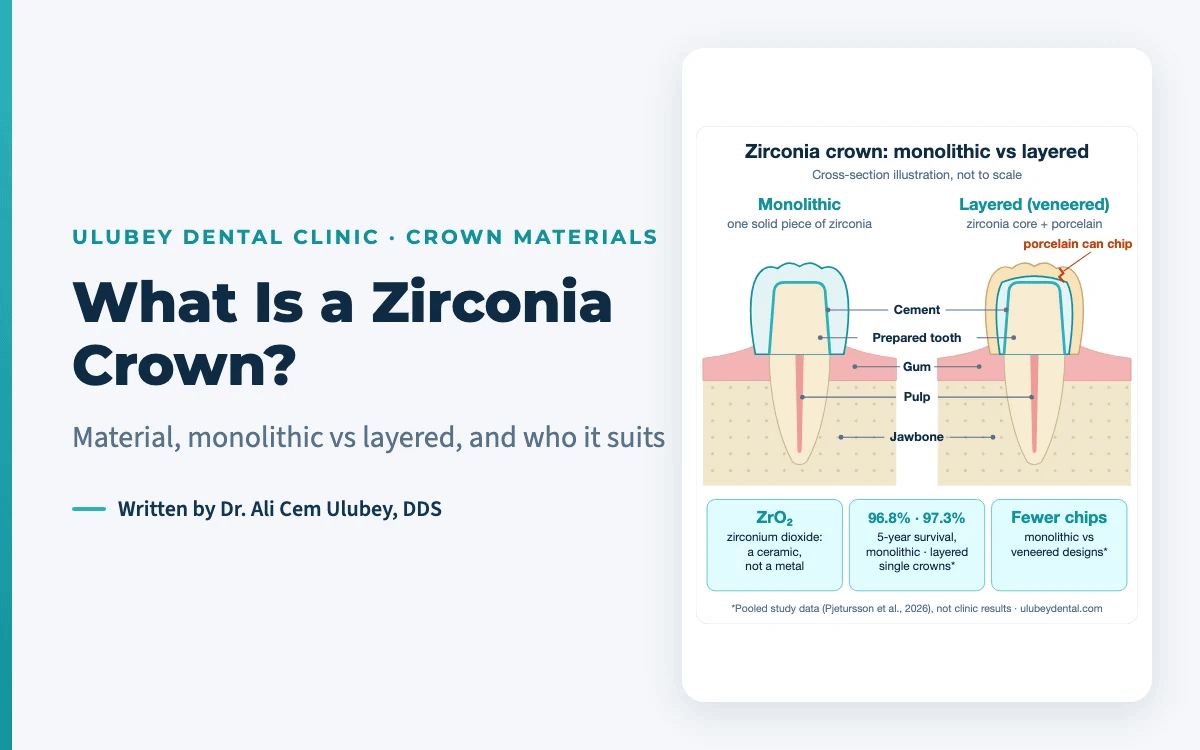
“Monolithic” means the crown is milled from one solid piece of zirconia and then stained and glazed. “Layered” (or veneered) means a zirconia core is covered with a hand-built layer of porcelain. The layer can look very natural, but it is also the part that can chip.
A 2026 systematic review of 64 studies found that monolithic lithium-disilicate and monolithic zirconia crowns “showed significantly fewer ceramic fractures and chipping compared to veneered alternatives” [1]. Earlier reviews point the same way: veneered zirconia single crowns were more often lost because of fractures of the veneering ceramic than metal-ceramic crowns [3], and layered zirconia bridges on implants showed a higher risk of chipping [4].
| Feature | Monolithic zirconia | Layered (veneered) zirconia |
|---|---|---|
| Structure | One solid piece of zirconia, stained and glazed | Zirconia core + hand-layered porcelain |
| Chipping risk | Significantly fewer fractures and chipping [1] | Higher; the porcelain layer is the weak point [1][4] |
| 5-year survival (single crowns) | 96.8% [1] | 97.3% [1] |
| Aesthetics | Good; translucency depends on the zirconia type [2] | Can be more lifelike in front teeth |
| Typical use | Back teeth, crowns on implants, bridges | Front teeth where aesthetics lead |
Survival figures are pooled data from published studies, not our clinic’s results.
Our standard at Ulubey Dental Clinic is a monolithic crown milled from Amann Girrbach zirconia. If a front tooth needs a different material for aesthetic reasons, we explain the options before treatment.
Who a zirconia crown suits, and who should think twice
A zirconia crown suits most back teeth and many front teeth that need full coverage. The decision depends on how much tooth is left, the bite, and how visible the tooth is.
Situations where zirconia is commonly chosen
- Teeth with large old fillings or cracks that need protection.
- Teeth after root canal treatment, which are often weakened.
- Crowns on dental implants.
- Bridges that replace one or more missing teeth.
- Full-arch restorations on implants (see full-mouth dental implants).
Crown and bridge guarantees exclude fracture due to bruxism (teeth grinding), and patients who grind their teeth must wear the night guard we provide. Tell us at the start if you grind or clench, so the plan and the bite can be adjusted.
When another material may be the better choice
For a single front tooth where the highest translucency matters, a glass-ceramic such as E.max may be chosen. Our zirconia vs porcelain crown comparison covers that decision in detail. Every case needs an examination first: no material is right for every tooth.
How zirconia compares with E.max and metal-ceramic crowns
In a 2026 systematic review of 64 studies, zirconia, lithium-disilicate (E.max type) and metal-ceramic single crowns all reached five-year survival between 96.8% and 98.5%. The weaker results were for older ceramics such as feldspathic porcelain and alumina [1].

| Crown type | 5-year survival | Chipping / fracture vs veneered |
|---|---|---|
| Monolithic lithium-disilicate glass-ceramic (E.max type) | 98.5% | Significantly fewer than veneered |
| Veneered (layered) zirconia | 97.3% | Reference group (veneered) |
| Metal-ceramic | 97.1% | Not compared in this way |
| Monolithic zirconia | 96.8% | Significantly fewer than veneered |
| Veneered leucite / lithium-disilicate glass-ceramic | 95.7% | Reference group (veneered) |
| Densely sintered alumina | 94.5% | Not compared in this way |
| Glass-infiltrated alumina | 94.3% | Not compared in this way |
| Feldspathic / silica-based ceramic | 90.4% | Not compared in this way |
Source: Pjetursson BE et al., Int J Prosthodont 2026 [1]; 64 studies, 3,509 metal-ceramic and 8,051 all-ceramic crowns. Pooled data from studies, not our clinic’s results. You may cite this table with a link to this page.
Survival is only one number. Studies count a crown as “surviving” while it stays in the mouth, even after a small repair. How long a crown lasts for you depends on the bite, hygiene, check-ups and the tooth underneath. For the lifespan question in detail, read how long zirconia lasts compared with porcelain.
How a zirconia crown is made, step by step
A zirconia crown is made in a fully digital workflow: the tooth is scanned, the crown is designed on screen, milled from a zirconia block and fitted. For most patients this takes 4–5 treatment days.
Examination and plan
We examine the tooth and X-ray and confirm that a crown is the right treatment. If you want whiter teeth, whitening is done first in the same trip so the crown can be matched to the new shade.
Preparation and digital scan (day 1)
The tooth is shaped and scanned with a Dentsply Sirona Primescan intraoral scanner. No silicone impression trays are needed.
Same-day temporary
A temporary crown is delivered the same day, within 2–3 hours.
Design and milling at our partner lab
The crown is designed digitally and milled from Amann Girrbach zirconia at our partner laboratory.
Try-in (about 1 day later)
We check fit, bite and shade in your mouth before the crown is finished.
Final fitting (about 2 days later)
The finished crown is cemented and the bite is checked again.
The typical digital flow is 4–5 treatment days. Including the first check-up and the start, the stay is usually 5–7 days. Outside full-arch cases, single crowns are usually finished within 1–2 days. Plan your dates with the dental treatment stay planner.
Brand, lab and guarantee: what to ask for in writing
Ask any clinic three things in writing: which zirconia brand is used, where the crown is made, and what the guarantee covers. At Ulubey Dental Clinic our standard zirconia is Amann Girrbach Zolid, milled at our partner lab. Ivoclar IPS e.max ZirCAD Prime is available on request and quoted individually.
Amann Girrbach states on its own website that it offers “a 10-year warranty on all Zolid zirconia restorations” [5]. Our clinic guarantee, word for word:
10-year fracture guarantee on Amann Girrbach zirconia crowns and bridges made at our partner lab; 5-year clinic guarantee on crowns and bridges in other materials; crown and bridge guarantees exclude fracture due to bruxism (teeth grinding), and patients who grind their teeth must wear the night guard we provide; all conditional on recommended check-ups; covers the prosthesis, not the root canal or filling under it; manufacturer lifetime guarantee on the implant fixture; a fixture guarantee does not mean every implant integrates (smoking, uncontrolled diabetes and gum health affect healing).
The full conditions are on our written dental guarantee page. Before you book anywhere, our checklist what to check before getting zirconia crowns in Antalya lists the questions to ask.
How we work with zirconia in our clinic
Every crown at Ulubey Dental Clinic is planned and fitted by one of the two founding dentists, Dr. Ali Cem Ulubey or Dr. Surur Ulubey. There is no rotating team: the same two dentists see you through from the scan to the final fitting.
- Digital workflow: Dentsply Sirona Primescan intraoral scanning. Dr. Ali Cem Ulubey completed Dentsply Sirona CEREC training.
- Material: Amann Girrbach zirconia blocks (Zolid as standard), milled at our partner laboratory.
- Price: €185 per zirconia crown, €250 per E.max crown. Your written quote is valid for 30 days. Estimate your case with the zirconia crown cost calculator, or see zirconia crowns in Antalya.
Frequently asked questions
Is zirconia a metal?
No. Zirconia is zirconium dioxide (ZrO₂), a ceramic. It is an oxide of the metal zirconium, but it behaves like a ceramic: it is tooth-coloured and a zirconia crown contains no metal framework. Dental zirconia is stabilised with a small amount of yttria, which is why it is often called Y-TZP in the scientific literature.
What does “monolithic zirconia” mean on my quote?
It means the crown is milled from one solid piece of zirconia, then stained and glazed, with no separate porcelain layer on top. A 2026 systematic review found significantly fewer ceramic fractures and less chipping with monolithic designs than with veneered ones. Monolithic Amann Girrbach zirconia is our standard at Ulubey Dental Clinic.
How long does a zirconia crown last?
Pooled studies report 96.8% five-year survival for monolithic zirconia single crowns (Pjetursson et al., 2026). How long your crown lasts depends on your bite, hygiene, check-ups and the tooth underneath. Our zirconia vs porcelain comparison page covers longer-term lifespan and how zirconia compares with other crown materials.
Can a zirconia crown be whitened later?
No. Only natural teeth can be whitened, not tooth-coloured restorations such as crowns (American Dental Association), so the crown keeps the shade it was made in. If you want whiter teeth, whiten first and then match the crown to the new shade. Whitening and crowns can be combined in the same trip, and this does not extend the stay.
I grind my teeth: can I still have zirconia crowns?
Often yes, but it must be planned. Tell us at the start if you grind or clench. Crown and bridge guarantees exclude fracture due to bruxism (teeth grinding), and patients who grind their teeth must wear the night guard we provide. We check the bite at the try-in and the final fitting.
Which zirconia brand do you use?
Our standard is Amann Girrbach Zolid zirconia, milled at our partner laboratory, at €185 per tooth. Ivoclar IPS e.max ZirCAD Prime is available on request and quoted individually. The brand and the guarantee terms are written into your treatment plan and quote, which is valid for 30 days.
Sources
- Pjetursson BE, Pitta J, Balet A, Bjarnadottir GR, Sailer I, Romandini P. A systematic review and meta-analysis evaluating the survival, failure, and complication rates of metal-ceramic, veneered, and monolithic all-ceramic tooth-supported single crowns, Part 1. Int J Prosthodont. 2026;39(3):308-324. pubmed.ncbi.nlm.nih.gov/41489982
- Zhang Y, Lawn BR. Novel zirconia materials in dentistry. J Dent Res. 2018;97(2):140-147. pmc.ncbi.nlm.nih.gov/articles/PMC5784474
- Sailer I, Makarov NA, Thoma DS, Zwahlen M, Pjetursson BE. All-ceramic or metal-ceramic tooth-supported fixed dental prostheses (FDPs)? Part I: Single crowns. Dent Mater. 2015;31(6):603-623. pubmed.ncbi.nlm.nih.gov/25842099
- Sailer I, Strasding M, Valente NA, Zwahlen M, Liu S, Pjetursson BE. A systematic review of the survival and complication rates of zirconia-ceramic and metal-ceramic multiple-unit fixed dental prostheses. Clin Oral Implants Res. 2018;29 Suppl 16:184-198. pubmed.ncbi.nlm.nih.gov/30328185
- Amann Girrbach. The Amann Girrbach promise of quality: 10-year warranty on all Zolid restorations (manufacturer page). amanngirrbach.com
- Cleveland Clinic. Dental crowns (patient reference). my.clevelandclinic.org/health/treatments/10923-dental-crowns
- American Dental Association, MouthHealthy. Crowns. mouthhealthy.org/all-topics-a-z/crowns
- American Dental Association. Whitening (Oral Health Topics). Accessed 25 October 2026. ada.org/resources/ada-library/oral-health-topics/whitening
This article is general patient information and does not replace a clinical examination, X-rays or a personal treatment plan.
Editor contact: [email protected] · ulubeydental.com/contact-us