
Mitra’s Full Mouth Reconstruction in Turkey: A 70-Year-Old’s TMJ, Zirconia Crown Story
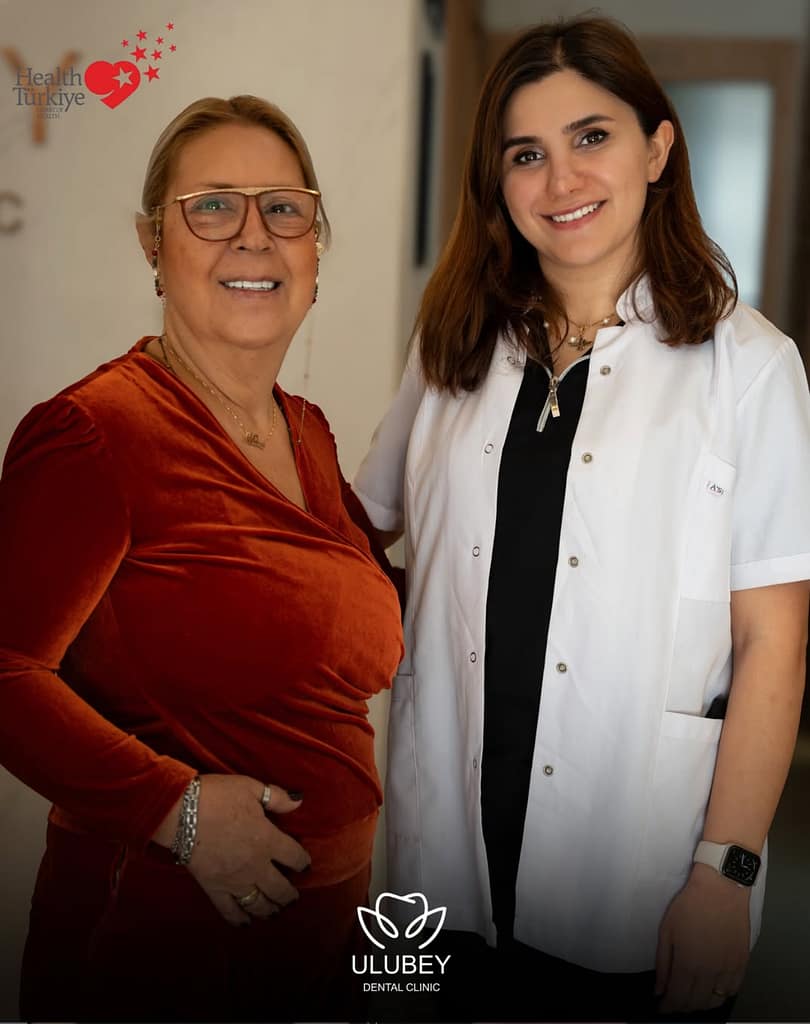
Written by: Dr. Ali Cem Ulubey, DDS · Multi-language communication: Dr. Surur Ulubey, DDS (Farsi) · Case published with patient consent · Updated: July 2026 · Reading time: ~10 min
💡 Curious about your own case cost?
Try our zirconia crown or full mouth calculator. Answer 5 questions, get a personalized 2026 price range in 60 seconds. No email required.
This is a real patient case study of full mouth reconstruction Turkey — specifically, a full-arch zirconia crown restoration combined with TMJ repositioning at Ulubey Dental Clinic in Antalya. Mitra V., 70 years old and living in Antalya (originally from Iran), came to us with a combination of worn teeth from decades of bruxism, age-related dental abrasion, aesthetic concerns that had made her stop smiling openly, and jaw joint discomfort that had gradually become part of her daily life.
What follows is her clinical journey — how we assessed her case, why we chose a full mouth zirconia crown reconstruction with TMJ repositioning rather than veneers or implants, the digital workflow we used (Dentsply Primescan + Amann Girrbach), and where she stands one year later. If you’re researching full mouth reconstruction Turkey options and wondering whether your case might resemble Mitra’s, this article should give you a realistic picture. Published with her written consent.
Who is Mitra?
Mitra is 70. She was born in Iran and has been living in Antalya for many years — part of the local Iranian community here. Farsi is her first language, and every clinical conversation with her went through Dr. Surur Ulubey, my wife and clinical partner, who is bilingual in Turkish and Farsi. That mattered — Mitra didn’t have to translate emotionally difficult concerns through anyone else.
Her presenting complaint was mostly aesthetic. She had stopped smiling openly. Family photos, social events, everyday conversations — she found herself hiding her teeth. But underneath the aesthetic concern was a clinical picture that had been developing for decades: bruxism (grinding), age-related dental abrasion, and jaw joint dysfunction that had crept up quietly.
The clinical picture — three problems, one solution needed
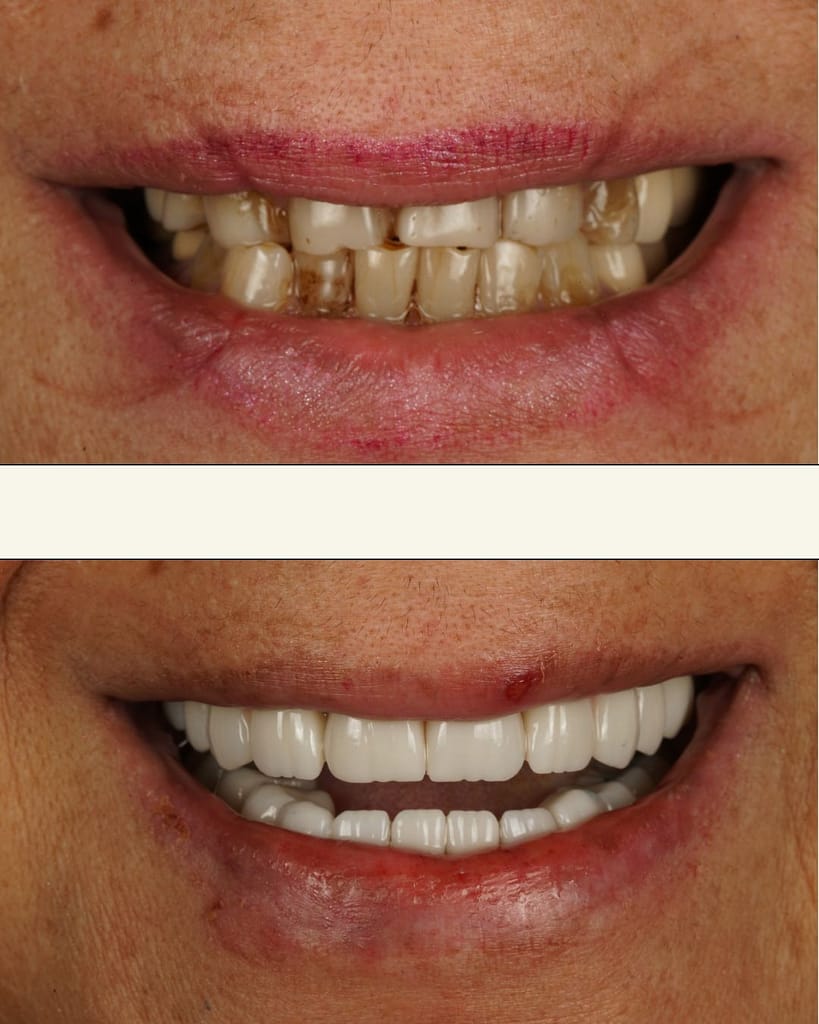
Bruxism impact. Mitra had ground her teeth at night for most of her adult life. The consequence was uniform reduction of tooth height across her arches. Her posterior teeth were shorter than they should be. Her canines had lost their proper guidance shape. The vertical dimension of her bite had collapsed — meaning her lower jaw was closing higher than natural, over-loading her jaw joint.
Age-related dental abrasion. On top of bruxism, decades of chewing had smoothed her tooth edges. The natural cusps and grooves that should distribute chewing forces were gone. Aesthetically, this made her teeth look “flat” and shorter than the surrounding gum tissue expected.
TMJ (temporomandibular joint) dysfunction. This was the piece many clinics would have missed if they only assessed her aesthetically. Mitra had developed mild-to-moderate discomfort in her jaw joints and adjacent muscles. Morning tension. Occasional clicking when opening wide. These were symptoms of her bite having lost its correct interocclusal position — the joint and muscles were compensating.
Together, this was not just a cosmetic case. Treating only the appearance would have been dishonest. If we placed veneers or crowns at the current collapsed bite height, we would have locked in her TMJ dysfunction — potentially making it worse over the following years. See our zirconia vs porcelain crowns comparison for material context, and our smile design vs veneers guide for when crowns are indicated over veneers.
Why we chose full mouth zirconia crowns (not veneers, not implants)
Three clinical decisions had to converge:
Not implants. Mitra had her own teeth. All of them. They were worn, but structurally rooted and healthy. Extracting healthy teeth to place implants would have been aggressive over-treatment — a common mistake in dental tourism marketing where “full mouth implants” gets sold to patients who don’t actually need them. Mitra’s roots were her friends.
Not veneers. Veneers only cover the front surface of a tooth (0.3–0.5mm). Mitra needed structural rebuilding across all surfaces — cusps, grooves, chewing anatomy — not just aesthetic overlay. Additionally, her bruxism grinding forces would have chipped veneers within a year. See our Hollywood smile calculator for when veneers are appropriate; Mitra’s case was outside that indication.
Full mouth zirconia crowns — the right answer. Zirconia crowns cover the entire tooth (360 degrees), rebuild the correct anatomy, absorb bruxism forces, restore the vertical dimension, and set the bite at the correct interocclusal position. Amann Girrbach zirconium (Austrian manufacturing) has the strength profile needed for grinders and gives natural aesthetics through modern layering techniques. See our zirconia crowns treatment page for full clinical detail, or our zirconia crown cost calculator for pricing detail on this material.
CURIOUS ABOUT YOUR OWN CASE
Get your personalized full mouth reconstruction cost in 60 seconds
TRY OUR CALCULATORS →TMJ repositioning — the piece most clinics skip
Before we prepared a single tooth, we spent time getting the correct interocclusal position for her jaw. This is where full mouth reconstruction becomes real dentistry rather than aesthetic dentistry.
We used centric relation techniques — placing her jaw in the anatomically correct joint position (not the position her muscles had been holding it in due to compensation). We measured her ideal vertical dimension. We assessed her range of motion, clicking, muscle tenderness. From this, we determined how much we needed to “open” her bite vertically to relieve the joint and restore proper cusp-to-fossa relationships.
Then we designed her new full mouth zirconia crowns to hold that corrected position permanently. The joint and muscles could finally rest in their natural home. Within weeks of the final placement, her morning tension started resolving. By month three, the clicking was gone.
The digital workflow — Primescan, digital design, digital manufacturing
For Mitra’s case, we used our full digital protocol:
Dentsply Sirona Primescan. Instead of traditional silicone impressions (unpleasant for full-arch cases, especially at 70), we captured her upper and lower arches with a Primescan optical scanner. Precise 3D digital models in minutes, no gagging, no material distortion.
Digital design. We designed each of her 24+ crowns in CAD software. Cusp anatomy calibrated to the corrected occlusal plane. Aesthetic proportions (golden ratio for anteriors) applied. Preview shown to Mitra before we prepared any teeth — she could see her possible outcome first.
Amann Girrbach zirconium milling. The designs were sent to our lab where Amann Girrbach zirconium blanks (Austrian CAM standard) were milled and characterized. Grinding-safe strength profile combined with layered translucency for natural front-teeth appearance.
Zero silicone moulds, zero guesswork. The whole treatment was designed digitally, produced digitally, and fitted with precision that traditional workflows can’t match — critical when you’re rebuilding 24+ teeth simultaneously.
Working across languages — Surur and the Iranian community
This is a piece of clinical care that gets underestimated: language. Mitra’s first language is Farsi. Dr. Surur Ulubey is a native speaker of Farsi and Azerbaijani Turkish. Every consultation, every treatment planning discussion, every recovery check-in, every question — Mitra had them in Farsi with a dentist, not translated through an interpreter or a call center.
During the restorative phases where we adjusted the temporary crowns and evaluated her comfort with the new bite, I worked alongside Surur. It was Mitra, her husband, Surur, and me — the four of us. Her husband was present at every clinical decision, and we made sure he understood everything too. That’s part of what boutique clinical care means to us — you’re not a booking on a spreadsheet.
If you’re an Iranian patient reading this and considering Antalya for dental treatment, our approach to Farsi-language care is described more fully in our Iranian patients guide to Antalya dental treatment.
The result — younger, more confident, functional
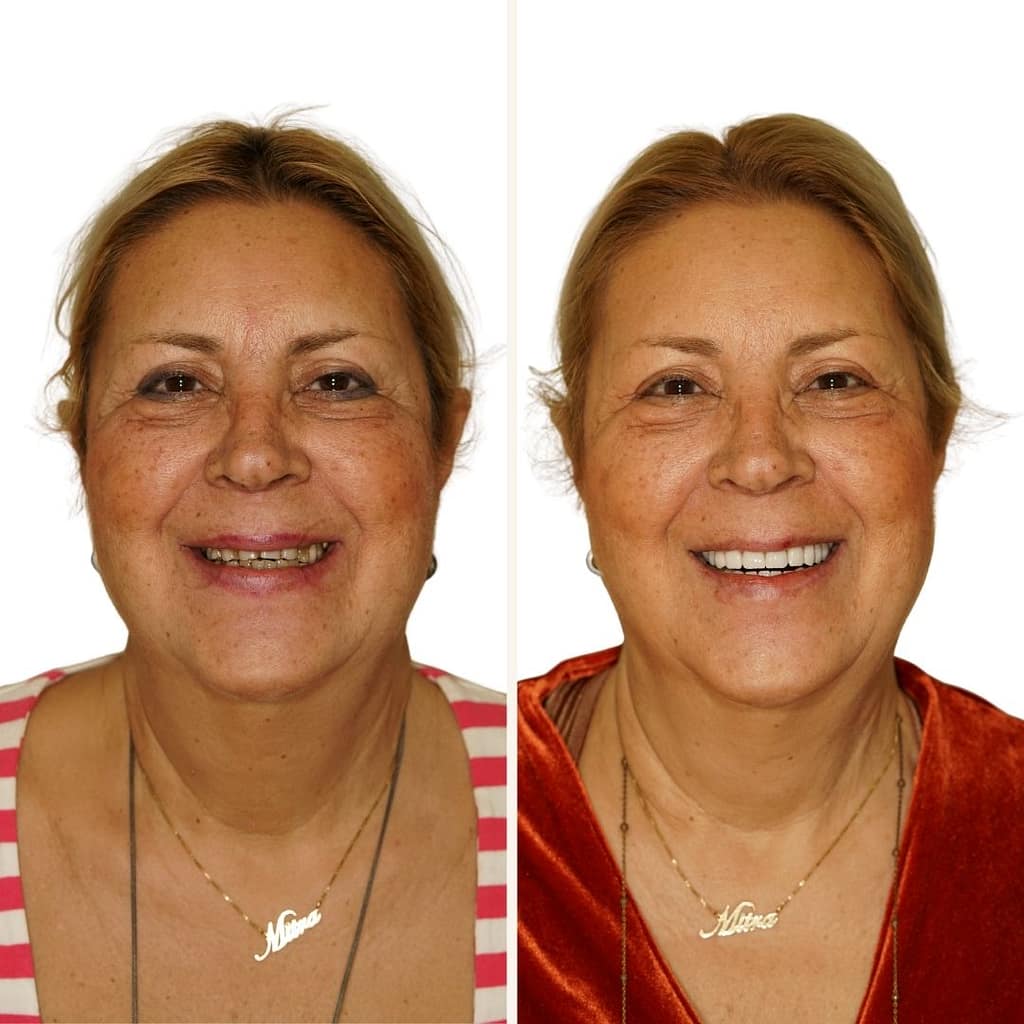
Mitra’s before/after documentation is available (see photo gallery above). The aesthetic transformation is visible immediately — restored tooth height, correct proportions, natural shade matched to her skin tone (not the overly-bright “Hollywood white” that ages poorly). But the functional transformation matters more.
Within days of the final placement, Mitra reported chewing food she had avoided for years — harder textures she had eliminated one by one as her bite deteriorated. Within weeks, her morning jaw tension was resolving. By month three, the joint clicking that had accompanied her wide mouth movements was gone.
And the smile — she smiles openly now. She recorded a video interview with us where she talks about the difference (see video embed above). Her own words describe the change better than clinical notes can.
One year later — the follow-up
We’ve followed Mitra clinically for nearly a full year post-treatment. Regular check-ups every 3–4 months. Every observation has been positive:
- Crown integrity. All 24+ zirconium crowns intact. No chips, no fractures despite continued mild bruxism (managed with night guard).
- Bite stability. The corrected interocclusal position has held. No signs of joint or muscle recompensation.
- TMJ symptoms. Resolved. No morning tension. No clicking. No muscle tenderness.
- Gum health. Excellent. Zirconia margins clean, no inflammation, standard hygiene routine sufficient.
- Patient satisfaction. Sustained. What was aesthetic transformation at month one is now simply her mouth — she doesn’t think about it anymore.
Long-term outlook: with proper night guard use and standard hygiene, this reconstruction is built for long-term service, backed by the 10-year fracture guarantee on the Amann Girrbach zirconia (conditional on check-ups). Zirconium doesn’t stain, doesn’t discolor, doesn’t wear the way natural teeth do — which is why full mouth zirconia reconstruction ages so well when done correctly.
What Mitra’s case teaches — for patients considering full mouth reconstruction Turkey
You’re never “too old.” 70 is not the end of aesthetic dental care — it’s when it matters most for quality of life. Bone health and healing at 70 are entirely adequate for full mouth zirconia reconstruction when the case is planned properly.
Function and aesthetics must be treated together. A full mouth reconstruction that only fixes appearance will fail. TMJ, occlusion, and vertical dimension have to be part of the treatment plan. Any Antalya clinic that quotes “20 zirconia crowns from £3,000” without discussing your bite is not treating your case fully.
Digital workflow reduces error. When you’re rebuilding 20+ teeth simultaneously, precision matters exponentially. Primescan-based digital protocols eliminate the compounding errors of traditional silicone-and-plaster workflows. Ask any clinic what scanner they use.
Language and continuity matter. Especially for full mouth reconstruction, which is a months-long clinical relationship — you want to be able to discuss subtle discomforts, aesthetic preferences, and recovery details with a dentist in your own language. If you’re an Iranian patient, our Iranian patients guide covers this in more depth.
Frequently Asked Questions
What is full mouth reconstruction and how does it differ from Hollywood smile?
Full mouth reconstruction is a comprehensive rebuilding of the entire dentition — usually involving crowns on all or most teeth to restore correct bite, function, and appearance simultaneously. Hollywood smile typically refers to aesthetic veneers on visible teeth only (usually 10–20 teeth). Full mouth reconstruction addresses functional problems (TMJ, worn teeth, collapsed vertical dimension); Hollywood smile addresses aesthetics only.
Do I need to have missing teeth for full mouth reconstruction?
No. Mitra had all her teeth — they were just worn and misaligned in bite. Full mouth reconstruction with crowns treats existing teeth. If teeth are missing, treatment combines implants + crowns (see our Full Mouth Implants Cost Calculator). If teeth are present but compromised, crown-based reconstruction preserves your natural roots.
How much does full mouth reconstruction Turkey cost?
For full-arch zirconia crown reconstruction (24+ crowns), expect from about €4,440 (24 zirconia crowns × €185) at Ulubey Dental Antalya depending on material tier and TMJ preparatory work. A published London fee list charges from £1,400 per all-ceramic crown (Harley Street Dental Studio, accessed 3 October 2026); ours is €185 per zirconia crown. Use our Zirconia Crown Cost Calculator for a personalized estimate.
What if I have TMJ pain like Mitra had?
TMJ symptoms should be assessed before any full mouth work — not after. If you have clicking, morning jaw tension, or muscle discomfort, mention this in your initial consultation. Proper full mouth reconstruction integrates TMJ repositioning; ignoring the joint locks in dysfunction.
How long does full mouth reconstruction take in Antalya?
For a Mitra-scale case (24+ zirconia crowns with TMJ repositioning), typically 10–14 working days across one to two visits — depending on whether we can complete lab work fast enough to fit within one stay. Digital workflow with Primescan and Amann Girrbach lab significantly shortens timeline vs traditional protocols.
Am I too old for full mouth reconstruction at 65, 70, or older?
No. Age is not a contraindication for zirconia crown reconstruction. Your general health, gum health, and bone health matter more than age. Mitra was 70 at treatment start. Many of our full mouth reconstruction patients are 60–80. If your general health permits routine dental treatment, you’re a candidate.
How long do zirconia crowns last after full mouth reconstruction?
No fixed lifespan can be promised; with proper night guard use (for bruxism patients), standard hygiene and regular check-ups, an Amann Girrbach zirconia reconstruction is built for long-term service and carries a 10-year fracture guarantee. Individual crowns may need occasional refinishing over that period, but the overall reconstruction stays stable. Zirconia made from Amann Girrbach material at our partner laboratory carries a written 10-year fracture guarantee (conditional on attending check-ups); realistic lifespan is longer.
Is Farsi-language dental care available in Antalya?
Yes — at Ulubey Dental Clinic, Dr. Surur Ulubey conducts consultations and treatment planning in Farsi. Iranian patients don’t work through translators; they work directly with a dentist in their first language. See our Iranian patients complete guide for more detail on our multilingual clinical care.
For patients who genuinely need full arch implant treatment (not Mitra’s case), see our All-on-4 and All-on-6 pages for honest clinical indications, or try our Full Mouth Implants Cost Calculator.
Considering full mouth reconstruction? Send us your case.
If Mitra’s case resembles what you’ve been dealing with — worn teeth, aesthetic concerns, jaw discomfort, avoiding smiling — send us clear photos of your smile (front and side) or a recent panoramic X-ray. Within 24 hours you’ll receive a specific written assessment: whether full mouth reconstruction is the right approach for you, which material tier fits your case, and honest cost breakdown.
- WhatsApp (English): +90 540 324 0004
- WhatsApp (فارسی, with Dr. Surur Ulubey): +90 540 324 0004
- Email contact form
You’ll speak with a dentist — not a salesperson.
— Dr. Ali Cem Ulubey, Ulubey Dental Clinic, Antalya. Case published with Mitra V.’s written consent.
This case study describes one patient’s individual clinical journey. Every case is different. Treatment decisions require in-person clinical assessment including intraoral examination, TMJ evaluation, and appropriate imaging (Primescan digital impression, panoramic X-ray, or CBCT). Prices referenced are typical 2026 ranges and vary by individual case. Published with patient written consent.
Editor contact: [email protected] · ulubeydental.com/contact-us