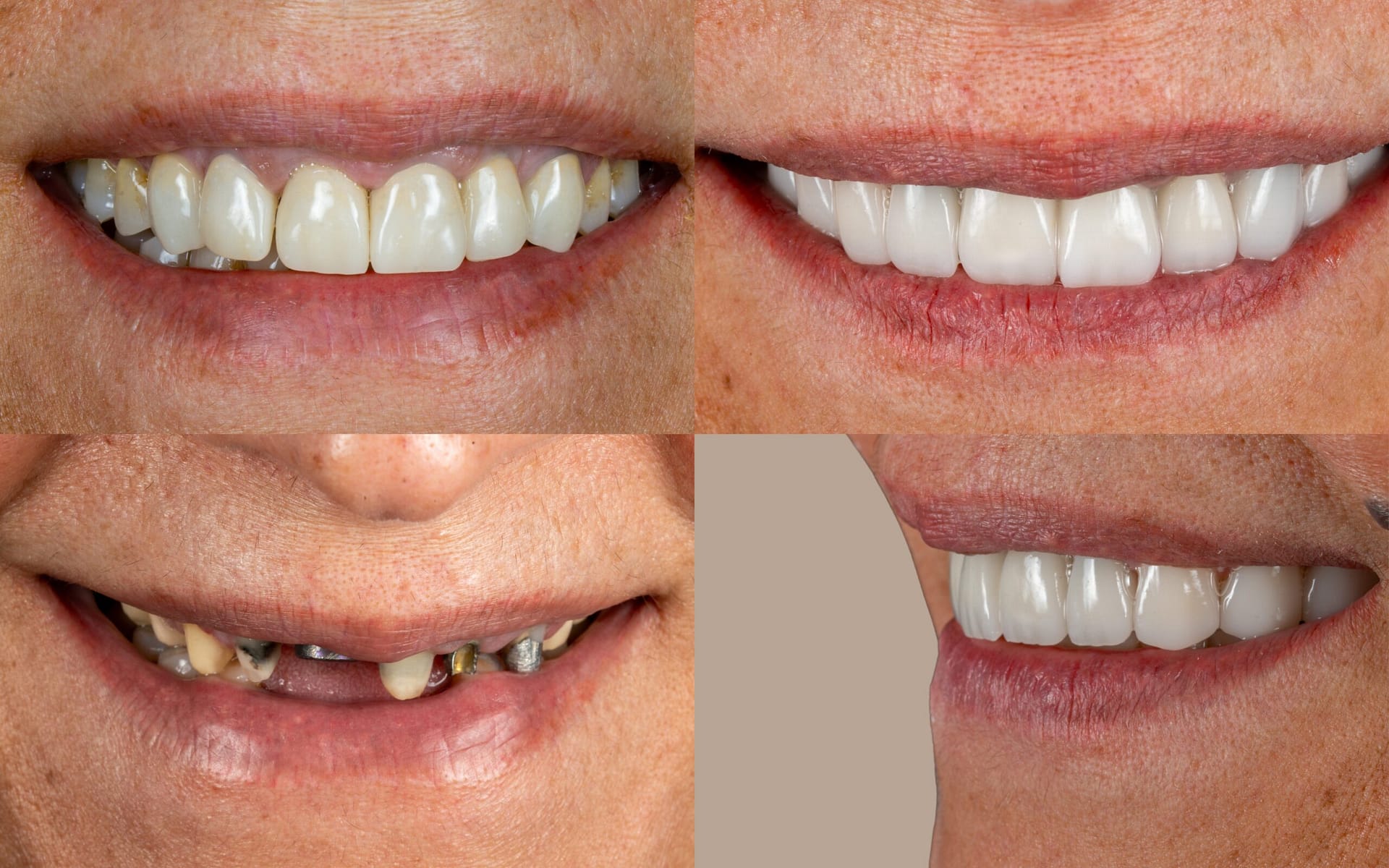
Dentures in Antalya: Types, Prices and Care
Dentures are removable false teeth: a complete (full) denture replaces all the teeth in the upper or lower jaw, and a partial denture replaces one or more missing teeth and clips onto the teeth you still have[1]. At Ulubey Dental Clinic in Antalya a full acrylic denture is €600 per arch (€700 metal-reinforced) and a partial denture is €550 in acrylic or €700 with a metal framework. Most people need a few weeks to get used to a denture[1], and dentures should come out at night[1]. An examination with a panoramic X-ray shows which type suits your mouth.
- 1. What are dentures?
- 2. Types of dentures
- 3. How dentures are made and fitted
- 4. Immediate dentures after extractions
- 5. Getting used to dentures
- 6. Caring for dentures
- 7. Denture stomatitis: the sore red palate
- 8. How long do dentures last?
- 9. Denture cost in Antalya
- 10. How we plan dentures at our clinic
- 11. Frequently asked questions
- 12. Sources
What are dentures?
Dentures are false teeth that replace missing teeth. They fit over the gums, and some types also clip onto the natural teeth you still have[1]. They help with the problems missing teeth cause, such as difficulty eating or speaking, and with how your smile looks[1].
Dentures are one of three ways to replace missing teeth. The other two are fixed: a bridge, which is attached to neighbouring teeth, and dental implants, which are fixed in the jawbone and can carry crowns or some types of denture[1][2]. If you are weighing a denture against implants, our guide to dental implants vs dentures compares the two in detail; this page is about removable dentures themselves.
Types of dentures
Which denture suits you depends on how many teeth are missing, how long they have been missing, the volume of your jawbone, how your upper and lower jaws meet, and whether you want something removable or fixed[2].
| Type | What it replaces | How it is held | At our clinic |
|---|---|---|---|
| Complete (full) denture | All the teeth in one jaw[1] | Rests on the gums; the upper relies on the palate, the lower on the jawbone ridge[2] | Yes: acrylic €600 or metal-reinforced €700 per arch |
| Partial denture | One or more missing teeth[1] | Rests on the gums and clips onto remaining teeth with clasps[2] | Yes: acrylic €550 or metal framework €700 |
| Immediate denture | Teeth that are being removed; worn straight after the extractions[2] | Rests on the healing gums; often adjusted or replaced later | Availability and price: ask at the examination |
| Implant-retained (snap-in) denture | All teeth in a jaw[2] | Snaps onto dental implants; still removable for cleaning[2] | Quoted per case, after an implant assessment |
| Implant-supported fixed bridge | All teeth in a jaw[2] | Fixed to implants; only the dentist can remove it[2] | See All-on-4 and All-on-6 |
Types and descriptions: NHS [1] and Cleveland Clinic [2]. Prices: Ulubey Dental Clinic, October 2026.
For people who have lost all their lower teeth, a 2002 consensus statement from McGill University proposed a lower denture held by two implants as the first-choice standard of care[5]. Whether implants are possible for you depends on your bone and health; our guide to who can get dental implants explains the checks.
How dentures are made and fitted
To make a denture, the dentist first records the shape of your mouth, with putty impressions or, in some practices, a scan[1]. A dental laboratory makes a model of your mouth from it, sets the artificial teeth in wax so their position can be checked, and then builds the final denture base[2]. At the fitting, the dentist checks for areas that press too hard on the gums and adjusts them[2].
The usual steps are these; the number of appointments for your own case is set out in your written plan.
Examination and X-ray
The gums, jaw ridges and any remaining teeth are examined; at our clinic every patient has a panoramic X-ray, so that teeth with decay or loose roots can be treated or removed before the denture is made.Records of your mouth
Impressions of the upper and lower jaw, and a record of how your jaws meet[2].Try-in
The teeth are set in wax so that their position, the look and the bite can be checked before the denture is finished[2].Fitting
The finished denture is fitted, pressure spots are adjusted and you are shown how to put it in, take it out and clean it.Adjustment visits
Several visits are usually needed to get the fit right, because the soft tissues need time to adapt[2].
Those adjustment visits matter if you are travelling to Antalya. Cleveland Clinic notes that you may need several adjustments during the first couple of weeks[2], so a denture should not be fitted on your last day. Your written plan states the number of appointments and the days you need here; you can then plan the trip with our dental treatment stay planner.
Immediate dentures after extractions
If teeth have to be removed and you need teeth straight away, an immediate denture can be made, usually within a few days[1]. The gums and bone change shape as they heal, so an immediate denture often needs to be adjusted or replaced up to a year later[1]. In some cases the immediate denture is a temporary one that is replaced by the final denture once you have healed[2].
Extractions are priced separately from the denture: a standard extraction is €50 and a surgical extraction €120. Aftercare for the extraction sites is in our tooth extraction aftercare guide.
Getting used to dentures
It can take a few weeks to get used to wearing dentures[1]; Cleveland Clinic says weeks or sometimes months[2]. The NHS suggests practising taking them in and out and eating softer foods until you are comfortable with your normal diet[1].
- Eating: start with softer foods and return to your usual diet once you are comfortable[1].
- Practice: practise taking the denture in and out[1].
- Sore spots: a spot that stays sore is a reason for an adjustment, not something to put up with[1].
Caring for dentures
The NHS gives clear daily instructions[1]:
- Brush your gums, tongue and any remaining teeth with fluoride toothpaste every morning and evening.
- Take the denture out and brush it with soft soap or washing-up liquid every morning and evening; do not use toothpaste on it, because toothpaste can damage it.
- Clean it over a sink filled with water or over a towel, because a dropped denture can break.
- Rinse it in cold water after meals.
- Take it out every night and keep it in water, in a denture-cleaning solution or in a denture bath.
The NHS advises not to wear dentures overnight unless your dentist recommends it: trapped food raises the risk of gum infection and decay, and there is a risk of choking[1]. In a Japanese study of 524 people aged 85 or older, those who wore their dentures while asleep had about 2.4 times the risk of pneumonia over 3 years (hazard ratio 2.38)[4]. That study was in very elderly people; it is one more reason to take dentures out at night.
If you also have implants or a bridge elsewhere in your mouth, our guide on how to clean implants and bridges covers those.
Denture stomatitis: the sore red palate
Denture stomatitis is inflammation and redness of the gum and palate under a denture. A review reported it in 15% to over 70% of denture wearers, depending on the group studied, and more often in older people and in women[3]. The reported causes are poor denture hygiene, wearing the denture continuously and at night, plaque on the denture, and bacteria and yeast (Candida albicans) on its surface; a poorly fitting denture adds trauma to the gum[3].
Antifungal treatment can clear the yeast and relieve the symptoms, but the problem comes back once treatment stops unless the denture itself is cleaned and kept clean[3]. So the fix is twofold: treatment prescribed after an examination, and better denture hygiene and night-time removal. See a dentist if your gums are very red or bleeding, or if you have bad breath, which can be signs of gum disease, a fungal infection or decay[1].
How long do dentures last?
Cleveland Clinic gives an average denture lifespan of 7 to 10 years and recommends a reline every 1 to 2 years, or whenever the fit changes[2]. A reline adds new material to the fitting surface so the denture sits closely on the gums again[2]. Dentures loosen over time because the gums and jawbone shrink and change shape as you get older, and the teeth wear[1].
The NHS advises seeing a dentist if your denture clicks when you talk, slips, no longer fits, causes pain, or is worn or damaged; bring any broken parts with you[1].
Denture cost in Antalya
| Denture | Material | Price |
|---|---|---|
| Full denture, per arch | Acrylic | €600 |
| Full denture, per arch | Metal-reinforced | €700 |
| Partial denture | Acrylic | €550 |
| Partial denture | Metal framework | €700 |
| Tooth extraction, if needed | Standard / complicated / surgical | €50 / €90 / €120 |
A full upper and lower set in acrylic is 2 × €600 = €1,200. Implant options are priced from the implants and the prosthesis; see our dental treatment prices page.
- The price is per denture, as listed above.
- No fee: the consultation and the panoramic X-ray; follow-up messages at 30, 90 and 365 days after treatment.
- Charged separately only if needed: extractions, fillings or other treatment on the teeth you keep, as itemised in your quote.
- Airport transfer and hotel: included in larger treatment plans, confirmed in your written quote.
Prices are indicative; your final written quote follows the examination and X-rays and is valid for 30 days. Unless the treatment plan changes, the written price does not change.
All fees are on our dental treatment prices page.
How we plan dentures at our clinic
Ulubey Dental Clinic is run by two dentists, Dr. Ali Cem Ulubey and Dr. Surur Ulubey, who examine and treat their own patients; there are no rotating dentists. For dentures that means:
- We make both main types: complete (full) dentures and removable partial dentures.
- Options are compared honestly: a denture, a bridge or implants, with the price of each, so you can choose. Implant surgery is done by Dr. Ali Cem Ulubey.
- Thin bone in older patients: where advanced surgery should be avoided and the bone is thin, we occasionally use mini implants; this is decided case by case at the examination.
- Remaining teeth first: every patient has a panoramic X-ray, and teeth that will hold a partial denture are checked and treated before it is made.
- Walk-in and languages: walk-in patients are seen Monday to Saturday, 09:00–19:00, at Barınaklar Bulvarı No:109A in Antalya; we speak English, Turkish, Farsi and Azerbaijani.
Frequently asked questions
How much do dentures cost in Antalya?
At Ulubey Dental Clinic a full acrylic denture is €600 per arch and a metal-reinforced full denture €700. A partial denture is €550 in acrylic or €700 with a metal framework. Extractions or treatment on the teeth you keep are priced separately. The consultation and panoramic X-ray carry no fee, and your written quote is valid for 30 days.
How long do dentures last?
Cleveland Clinic gives an average lifespan of 7 to 10 years and recommends a reline every 1 to 2 years, or sooner if the fit changes. Dentures loosen because the gums and jawbone shrink over time, and the teeth wear. See a dentist if your denture clicks, slips, hurts or is damaged.
Should I sleep with my dentures in?
No, unless your dentist advises it. The NHS recommends taking dentures out every night and keeping them in water or a cleaning solution, because trapped food raises the risk of gum infection and decay. A study of people aged 85 or older found that sleeping in dentures was linked to about 2.4 times the risk of pneumonia.
What is an immediate denture?
An immediate denture is fitted straight after teeth are removed, so you are not left without teeth. The NHS says it can usually be made within a few days. Because the gums and bone change shape while they heal, an immediate denture often needs adjusting or replacing up to a year later. Whether it suits you is decided at the examination.
Why is the roof of my mouth red under my denture?
This is often denture stomatitis, an inflammation of the gum under the denture. It is linked to poor denture hygiene, wearing the denture day and night, and yeast on the denture surface. Treatment prescribed after an examination can clear it, but it returns unless the denture is cleaned daily and taken out at night. See a dentist to have it checked.
Can I get dentures in one trip to Antalya?
A denture needs several steps: records of your mouth, a try-in, the fitting and usually some adjustment visits while your gums adapt. Your written plan states the appointments and the days you need here. If teeth must be removed first, the healing time is planned into the schedule. Do not plan the fitting for your last day.
Sources
- NHS. Dentures (false teeth) (page last reviewed 19 March 2025; accessed 26 October 2026). www.nhs.uk/tests-and-treatments/dentures
- Cleveland Clinic. Dentures: types, how they are made, care and lifespan (last updated 10 March 2023; accessed 26 October 2026). my.clevelandclinic.org/health/treatments/10900-dentures
- Gendreau L, Loewy ZG. Epidemiology and etiology of denture stomatitis. J Prosthodont. 2011;20(4):251-260. PMID 21463383. pubmed.ncbi.nlm.nih.gov/21463383
- Iinuma T, Arai Y, Abe Y, et al. Denture wearing during sleep doubles the risk of pneumonia in the very elderly. J Dent Res. 2015;94(3 Suppl):28S-36S. PMID 25294364. pubmed.ncbi.nlm.nih.gov/25294364
- Thomason JM. The McGill Consensus Statement on Overdentures. Mandibular 2-implant overdentures as first choice standard of care for edentulous patients. Eur J Prosthodont Restor Dent. 2002;10(3):95-96. PMID 12387249. pubmed.ncbi.nlm.nih.gov/12387249
This article is general patient information and does not replace a clinical examination or X-rays.
Editor contact: [email protected] · ulubeydental.com/contact-us