Clip-On Veneers vs Real Veneers: What to Know
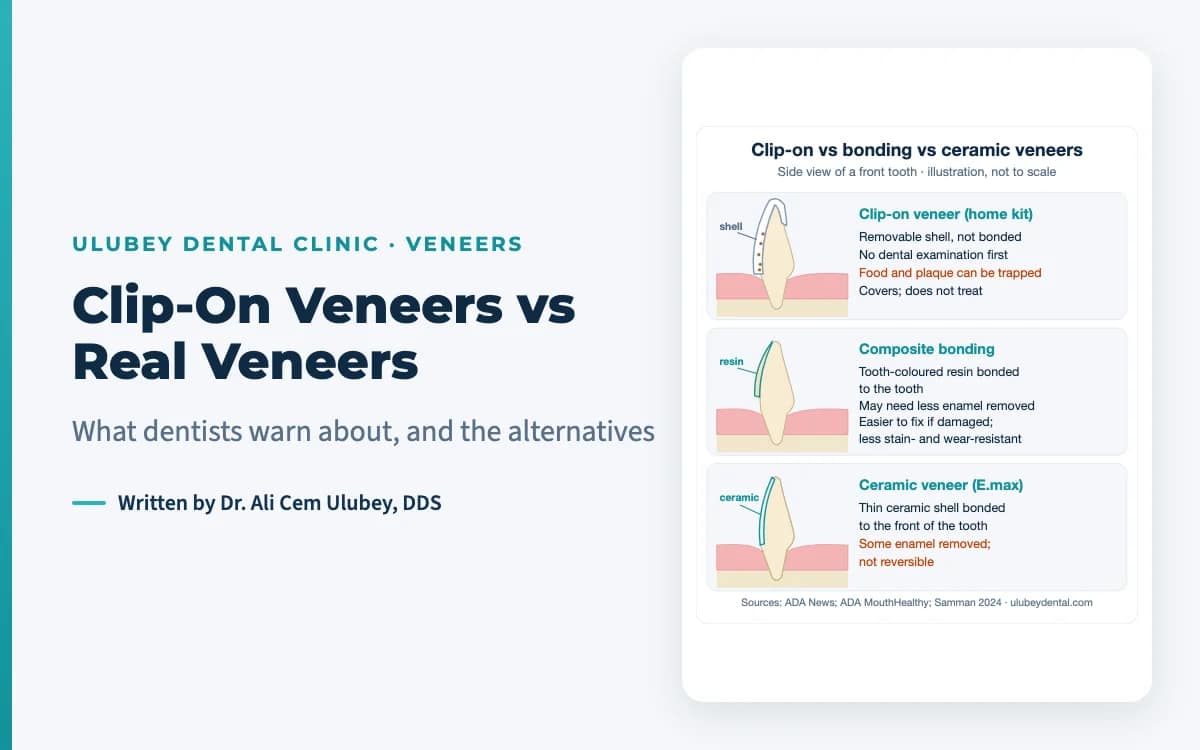
Clip-on (snap-on) veneers are removable plastic or resin covers that sit over your own teeth. They hide gaps or stains while they are worn but do not treat anything. Experts cited in an ADA News summary warn that they can trap food against the teeth and raise the risk of decay and gum disease[1], and in a 2024 survey most users reported discomfort and did not recommend them[2]. Bonded veneers and composite bonding are permanent treatments planned by a dentist; a mock-up lets you test a new smile first.
What are clip-on veneers?
Clip-on veneers, also called snap-on or press-on veneers, are thin removable shells shaped like a row of teeth that you push over your own teeth. Social-media videos have made them popular because they look like an instant smile makeover at a low price[1].
Two very different products share the name:
- Over-the-counter kits. You make an impression at home with a putty kit and post it to a company, or buy a one-size product. No dentist examines your teeth or gums first. The 2024 survey studied these “fake snap-on veneers”[2].
- Dentist-made removable appliances. Some dentists use lab-made snap-on shells for specific situations, for example as temporary teeth while veneers are being made; a 2020 technique article describes snap-on provisionals for veneer cases[5].
Neither type is bonded to the teeth, and neither changes the teeth underneath. They cover; they do not treat.
Risks dentists warn about
The main concern is what happens underneath. ADA News summarised expert warnings that plastic snap-on veneers “can trap food particles against the tooth’s surface, thereby increasing the risk of tooth decay and gum disease,” and that they can damage tooth enamel[1]. That fits how decay works: caries is a sugar-driven disease of the plaque biofilm on the tooth surface[6].
- Decay and gum inflammation from food and plaque trapped under the shell[1].
- Hidden problems. Without an examination, decay or gum disease underneath can go unnoticed. The ADA notes that a dentist must treat decay or gum disease before veneers, because covering unhealthy teeth may worsen existing problems[3].
- Discomfort. Most users in the 2024 survey reported discomfort[2].
- Unregulated sellers. The survey authors call for stricter regulation and public awareness[2].
Take them out to eat, clean both the shell and your teeth thoroughly before putting them back, and follow the instructions that came with them. Pain, bleeding gums or a bad taste under the shell are reasons to see a dentist.
Clip-on veneers vs composite bonding vs bonded veneers
The table compares the options by how they work and whom they suit, not by which is “best”. Every option has a place; the right one depends on your teeth, gums and bite.

| Feature | Over-the-counter clip-on veneers | Composite bonding / composite veneers | Ceramic veneers (E.max, porcelain) |
|---|---|---|---|
| What it is | Removable shell over the teeth[1] | Tooth-coloured resin bonded to the tooth[3] | Thin ceramic shell bonded to the front of the tooth[3] |
| Dental examination first | No (home kit)[2] | Yes; decay or gum disease is treated first[3] | Yes; decay or gum disease is treated first[3] |
| Tooth preparation | None | May need less enamel removed than ceramic[3] | Some enamel removed; not reversible[3] |
| Wear and repair | No long-term clinical data[7] | Easier to fix if damaged; less stain- and wear-resistant[3] | Glass-ceramic survival 94% at a median 9 years; chipping most frequent complication[4] |
| Main risk | Trapped food: decay and gum disease[1] | Staining, chipping, need for touch-ups[3] | Chipping, debonding; grinding is a concern[3][4] |
| Who it may suit | Short-term cosmetic cover, not treatment | Small chips, gaps or shape changes; people who want to keep enamel | Colour and shape changes that bonding cannot achieve, on healthy teeth and gums |
Sources: ADA News [1], Samman 2024 [2], ADA MouthHealthy [3], Morimoto 2016 [4], PubMed search [7]. “Who it may suit” is our clinical summary, not a study result. You may cite this table with a link to this page.
When a clip-on might make sense
A removable shell may have a role as a short-term cover, for example while you plan treatment, as long as you take it out to eat and keep your teeth very clean. A dentist-made removable appliance can also serve as a temporary, which is how the 2020 technique article uses snap-on shells during veneer treatment[5]. What a clip-on cannot do is fix the reason your teeth look the way they do: staining, worn edges, gaps or old fillings stay underneath.
If whitening alone would be enough, that is the least invasive start; see our guide to teeth whitening. For small chips and gaps, composite bonding often needs little or no drilling.
Testing a new smile without drilling: the mock-up
Many people buy clip-ons because they want to see a new smile before committing. A dental mock-up does that in a controlled way: after a digital smile design, a tooth-coloured resin try-in of the planned shape is placed over your own teeth, without drilling, so you can see it, speak with it and change it before any final work is made. For cosmetic treatment plans at our clinic, the digital smile design and mock-up are included in the price. See smile design or veneers.
How we plan veneers at our clinic
- Examination first: a panoramic X-ray for every patient; decay and gum problems are treated before any veneer.
- Minimal preparation: we keep as much enamel as the plan allows, and we consider bonding when it can reach the goal. Over-prepared teeth are what the media call Turkey teeth; avoiding them is part of the plan.
- Shade: measured with VITA Easyshade and cross-polarised photography, and chosen with your skin tone, the white of your eyes and your age in mind.
- Materials: Ivoclar IPS e.max veneers, zirconia veneers made of Amann Girrbach material at our partner laboratory, or composite veneers.
- Guarantee: a 5-year guarantee on E.max veneers against fracture and debonding, excluding trauma and bruxism without a night guard, conditional on attending recommended check-ups. A night guard is included with veneer treatment.
Prices for each veneer type are on our veneers page; your written quote follows the examination.
Frequently asked questions
Are clip-on veneers bad for your teeth?
They can be. Experts cited in an ADA News summary warn that plastic snap-on veneers can trap food against the teeth, which increases the risk of tooth decay and gum disease, and can damage enamel. Because over-the-counter kits are made without a dental examination, existing decay or gum disease can stay hidden underneath. If you use them, take them out to eat and clean your teeth carefully.
Can you eat with clip-on veneers?
It is safer not to. Food and sugar trapped under the shell sit against the tooth surface, where plaque turns sugar into acid. Taking the shell out for meals and cleaning both the shell and your teeth before putting it back reduces that risk. A removable shell is a cosmetic cover, not a bonded restoration; in our clinical view it should not be relied on for chewing.
How long do clip-on veneers last?
There is no reliable answer, because we found no controlled long-term clinical study on over-the-counter clip-on veneers in PubMed. The published papers are case reports, technique articles and one user survey, in which most users reported discomfort. For comparison, a systematic review estimated 94% survival for bonded glass-ceramic veneers over a median of 9 years.
Do real veneers ruin your teeth?
Ceramic veneers usually need some enamel removed, and that is not reversible, so they should only be placed on healthy teeth with a clear reason. Over-preparation of healthy teeth is the problem behind the so-called Turkey teeth. Composite bonding often needs little or no drilling. A mock-up lets you test the planned shape before anything is changed.
Can I try a new smile before getting veneers?
Yes. After a digital smile design, a tooth-coloured resin mock-up of the planned shape is placed over your own teeth without drilling, so you can see it, speak with it and ask for changes. At our clinic the digital smile design and mock-up are included in the price of cosmetic treatment plans. Final veneers are made only after you approve the design.
Can clip-on veneers fix crooked or discoloured teeth?
No. They only cover the teeth while you wear them; the teeth underneath stay the same. Discolouration may respond to whitening, small chips and gaps to composite bonding, and crooked teeth to orthodontics, sometimes combined with veneers. A dental examination shows which option, or which combination, fits your teeth, gums and bite.
Sources
- American Dental Association, ADA News. Latest TikTok trend could harm teeth: DIY veneers (ADA Huddles; accessed 25 October 2026). adanews.ada.org/huddles/latest-tiktok-trend-could-harm-teeth-diy-veneers
- Samman M, Tashkandi A, Alsharif M, et al. User insights into fake snap-on veneers: perceptions and experiences. Clin Cosmet Investig Dent. 2024;16. doi:10.2147/CCIDE.S489013 pubmed.ncbi.nlm.nih.gov/39463474
- American Dental Association (MouthHealthy). Veneers (accessed 25 October 2026). www.mouthhealthy.org/all-topics-a-z/veneers
- Morimoto S, Albanesi RB, Sesma N, Agra CM, Braga MM. Main clinical outcomes of feldspathic porcelain and glass-ceramic laminate veneers: a systematic review and meta-analysis of survival and complication rates. Int J Prosthodont. 2016;29(1):38-49. pubmed.ncbi.nlm.nih.gov/26757327
- Esquivel J, Villarroel M, Tran D, et al. The utilization of snap-on provisionals for dental veneers: from an analog to a digital approach. J Esthet Restor Dent. 2020;32(2). pubmed.ncbi.nlm.nih.gov/31916380
- Pitts NB, Zero DT, Marsh PD, et al. Dental caries. Nat Rev Dis Primers. 2017;3:17030. pubmed.ncbi.nlm.nih.gov/28540937
- PubMed search run by Ulubey Dental Clinic on 25 October 2026: “snap-on veneer(s)” OR “clip-on veneer(s)” OR “removable veneers” OR “snap-on smile” in title/abstract, 10 results. pubmed.ncbi.nlm.nih.gov/?term=%22snap-on+veneers%22%5Btiab%5D+OR+%22clip-on+veneers%22%5Btiab%5D+OR+%22removable+veneers%22%5Btiab%5D+OR+%22snap-on+smile%22%5Btiab%5D
This article is general patient information and does not replace a clinical examination. We do not endorse or compare named products or sellers.
Editor contact: [email protected] · ulubeydental.com/contact-us