
Before Dental Treatment Abroad: What to Send, Bring and Ask
This page is general information and does not replace an examination.
Before you fly for dental treatment, send the clinic a recent X-ray, photos of your teeth and a list of your medicines and medical conditions, and get a written plan and quote. The UK General Dental Council advises that you should always be assessed by a qualified dentist before being given a treatment plan and cost estimate, and that you should ask who will treat you and what aftercare is provided[1]. If you take a blood thinner, a bone-strengthening medicine or have diabetes, sort this out with your physician before you book: at Ulubey Dental Clinic these affect whether and when surgery can be done.
What to send before you book
A good plan starts before you book a flight. Send these on WhatsApp or by e-mail:
- An X-ray: a recent panoramic X-ray if you have one. If you do not, we take one at your first visit; we take a panoramic X-ray for every patient. If you already have a CBCT scan, send it too.
- Photos: a clear smile photo and close-ups of the teeth you are worried about.
- What you want: which teeth, what bothers you, and any treatment another dentist has proposed.
- Your health in a few lines: medical conditions, medicines and allergies (see the checklist below).
- Your dates: when you could travel and how long you can stay.

A written quote usually follows within 24 hours after the photos or X-ray arrive. It is an estimate based on what we can see: the GDC advises that you should always be assessed by a qualified dentist before being given a treatment plan and cost estimate, and that the dentist should ask for your full medical history[1]. We confirm the final plan after the examination, and unless the treatment plan changes, the written price does not change.
Medicines and health: the checklist
This is the part most people forget, and it decides whether surgery such as extractions or implants can go ahead on your trip. Tell us about every medicine, including non-prescribed and herbal ones[2].
| If you… | Do this before you book | What we do |
|---|---|---|
| take a blood thinner (anticoagulant or antiplatelet) | Tell us which one; do not stop or change it unless your doctor tells you to[2]. If you take warfarin, bring your INR record[2]. | We consult the physician who prescribed it and act after their approval; they permit the procedure or adjust the medication if needed. |
| have diabetes | Ask your doctor for your latest HbA1c result. | For implant surgery we prefer HbA1c below 6.8%; above that we treat after it is brought to about 6.4% and followed for 3 months; never above 7.0%. Poor control impairs implant healing[6]. |
| take or took a bone-strengthening medicine (bisphosphonate, denosumab) | Note the name, how it was given (tablet or injection) and since when. Do not stop it on your own[3]. | We refer you to your physician; after an intravenous bisphosphonate we do no oral surgery for up to 5 years. |
| have a heart condition that needs antibiotic cover | Ask your cardiologist whether you are in a group that needs antibiotics before dental procedures[4]. | Patients who need prophylaxis receive a preventive antibiotic before the procedure. |
| are allergic to any medicine | List the medicine and what happened. | The dentist chooses alternatives, for example if you are allergic to penicillin. |
| are pregnant | Tell us and talk to your physician. | Only urgent work, in the second trimester, approved by your physician; definitive treatment waits until after the birth. |
| smoke | Stop as early as possible; ideally at least 4 weeks before surgery[5]. | If you cannot stop, we ask for no more than 6–8 cigarettes a day, and none for at least 1 week after surgery. |
Sources as cited per cell; “What we do” = Ulubey Dental Clinic protocol. More on how these conditions affect the mouth is in our guide to oral health and medical conditions.
Before every implant patient we also run routine blood tests, even without known disease: complete blood count, biochemistry, HbA1c, fasting glucose, vitamin D and calcium. If you know a result is abnormal, tell us before you travel rather than after you arrive.
What to bring on the trip
- Your medicines in their original packaging, in your hand luggage, with a written list of the medicine names and doses.
- Letters and results: your physician’s approval if you take a blood thinner, your latest HbA1c if you have diabetes, and any recent blood tests.
- Dental records: previous X-rays, CBCT scans and implant passports from earlier treatment, if you have them.
- Flexibility: keep a little room in your return date. Some treatments need a check before you fly; for example, after a complex surgical extraction or a graft we advise waiting 48 hours before flying.
Questions to ask any clinic abroad
The GDC suggests a list of questions to ask any clinic abroad, and advises: “Don’t be afraid to ask lots of questions, even if they seem blunt or obvious”[1]. Here are its questions with our answers.
| Question (GDC)[1] | Our answer |
|---|---|
| Who will be carrying out my treatment and what qualifications do they have? | Dr. Ali Cem Ulubey, DDS, and Dr. Surur Ulubey, DDS, licensed dentists in Türkiye; they treat patients themselves, with no rotating dentists. See meet the dentists. |
| Will the dental team speak English? If not, will you provide a translator? | Yes, both dentists consult in English. Dr. Surur Ulubey is also a native Farsi and Azerbaijani speaker, and Arabic translation support is available on request. |
| Are you regulated by a professional body and are you registered with them? | The clinic holds the Ministry of Health International Health Tourism Authorisation Certificate (ST-6000) and is inspected by the Ministry of Health under its requirements; Dr. Ali Cem Ulubey is a member of the Turkish Dental Association (TDB). |
| Is the work guaranteed for a certain period of time? | Manufacturer lifetime guarantee on the implant fixture; 10-year fracture guarantee on Amann Girrbach zirconia crowns and bridges made at our partner lab (AG-backed); 5-year clinic guarantee on crowns and bridges in other materials; 5-year guarantee on E.max veneers against fracture or debonding (excluding trauma, and bruxism without a night guard). Crown and bridge guarantees exclude fracture due to bruxism (teeth grinding), and patients who grind their teeth must wear the night guard we provide. All guarantees are conditional on attending recommended check-ups and cover the prosthesis, not the root canal or filling beneath. Biology varies: smoking, uncontrolled diabetes and gum health affect results, and a fixture guarantee does not mean every implant integrates. Details: written dental guarantee. |
| What aftercare do you provide? | WhatsApp check-ins at 30, 90 and 365 days; a yearly check-up at our clinic (no fee) or with a licensed dentist at home, reviewed in writing by Dr. Ali Cem or Dr. Surur within 7 days; your records handed over on request. |
| What happens if I am unhappy with the results? Who pays for the extra flights, hotel and remedial work? | Within the guarantee, a remake at our clinic is done at no treatment cost; travel and hotel are paid by the patient. |
| Who can I contact for advice after the treatment? | The clinic directly on WhatsApp (+90 540 324 00 04), answered 7 days a week, usually within 4 hours. |
Questions quoted from the GDC [1]. Answers: Ulubey Dental Clinic.
Insurance, invoices and payment
Insurance. We are a private clinic and do not process insurance claims. On request we provide the documents your insurer or tax office may ask for: a standard Turkish invoice, an itemised treatment report written and signed by the dentist, the treatment plan, and X-rays and records. Whether any cost is reimbursed or tax-deductible depends on your insurer, your policy and the rules of your country; we cannot guarantee it and take no responsibility for those decisions. Please check with your insurer in writing before you travel.
Payment. No deposit is required for treatment. You book with your flight details and pay at the clinic for the treatment done at each visit. We do not offer instalment plans. Prices are on our dental treatment prices page.
How long to plan for
Length of stay depends on the treatment. Typical examples from our clinic:
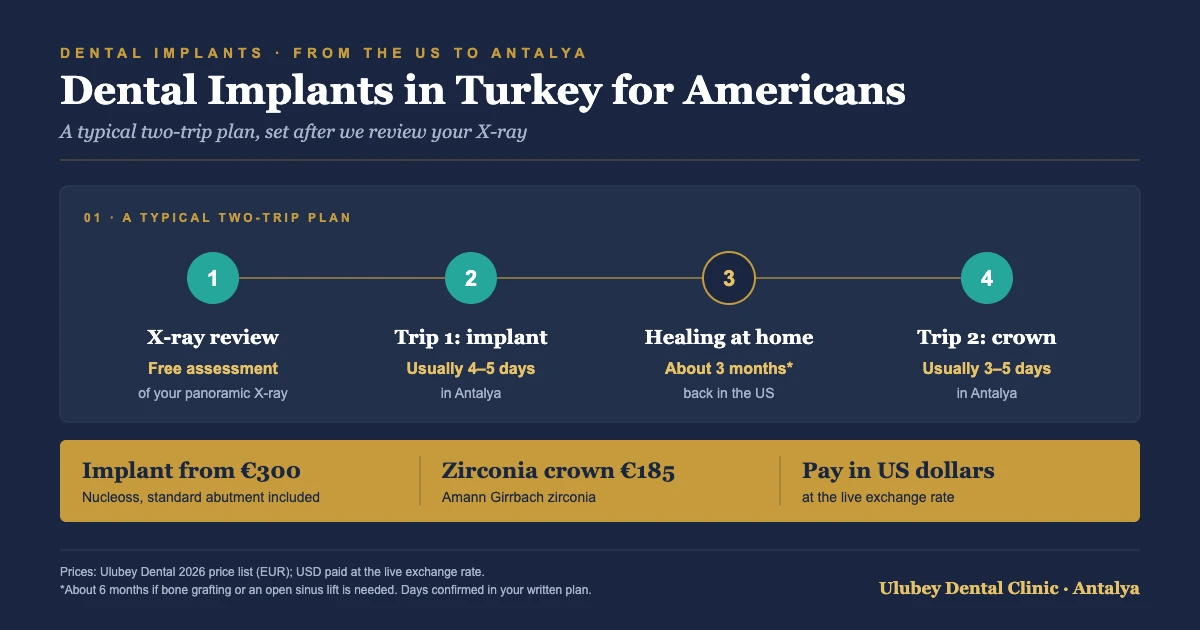
- Single implant: visit 1 about 4–5 days; visit 2 for the crown about 3–5 days, after about 3 months of healing (about 6 months with bone grafting or an open sinus lift).
- All-on-4 or All-on-6: visit 1 about 4 nights, visit 2 about 5–6 nights.
- Crowns or veneers with the digital workflow: about 4–5 treatment days; with the first check-up a stay of 5–7 days.
- Flying after surgery: single implant usually 24–48 hours; closed sinus lift 3–5 days; open sinus lift 5–7 days; complex surgical extraction or graft 48 hours. A signed fit-to-fly letter in English is available on request.

Use the dental treatment stay planner to map your dates, and read is dental treatment in Turkey safe? for the wider risks to weigh.
Frequently asked questions
What should I send a dental clinic abroad before booking?
A recent panoramic X-ray if you have one, clear photos of your teeth, a short description of what you want, your medicine list, medical conditions and allergies, and your travel dates. With these we can usually send a written quote within 24 hours. The final plan is confirmed after the examination, because a quote from photos is always an estimate.
Should I stop my blood thinner before dental treatment abroad?
No, not on your own. Do not stop or change an anticoagulant or antiplatelet medicine unless your doctor tells you to. Tell us which one you take before you book. We consult the physician who prescribed it and act after their approval; they decide whether anything needs adjusting for the procedure.
I have diabetes. What do I need before implant treatment abroad?
Ask your doctor for your latest HbA1c result and send it with your X-ray. For implant surgery we prefer HbA1c below 6.8%; if it is higher, we treat after it has been brought to about 6.4% and followed for 3 months. We never place implants when HbA1c is above 7.0%, so check this before you book flights.
Do I need to pay a deposit before travelling?
No deposit is required for treatment at our clinic. You book with your flight details and pay at the clinic for the treatment done at each visit. We do not offer instalment plans. Unless the treatment plan changes after the examination, the written price does not change.
Will my insurance pay for dental treatment abroad?
We cannot promise that. We are a private clinic and do not process insurance claims, but on request we provide a standard Turkish invoice, an itemised treatment report signed by the dentist, the treatment plan, and X-rays and records. Whether anything is reimbursed depends on your insurer, your policy and your country, so check with your insurer in writing before you travel.
What questions should I ask a dental clinic abroad?
The UK General Dental Council suggests asking who will treat you and what their qualifications are, whether the team speaks your language, whether the clinic is regulated, whether the work is guaranteed, what aftercare is provided, and who pays if remedial work is needed. A good clinic answers these in writing before you book.
Sources
- General Dental Council (GDC). Going abroad for dental treatment (accessed 25 October 2026). www.gdc-uk.org/standards-guidance/information-for-patients-public/going-abroad-for-dental-treatment
- SDCEP. Anticoagulant or antiplatelet medication and your dental treatment: information for patients (2022; accessed 25 October 2026). www.sdcep.org.uk/media/r3cjkyl5/sdcep-anticoagulant-or-antiplatelet-medication-and-your-dental-treatment.pdf
- SDCEP. Dental advice for patients prescribed anti-resorptive drugs for the treatment of osteoporosis or other non-malignant diseases of bone (patient leaflet; accessed 25 October 2026). www.sdcep.org.uk/media/0fldawef/sdcep-mronj-information-for-osteoporosis-patients.pdf
- Wilson WR, Gewitz M, Lockhart PB, et al. Prevention of viridans group streptococcal infective endocarditis: a scientific statement from the American Heart Association. Circulation. 2021;143(20):e963-e978. pubmed.ncbi.nlm.nih.gov/33853363
- Wong J, Lam DP, Abrishami A, Chan MT, Chung F. Short-term preoperative smoking cessation and postoperative complications: a systematic review and meta-analysis. Can J Anaesth. 2012;59(3):268-279. pubmed.ncbi.nlm.nih.gov/22187226
- Naujokat H, Kunzendorf B, Wiltfang J. Dental implants and diabetes mellitus: a systematic review. Int J Implant Dent. 2016;2(1):5. pubmed.ncbi.nlm.nih.gov/27747697
This article is general patient information and does not replace a clinical examination.
Editor contact: [email protected] · ulubeydental.com/contact-us