
Dental Bone Graft for Implants: When You Need It and What Happens
A dental bone graft rebuilds jawbone where it is too thin or too low to hold an implant. Small grafts are often placed at the same time as the implant; larger ones heal first. At Ulubey Dental Clinic in Antalya, implant cases with grafting or an open sinus lift take about 6 months on average before the final teeth, versus about 3 months without. Graft material costs €150 per cc, and your X-rays — with a 3D cone-beam (CBCT) scan when a case needs one — decide whether you need it.
What is a dental bone graft?
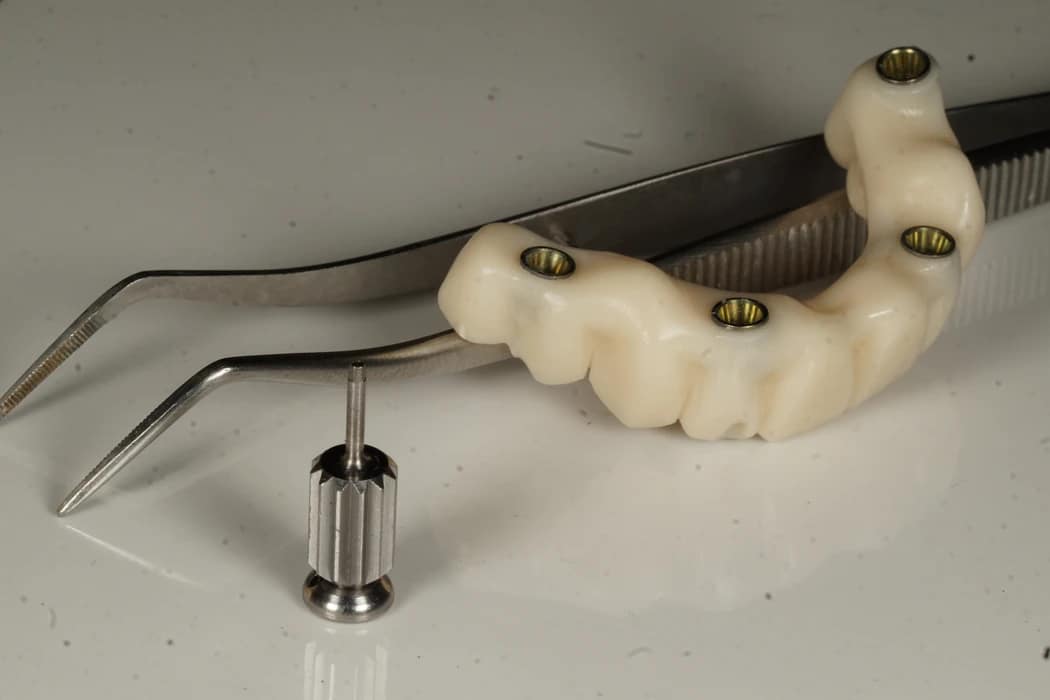
A dental bone graft is a procedure that adds bone, or a bone substitute, to the jaw so that there is enough volume to hold a dental implant. The graft material acts as a scaffold: over the following months your own bone grows into it and the area becomes firm enough for an implant.
Cleveland Clinic lists the main uses: filling an empty tooth socket after an extraction, increasing the width and volume of the jawbone, and lifting the floor of the maxillary sinus in the upper back jaw [5].
Do you need a bone graft before an implant?
You need a bone graft only if the bone at the implant site is too thin, too low or too damaged to hold the implant securely. Many patients do not need one. The decision is made on your scans, not on a general rule.
Common reasons for too little bone:
- Time since extraction. After a tooth is removed, the ridge changes shape; the Cochrane review notes that these bone changes “can compromise” later implant treatment [2].
- Gum disease that has destroyed bone around the lost tooth [5].
- Long-term denture wear over a toothless ridge.
- The sinus in the upper back jaw, which can leave little height above the root area (see our sinus lift guide).
Dr. Ali Cem Ulubey reviews the 3D cone-beam (CBCT) scan when a case needs one. The scan shows the height and width of the bone and the position of the sinus and nerves, and it shows roughly how much graft material, in cc, a site would need.
Types of bone graft material
There are four families of graft material: your own bone, human donor bone, animal-derived bone mineral and synthetic substitutes. Reviews have not shown that one augmentation approach is clearly better than the others for every case [1][3].
| Type | Origin | How it is used | Points to weigh |
|---|---|---|---|
| Autograft (autogenous) | Your own bone, taken from another area of your body [5] | Often for larger defects and block grafts | Needs a second surgical site; a Cochrane review found that some bone substitutes could be a preferable alternative to autogenous bone [3] |
| Allograft | Human bone from a licensed donor bank [5] | Particulate grafts, socket filling | No second surgical site |
| Xenograft | Animal-derived bone mineral, commonly bovine or porcine [5] | Particulate grafts, socket preservation, sinus lift | Processed to a mineral scaffold; ask about the origin if this matters to you |
| Alloplast | Lab-made bone substitute, for example hydroxyapatite [5] | Particulate grafts | Fully synthetic |
Materials we use include: Cerabone, a bone mineral of bovine origin that its manufacturer produces in a 1,200 °C process [6], with a Jason collagen membrane, which the manufacturer obtains from porcine pericardium [7]. Non-porcine membrane and graft alternatives are available on request; your dentist chooses the material for your case.
If you prefer to avoid porcine or bovine materials for religious or personal reasons, tell us before planning. Non-porcine membrane and graft alternatives are available on request, chosen by your dentist, and we discuss the material with you before anything is placed.
Grafting procedures: which one fits which problem
The procedure depends on where the bone is missing and how much. These are the main techniques described in the literature:
Socket preservation (alveolar ridge preservation)
Graft material is placed into the socket right after an extraction to limit shrinkage of the ridge. The Cochrane review found very low-certainty evidence that it reduces loss of ridge width and height over about six months, and no clear difference in later implant failure [2].
Guided bone regeneration (GBR) with a membrane
Particulate graft is placed where the ridge is thin and covered with a membrane that keeps soft tissue out while bone forms. Small amounts are often added at the time of implant placement [4].

Sinus lift
In the upper back jaw, the sinus floor is raised and graft material placed underneath. A closed (crestal) lift is done through the implant site; an open (lateral) lift through a small window in the side of the jaw. Our sinus lift page explains both.
Ridge split
A narrow ridge is gently widened so an implant can be placed inside it, often in combination with grafting. Chiapasco and colleagues include split-ridge and ridge-expansion techniques among the augmentation procedures they reviewed [1].
Block grafts
For severe bone loss, a block of bone can be fixed onto the ridge and left to heal before an implant is placed. The Cochrane review on horizontal and vertical augmentation notes that complications, especially for vertical augmentation, are common, and that short implants appear to be a better alternative to vertical bone grafting of resorbed lower jaws [3]. Whether a block graft is right for you is a decision made after a full examination.
Bone graft and implant on the same day, or staged?
A small graft can usually be placed during the implant surgery; a large graft is usually placed first and left to heal. The Cambridge University Hospitals NHS leaflet states: “If minimal bone grafting is required, it can be carried out at the time of your implant placement. If more extensive grafting is required, it will be carried out at least four months before your implant placement” [4].
Chiapasco’s review advises that priority should go to procedures that are “simpler and less invasive”, carry less risk of complications and reach their goal in the shortest time [1]. That is also how we plan: the smallest procedure that gives the implant enough bone.
For large augmentations, Dr. Ali Cem Ulubey prefers to follow the early healing here in Antalya, so the first stay is longer: a few extra days, confirmed after the examination.
| Situation | Usual procedure | Same day or staged | Typical wait before final teeth | Evidence |
|---|---|---|---|---|
| Fresh extraction, implant planned later | Socket preservation | Staged (implant after the socket heals) | Ridge changes measured over about 6 months in trials [2] | Very low certainty [2] |
| Slightly thin ridge | Small particulate graft (GBR) with a membrane | Often at implant placement [4] | About 6 months on average with grafting (our clinic) | Few trials; no technique clearly superior [3] |
| Low sinus floor (upper back jaw) | Closed or open sinus lift | Closed: with the implant; open: with or before the implant | About 6 months on average after an open sinus lift (our clinic) | Long-term benefit in moderate cases not yet proven [1] |
| Severe bone loss | Staged augmentation (for example a block graft); sometimes short implants instead | Staged: graft at least 4 months before the implant [4] | Planned individually after the graft has healed | Complications common, especially vertical [3] |
Sources: Chiapasco 2009 [1], Cochrane 2021 [2], Cochrane 2009 [3], CUH NHS leaflet [4]. Only the “about 6 months” cells are our clinic’s planning figures; everything else is from the literature. You may cite this table with a link to this page.
How long does a bone graft take to heal before an implant?
At Ulubey Dental Clinic, implant treatment with bone grafting or an open sinus lift takes about 6 months on average before the final teeth, compared with about 3 months for a standard implant. The exact time is planned individually from your scans and how the site heals.
Published patient guides give a range. Cleveland Clinic says initial recovery takes about a week, the graft needs at least three months to heal, and a large graft may take nine to 12 months [5]. That range is why we do not promise a fixed date before we have seen your scans.

A typical single-implant timeline with grafting:
Visit 1 (4–5 days)
Examination, scan review, implant placement and the graft where needed. Larger augmentations may need a few extra days.
Healing at home (about 6 months on average with grafting)
The graft and implant integrate. We check in on WhatsApp at 30, 90 and 365 days after treatment.
Visit 2 (3–5 days)
The final crown is made and fitted.
For stay lengths by treatment, read how long to stay in Antalya for dental implants, or plan your dates with the dental treatment stay planner. Travel advice after surgery is in our guide to flying after dental implants.
What does a bone graft cost in Antalya?
At Ulubey Dental Clinic, bone graft material costs €150 per cc. The amount in cc is measured on your scans (a CBCT scan when a case needs one) and written into your quote, which is valid for 30 days.
| Item | Price | Notes |
|---|---|---|
| Bone graft (particulate) | €150 per cc | Amount measured on your scan |
| Membrane | €150 | Used where the plan needs it |
| PRGF (BTI Endoret) | €300 | Optional, per plan |
| Sinus lift, closed | €350 per implant site | Up to 1 cc of graft included |
| Sinus lift, open | €800 per side | Up to 2 cc of graft and 1 membrane included; extra graft €150 per cc |
Our single implant cost calculator assumes 1–4 cc of graft (€150–600) when you tick grafting. The full price list is on our dental treatment prices page, and implant options are on the dental implants in Antalya page.
Risks and honest limits of bone grafting
Bone grafting is a routine surgical step, but it can fail or cause complications, and nobody can promise that every graft will take. The Cambridge NHS leaflet lists swelling, pain, bleeding and numbness early on, and later infection of the graft area, graft exposure and graft failure, with a higher risk in smokers [4].
Trials in the Cochrane review on socket preservation reported complications such as delayed healing, membrane exposure and partial loss of grafting material [2]. For vertical augmentation, complications are common [3].
Smoking, uncontrolled diabetes and gum health affect how bone and implants heal. A manufacturer’s lifetime guarantee on the implant fixture does not mean every implant integrates. Tell us about your medical history and medicines before planning. If a graft does not integrate, we explain the options before anything else is done.
Follow the aftercare instructions your dentist gives you before you leave. If you notice increasing pain or swelling after the first days, or a feeling that graft material or the membrane is exposed, contact us on WhatsApp. The general risks are also explained in our guide to dental implant failure.
What you take home: graft labels in your implant passport
Every implant patient receives the manufacturer’s implant passport. The original labels of each implant, abutment, membrane and bone-graft product, with brand, LOT and reference numbers, are stuck into it, and the passport is signed by the dentist. Your home dentist can receive your records on request.
All implant and graft components come from official distributors in their original sealed packaging. Dr. Ali Cem Ulubey carries out the implant and grafting surgery himself; the two founding dentists plan and follow your treatment together, with no rotating surgeons.
If you are still deciding whether to replace a missing tooth with an implant at all, our guide dental implant vs bridge walks through the alternatives.
Frequently asked questions
What is a bone graft for teeth?
It is a procedure that adds bone or a bone substitute to the jaw where there is too little bone to hold a dental implant. Your own bone gradually grows into the graft material over the following months. It can fill a socket after an extraction, widen a thin ridge or raise the sinus floor in the upper back jaw.
How long after a bone graft can I get an implant?
Small grafts are often placed at the same time as the implant. For extensive grafting, the Cambridge University Hospitals NHS leaflet states it is carried out at least four months before implant placement. At Ulubey Dental Clinic, implant cases with grafting or an open sinus lift take about 6 months on average before the final teeth.
Is the graft material from animals?
Often, yes. Materials we use include Cerabone, a bone mineral of bovine origin, with a Jason collagen membrane, which its manufacturer obtains from porcine pericardium. Non-porcine membrane and graft alternatives are available on request, chosen by your dentist. If you prefer to avoid porcine or bovine materials for religious or personal reasons, tell us before planning so the material can be discussed with you first.
When can I fly after a bone graft?
About 48 hours after a bone graft or a complex surgical extraction. After a sinus lift the wait is longer: 3–5 days after a closed sinus lift and 5–7 days after an open (lateral) sinus lift. Your dentist confirms the day before you book or change a flight.
Will the NHS or my insurer pay for a bone graft?
The NHS says implants are usually only available privately. We are a private clinic and do not process insurance claims. On request we provide the documents your insurer or tax office may ask for (standard Turkish invoice; on request an itemised treatment report written and signed by the dentist; treatment plan, X-rays and records). Whether any cost is reimbursed or tax-deductible depends on your insurer, your policy and the rules of your country — we cannot guarantee it and take no responsibility for those decisions. Please check with your insurer in writing before you travel.
How much bone graft will I need?
It depends on the size and shape of the defect, which is measured on your scans (a CBCT scan when a case needs one). The amount in cc is written into your quote at €150 per cc. Our single implant cost calculator assumes 1–4 cc (€150–600) when grafting is ticked, but your scan gives the real figure.
Sources
- Chiapasco M, Casentini P, Zaniboni M. Bone augmentation procedures in implant dentistry. Int J Oral Maxillofac Implants. 2009;24 Suppl:237-259. pubmed.ncbi.nlm.nih.gov/19885448
- Atieh MA, Alsabeeha NH, Payne AG, Ali S, Faggion CMJ, Esposito M. Interventions for replacing missing teeth: alveolar ridge preservation techniques for dental implant site development. Cochrane Database Syst Rev. 2021;4:CD010176. pubmed.ncbi.nlm.nih.gov/33899930
- Esposito M, Grusovin MG, Felice P, Karatzopoulos G, Worthington HV, Coulthard P. Interventions for replacing missing teeth: horizontal and vertical bone augmentation techniques for dental implant treatment. Cochrane Database Syst Rev. 2009;(4):CD003607. pubmed.ncbi.nlm.nih.gov/19821311
- Cambridge University Hospitals NHS Foundation Trust. Bone grafting for dental implants (patient leaflet, version 3, 2024). cuh.nhs.uk/patient-information/bone-grafting-for-dental-implants
- Cleveland Clinic. Dental bone graft (patient reference). my.clevelandclinic.org/health/treatments/21727-dental-bone-graft
- botiss biomaterials. cerabone (manufacturer product page). botiss.com/product/cerabone
- botiss biomaterials. Jason membrane (manufacturer product page). botiss.com/product/jason-membrane
- NHS. Dental treatments (bridges, implants). nhs.uk/live-well/healthy-teeth-and-gums/dental-treatments
This article is general patient information and does not replace a clinical examination, scans or a personal treatment plan.
Editor contact: [email protected] · ulubeydental.com/contact-us